Formal and Informal Language Use
Introduction
Language varies according to the situation, audience and purpose of communication. Some situations require formal language, while others are best suited to informal language. Understanding the differences helps learners communicate appropriately and effectively in different speech situations.
Key Concepts
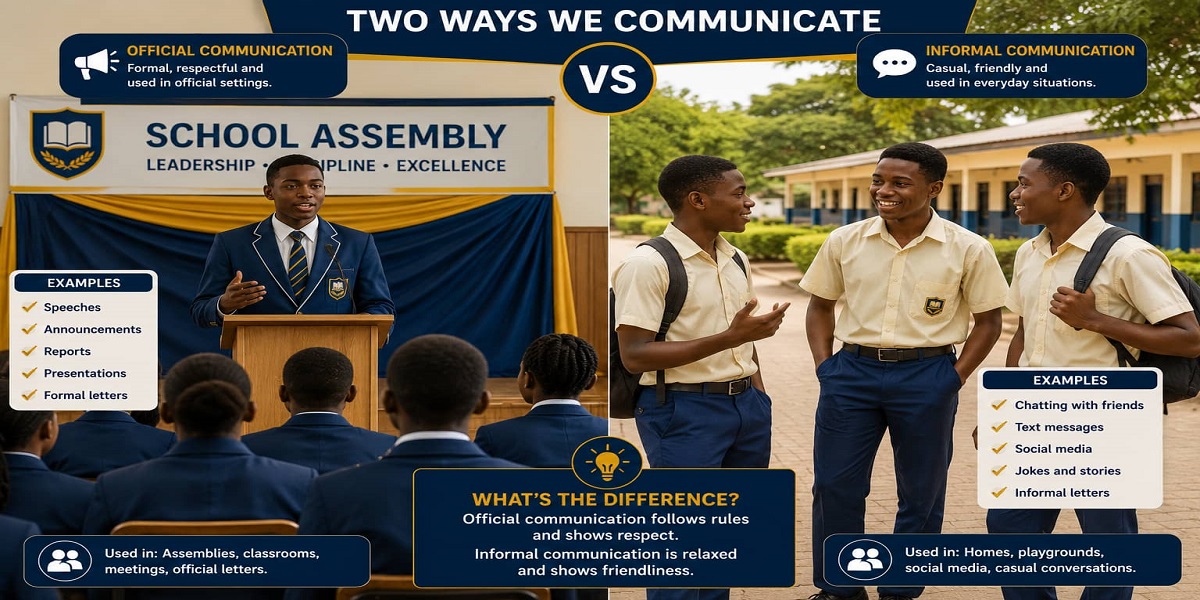
- Formal Language: Language used during official gatherings and occasions such as speeches, prize-giving ceremonies, debates, school assemblies, public speaking and professional communication.
- Informal Language: Language generally used in conversations among friends, peers and family members in relaxed and personal settings.
- Register: The style of language chosen to suit a particular communication context.
Explanation
Formal language is appropriate for official occasions and professional communication. It should be polite, avoid contracted verb forms and discourage the use of pidgin English. Formal language commonly includes polite expressions, quotations and statistics, rhetorical questions, idioms, idiomatic and figurative expressions, and controlled jokes or humour where appropriate.
Informal language is commonly used in peer conversations and personal interactions. It helps people exchange information in a relaxed manner and promotes familiarity. Informal language may include contracted forms of words, slang, pidgin, colloquialisms, ellipses and jargon depending on the context.
Appropriate language use depends on the communication situation. Learners should be able to distinguish between formal and informal contexts and select expressions that suit the audience and purpose. Examples of contexts include discussing the impact of COVID-19 on learners’ academic lives, asking for directions, requesting a favour, describing a market scene, attending a job interview and asking questions during classroom activities.
| Language Type | Typical Features | Common Contexts |
|---|---|---|
| Formal Language | Polite language, quotations and statistics, rhetorical questions, idioms and figurative expressions, controlled humour | School assemblies, debates, speeches, interviews, official meetings, ceremonies |
| Informal Language | Contracted words, slang, pidgin, colloquialisms, ellipses, jargon | Peer conversations, family discussions, friendly dialogue, casual communication |
Examples
Example 1
Problem: Identify the appropriate language register for a school assembly speech.
- Identify the audience.
- Determine the purpose of communication.
- Select polite and official expressions.
Final Answer: Formal language should be used.
Example 2
Problem: Determine the suitable language register for a conversation between close friends.
- Recognise the informal setting.
- Identify the relationship between the speakers.
- Select language suitable for casual interaction.
Final Answer: Informal language is appropriate.
Application and Activities
- Identify formal and informal language in conversations and texts.
- Engage in classroom discussions using appropriate language for different situations.
- Watch or listen to short stories and identify the language register used.
- Role-play conversations using both formal and informal language.
- Create conversations for situations such as ceremonies, meetings and casual discussions.
Practice
- Define formal language and informal language.
- State three features of formal language and three features of informal language.
- Create a short dialogue showing the appropriate use of formal language in an interview and informal language between friends.
Summary
Effective communication requires choosing language that matches the audience, purpose and situation. Formal language is suitable for official and professional contexts, while informal language is appropriate for relaxed personal interactions. Understanding these registers enables learners to communicate confidently and appropriately in different speech situations.
Access NaCCA-aligned Support Packs
Download your structured NaCCA-aligned Teacher Support Pack and Student Learning Pack, designed for clarity, practicality, and reliable teaching and learning.