
Research and Presentation
Introduction
Research is a systematic process of inquiry that seeks to discover new knowledge, validate existing theories or solve specific problems. It is important in science, technology, the humanities and the social sciences, and it supports informed decision-making in everyday life. This lesson introduces learners to the research process, research ethics and effective presentation techniques for organising and communicating research findings clearly and logically.
Key Concepts
- Research: A careful and detailed study of a specific problem, issue or phenomenon using scientific methods.
- Basic Research: Research that increases knowledge without immediate practical application.
- Applied Research: Research that seeks solutions to specific practical problems.
- Quantitative Research: Research involving the collection and analysis of numerical data.
- Qualitative Research: Research involving non-numerical data such as interviews and observations.
- Presentation: A structured delivery of information, ideas or arguments to an audience using spoken words, visual aids and sometimes multimedia.
Explanation
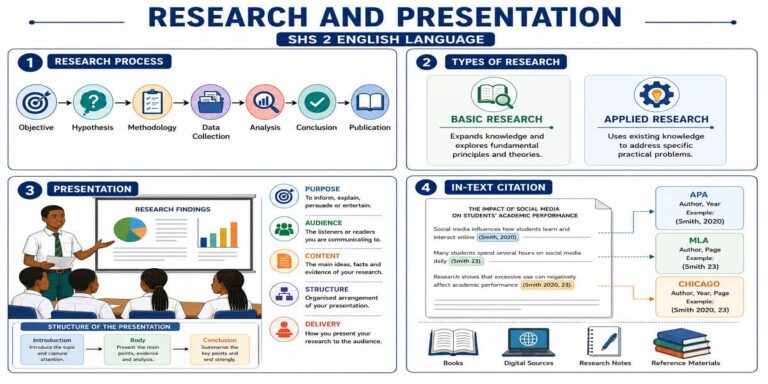
Research aims to explore new ideas, understand complex issues, provide evidence-based conclusions and contribute to knowledge in a particular field. Four major types of research are identified. Basic research focuses on expanding knowledge without immediate practical use, while applied research addresses specific real-life problems. Quantitative research uses numerical data obtained through methods such as surveys and experiments, whereas qualitative research uses interviews and observations to understand experiences and social phenomena.
The research process begins by identifying a research problem. This is followed by reviewing existing literature to determine what is already known and identify knowledge gaps. A clear research question or hypothesis is then formulated before designing the study, selecting data collection methods, sampling procedures and analysis techniques.
Data are collected through surveys, experiments, interviews or observations and analysed using appropriate statistical or thematic methods. The study concludes with findings, recommendations and dissemination of results through reports, publications or presentations.
| Research Stage | Purpose | Outcome |
|---|---|---|
| Identify Research Problem | Determine the issue to investigate | Research focus established |
| Literature Review | Study existing information | Knowledge gaps identified |
| Research Question or Hypothesis | Guide the investigation | Clear direction for the study |
| Study Design | Select methods and sampling | Research plan prepared |
| Data Collection | Gather information | Evidence obtained |
| Data Analysis | Interpret collected data | Findings developed |
| Conclusion and Recommendations | Summarise results and implications | Recommendations provided |
| Dissemination | Share findings | Reports, publications or presentations |
Ethical research requires informed consent, confidentiality, avoidance of harm and proper acknowledgement of sources to prevent plagiarism. Research also advances knowledge, informs policy and practice and promotes critical thinking.
A presentation communicates research findings to an audience. Effective presentations include appropriate content, a logical structure consisting of an introduction, body and conclusion, effective delivery, suitable visual aids and consideration of the audience. Common presentation formats include project work, term papers and PowerPoint presentations.
| Presentation Element | Purpose |
|---|---|
| Content | Presents facts, data, arguments and insights. |
| Structure | Organises ideas into introduction, body and conclusion. |
| Delivery | Uses voice, body language, eye contact and gestures effectively. |
| Visual Aids | Support understanding through slides, charts, graphs, images or videos. |
| Audience | Guides the choice of content and delivery style. |
Examples
Example 1
Problem: Arrange the stages of the research process in the correct order.
- Identify the research problem.
- Review related literature.
- Formulate the research question.
- Design the study.
- Collect and analyse data.
- Draw conclusions and disseminate findings.
Final Answer: Research follows a systematic process from identifying the problem to disseminating the findings.
Example 2
Problem: Identify the key elements of an effective presentation.
- Identify the content.
- Organise the presentation into introduction, body and conclusion.
- Use effective delivery and visual aids.
- Consider the audience.
Final Answer: An effective presentation includes content, structure, delivery, visual aids and audience awareness.
Application and Activities
- Research a selected topic and prepare a term paper presentation.
- Exchange drafts with classmates and conduct peer reviews.
- Research a topic using print, local and internet sources.
- Evaluate the credibility and reliability of research sources.
- Present a research proposal and receive class feedback.
Practice
- State the four types of research.
- Outline the major stages of the research process.
- Investigate a problem in your community and prepare a journal presentation of your findings.
Summary
Research is a systematic investigation that generates knowledge and solves problems through organised inquiry. Conducting quality research requires following the research process, observing ethical principles and presenting findings effectively. Well-planned presentations that combine clear content, logical organisation, effective delivery and appropriate visual aids enable researchers to communicate their findings confidently to different audiences.
Access NaCCA-aligned Support Packs
Download your structured NaCCA-aligned Teacher Support Pack and Student Learning Pack, designed for clarity, practicality, and reliable teaching and learning.