Difference Between Oral and Written Literature
Introduction
Literature can be shared in different ways. Some literary works are spoken and passed from one generation to another, while others are written and read from books or other written materials. Understanding the differences between oral and written literature helps learners appreciate how stories, poems and other literary works are created, shared and preserved.
In this lesson, you will learn the main features of oral literature and written literature, identify their differences and recognise examples of each form.
Key Concepts
- Literature: Creative works that express ideas, experiences and feelings.
- Oral Literature: Literature that is presented by word of mouth.
- Written Literature: Literature that is presented in written form.
- Audience: The people who listen to, watch or read a literary work.
Oral Literature
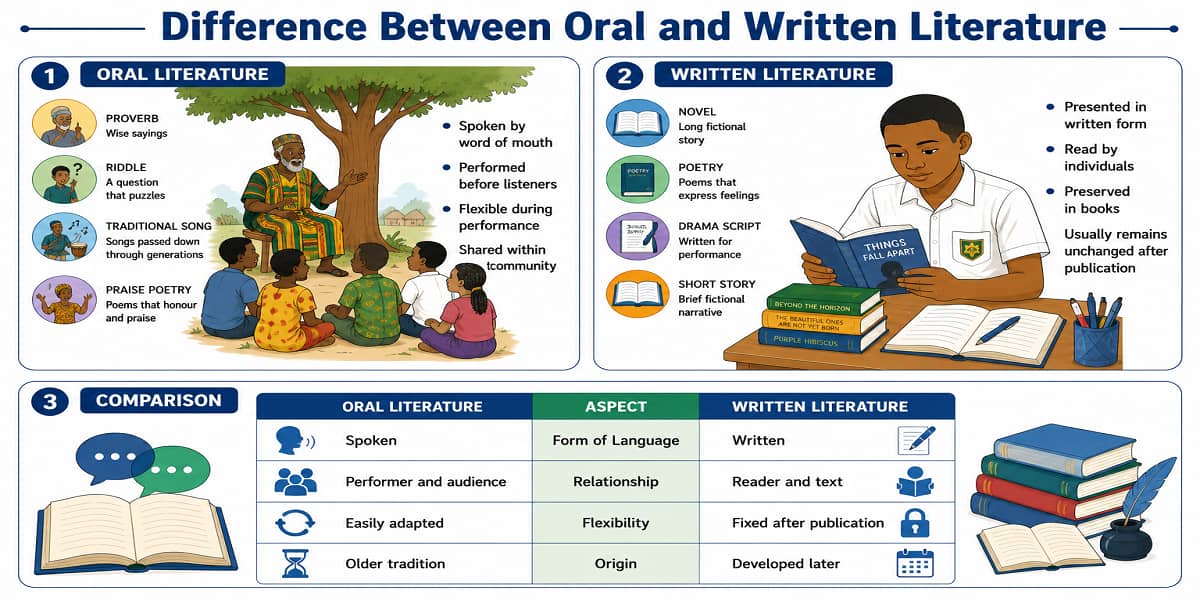
Oral literature is presented through spoken words. It is performed by a speaker and received by listeners. Because it is spoken, it can easily be changed to suit different audiences or occasions.
According to the lesson content, oral literature has the following features:
- It is presented through word of mouth.
- People who cannot read can perform it just as readers can.
- It belongs to the entire society.
- It takes place between a speaker and a hearer.
- It existed before written literature.
- It is flexible and can easily be adapted during performance.
Written Literature
Written literature is presented in written documents. It is usually read by individuals, although it may also be recited or performed before an audience.
The lesson content identifies the following features of written literature:
- It is presented in written documents.
- Only literate people can appreciate it on a personal level.
- It is usually read by individuals but may also be recited or performed to an audience.
- It developed after oral literature.
- Printed works cannot easily be changed to suit a particular audience.
Comparison of Oral and Written Literature
| Oral Literature | Written Literature |
|---|---|
| Presented through word of mouth. | Presented in written documents. |
| Can be performed by people who cannot read. | Personally appreciated by literate readers. |
| Belongs to the whole society. | Usually read by individuals, but may also be performed. |
| Requires a speaker and a hearer. | Can be read without a speaker being present. |
| Predates written literature. | Developed after oral literature. |
| Can easily be adapted during performance. | Printed works are not easily adapted for different audiences. |
Although oral literature and written literature are different in how they are presented, both are important ways of preserving and sharing ideas, beliefs, history and culture.
Forms of Oral Literature
Oral literature exists in different forms. Each form has its own purpose and is shared through speech or performance. These forms help to educate, entertain and preserve the traditions of a community.
- Folktales: Stories passed from one generation to another to teach moral lessons or entertain listeners.
- Proverbs: Short wise sayings that express truth, advice or experience.
- Riddles: Questions or statements that challenge listeners to think before finding the correct answer.
- Songs: Traditional songs performed during ceremonies, celebrations, work or recreation.
- Praise Poetry: Spoken poetry used to honour individuals, families or communities.
Forms of Written Literature
Written literature is presented in written form and can be read repeatedly without changing its original content. Common forms include the following:
- Novels: Long fictional stories written in prose.
- Short Stories: Brief fictional narratives that focus on a single event or idea.
- Drama: Literary works written to be performed on stage.
- Poetry: Creative writing that expresses ideas and emotions through carefully chosen words.
Explanation
Both oral and written literature communicate ideas, values and experiences. The main difference lies in the way they are presented. Oral literature depends on performance and interaction between the speaker and the audience, while written literature depends on written texts that readers can study at different times and places.
Oral literature can easily be adapted during performance to suit a particular audience. In contrast, written literature usually remains the same after it has been published, allowing readers to experience the author’s original work as written.
Although they are different in presentation, both forms play an important role in preserving culture, educating society and providing enjoyment.
Application and Activities
- Discuss examples of oral literature that are common in your community.
- Identify examples of written literature that you have read in school or at home.
- Compare one oral literary work with one written literary work by explaining how each is presented.
- Work in groups to present a short oral performance such as a folktale, proverb or song.
Practice
- Basic: Define oral literature and written literature.
- Moderate: State three differences between oral literature and written literature.
- Applied: Explain why both oral and written literature are important in preserving the culture and history of a people.
Examples
Example 1
Problem: Ama listens to her grandmother tell a folktale during a family gathering. Is this an example of oral literature or written literature? Give a reason for your answer.
- Identify how the literary work is presented.
- The story is told by speaking rather than by reading from a written text.
- The audience listens to the storyteller as the performance takes place.
Final Answer: It is oral literature because it is presented by word of mouth to listeners.
Example 2
Problem: Kofi borrows a novel from the school library and reads it at home. Is this an example of oral literature or written literature? Explain your answer.
- Identify how the literary work is presented.
- The work is contained in a written text.
- The reader understands the work by reading it.
Final Answer: It is written literature because it is presented in written form for readers.
Summary
Literature can be presented in two main forms: oral literature and written literature. Oral literature is shared through spoken words and performance, while written literature is presented in written documents. Oral literature can easily be adapted during performance, whereas written literature usually remains unchanged after publication. Both forms are valuable because they preserve knowledge, entertain audiences and communicate the beliefs, values and experiences of society.
Lesson Wrap-up
After completing this lesson, you should be able to distinguish between oral literature and written literature, identify their main features, recognise examples of each form and explain how both contribute to preserving culture and sharing human experiences.
Access NaCCA-aligned Support Packs
Download your structured NaCCA-aligned Teacher Support Pack and Student Learning Pack, designed for clarity, practicality, and reliable teaching and learning.