
The Role of Buyers and Sellers and the Concept of Demand
Markets are places—physical or virtual—where buyers and sellers come together to exchange goods, services or assets. To understand how markets work, we first need to understand the people who participate in them and then examine the idea of demand.
1. Buyers, Sellers and Markets
Buyers are individuals, organisations or entities that purchase goods or services from sellers.
Sellers are individuals, businesses or entities that offer goods or services for sale in exchange for payment.
A market is a physical or virtual space where buyers and sellers come together to exchange goods, services or assets.
| Participant | Main Role |
|---|---|
| Buyer | Purchases goods or services and makes payment. |
| Seller | Offers goods or services and receives payment. |
| Market | Provides the setting for exchange between buyers and sellers. |
2. What Buyers Consider
Buyers are influenced by their preferences and purchasing decisions. They consider factors such as:
- price;
- quality;
- brand;
- features; and
- personal preferences.
Buyers generally aim to maximise the satisfaction they receive from consuming goods and services.
3. Income and the Type of Good
A change in income can affect what consumers buy.
A normal good is one for which demand increases as consumer income rises and decreases as income falls, assuming other factors remain constant.
An inferior good is one for which demand decreases as consumer income rises and increases as income falls, assuming other factors remain constant.
| Type of Good | When Income Rises | When Income Falls |
|---|---|---|
| Normal good | Demand increases. | Demand decreases. |
| Inferior good | Demand decreases. | Demand increases. |
4. How Price Can Affect Buyers
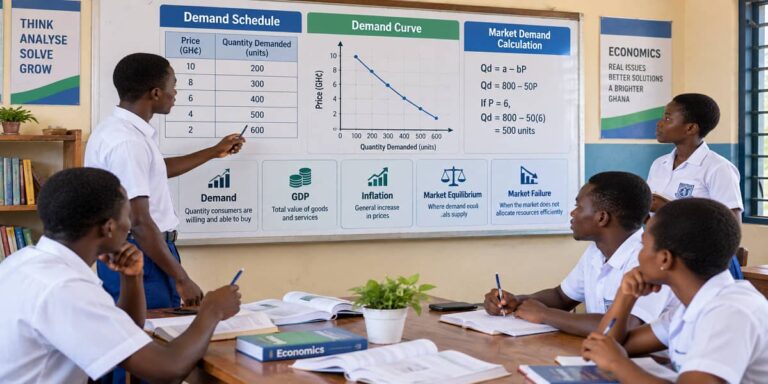
Buyers’ behaviour follows an inverse relationship between price and quantity demanded. Other things being equal, buyers tend to demand less when price rises and more when price falls.
Changes in prices can also create a substitution effect. Buyers may switch to alternative goods that have become relatively more affordable.
5. A Buyer’s Choice
Suppose Nii has a budget of GH₵1,500 for a smartphone.
| Phone | Price | Main Features |
|---|---|---|
| A | GH₵1,200 | Decent camera, adequate storage, moderate processor |
| B | GH₵1,500 | High-quality camera, ample storage, fast processor |
| C | GH₵1,800 | Excellent camera, large storage, powerful processor, premium features |
Phone C is beyond the budget. Phone A is affordable but has fewer desired features. Phone B costs exactly the available budget and provides a balance between price and features.
Nii therefore chooses Phone B at GH₵1,500.
His choice involves trade-offs: he gives up the additional features of Phone C and the potential cost saving of Phone A.
6. Sellers and Their Decisions
Sellers provide goods and services to meet buyers’ demand. They aim to maximise profits by making production and sales decisions carefully.
Sellers consider:
- input costs;
- production technology;
- market conditions; and
- competition.
Sellers seek to produce at a level where marginal revenue equals marginal cost.
7. A Seller’s Choice
Adjoa sells hand-woven baskets and beaded jewellery at a local craft market.
Her baskets are priced at GH₵30 each, while her beaded jewellery is priced at GH₵20 per piece.
Before setting her prices, she considers the time, effort and materials used, as well as market demand and competition.
She also uses attractive displays and explains the qualities of her handmade products to potential buyers.
Her pricing decision involves a trade-off. A higher price may affect the number of customers attracted, while a lower price may affect the return she earns.
8. Buyer and Seller: A Quick Comparison
| Buyer | Seller |
|---|---|
| Wants to obtain goods or services. | Offers goods or services for sale. |
| Considers price, quality, brand, features and preferences. | Considers costs, technology, market conditions and competition. |
| Makes payment. | Receives payment. |
| Seeks satisfaction from consumption. | Seeks to maximise profit. |
9. What Is Demand?
Demand is the quantity of a good or service that buyers are willing and able to purchase at various prices during a given period, while other factors remain constant.
Four key ideas must be present:
- Willingness to buy;
- Ability to buy;
- Various prices; and
- A given time period.
10. Purchasing Power
Purchasing power refers to the ability of consumers to buy goods and services with their income.
This helps explain why willingness alone is not enough to constitute demand. A person may want a product but, without the ability to purchase it, that desire does not become demand.
11. Demand in Everyday Life
Imagine an auction in which learners receive limited school money and compete to buy available products.
A learner may want a product, but demand depends on whether the learner is also willing and able to purchase it at the price offered.
As the price changes, the quantity the learner is prepared and able to buy may also change.
12. Market Exchange
In a market, buyers and sellers interact because both sides have something to exchange.
The buyer gives payment and receives a good or service. The seller gives the good or service and receives payment.
This exchange can take place in a physical market, shop, school canteen or through a virtual market.
13. Practice: Identify Demand
Situation: Ama wants to buy a school bag but does not have enough income to pay for it.
Question: Does her desire alone constitute demand?
Answer: No. Demand requires both willingness and ability to purchase.
Situation: Kojo has enough money to buy a product but does not want it.
Question: Does his ability alone constitute demand?
Answer: No. Demand requires both willingness and ability.
14. Practice: Buyers and Sellers
Question: What happens when a buyer purchases a product from a seller?
Answer: The buyer makes payment and receives the good or service, while the seller provides the good or service and receives payment.
Question: Mention three things a seller may consider when setting prices and deciding output.
Answer: Input costs, production technology, market conditions and competition are relevant considerations.
15. Practice: Price and Buying
Question: What generally happens to quantity demanded when price rises, assuming other factors remain constant?
Answer: Quantity demanded tends to decrease.
Question: What generally happens when price falls?
Answer: Quantity demanded tends to increase.
16. Group Activity
Imagine your class is a small market.
- Some learners act as buyers.
- Others act as sellers.
- Use classroom items as goods or services.
- Allow buyers and sellers to negotiate an exchange.
- Change the prices and observe how buying decisions change.
After the activity, explain the roles of the buyers and sellers and identify where demand appeared in the exchange.
17. Final Review
1. Who is a buyer?
A buyer is an individual, organisation or entity that purchases goods or services.
2. Who is a seller?
A seller offers goods or services for sale in exchange for payment.
3. What is a market?
A market is a physical or virtual space where buyers and sellers exchange goods, services or assets.
4. Define demand.
Demand is the quantity of a good or service buyers are willing and able to purchase at various prices during a given period, other factors remaining constant.
5. What is purchasing power?
It is the ability of consumers to buy goods and services with their income.
6. Distinguish between normal and inferior goods.
Demand for a normal good rises when income rises and falls when income falls. Demand for an inferior good falls when income rises and rises when income falls, assuming other factors remain constant.
18. Final Synthesis
Markets bring buyers and sellers together for exchange. Buyers seek satisfaction from goods and services, while sellers seek to provide goods and services and maximise profits.
Buyers consider factors such as price, quality, brand, features and preferences. Sellers consider costs, technology, market conditions and competition.
The key to understanding demand is remembering that a buyer must be both willing and able to purchase a good or service at a particular price and during a given period.
Wanting something is not enough. The ability to purchase it must also be present.
Access NaCCA-aligned Support Packs
Download your structured NaCCA-aligned Teacher Support Pack and Student Learning Pack, designed for clarity, practicality, and reliable teaching and learning.