Change in Quantity Supplied Vs. Change in Supply
1. The Key Question
When the quantity producers supply changes, the first question to ask is: What caused the change?
If the price of the commodity itself changes, there is a change in quantity supplied. If a factor other than price changes, there is a change in supply.
2. Change in Quantity Supplied
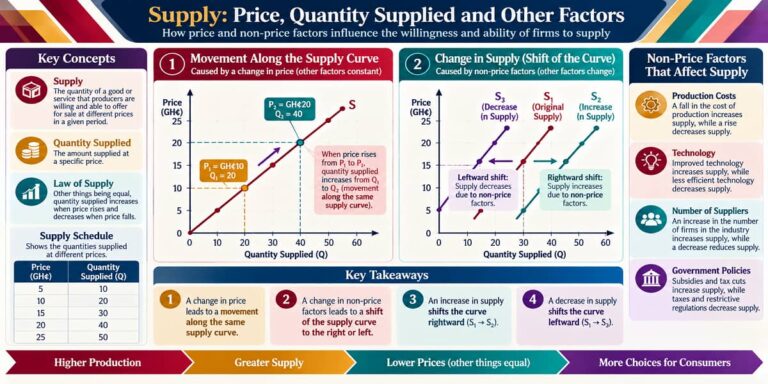
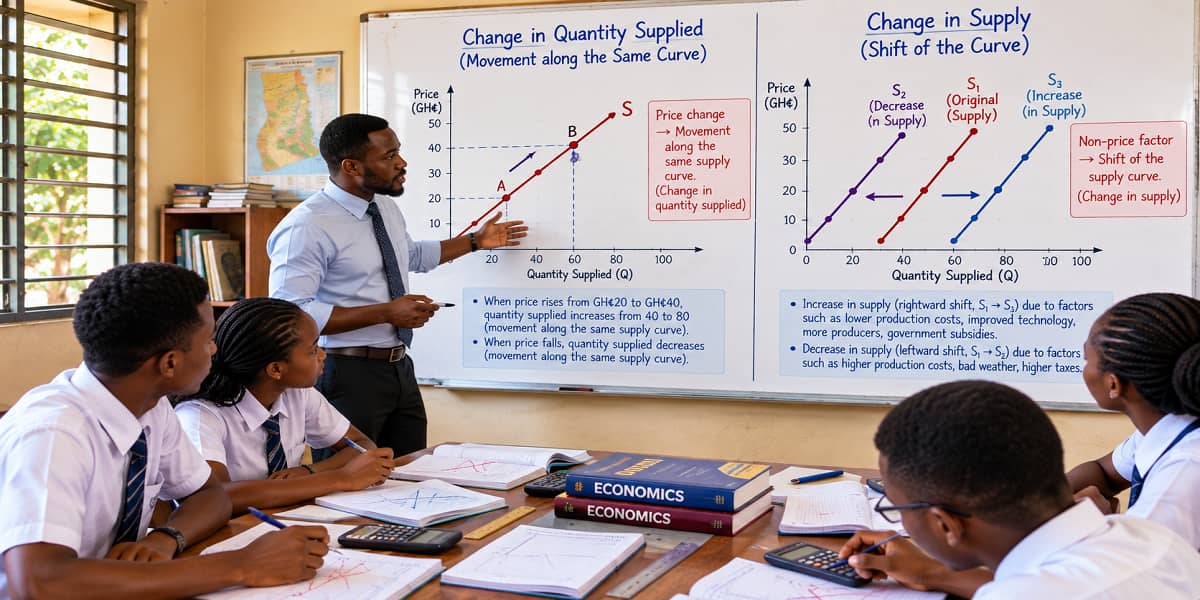
A change in quantity supplied is a movement from one point to another on the same supply curve caused by a change in the commodity’s price, while other factors remain constant.
- Price increases → quantity supplied increases.
- Price decreases → quantity supplied decreases.
- The supply curve itself does not shift.
Gari Example
If the price of gari falls from GH₵3 to GH₵2 and the quantity supplied falls from 10 units to 4 units, the change is a movement down the same supply curve.
3. Change in Supply
A change in supply occurs when the entire supply curve shifts because of a change in a factor other than the commodity’s own price.
Factors identified include:
- Production costs
- Technology
- Number of suppliers
- Government policies and regulations
- Expectations of future prices
- Prices of related goods
- Natural conditions
A favourable change in these factors can increase supply, causing a rightward shift. An unfavourable change can decrease supply, causing a leftward shift.
4. The Difference at a Glance
| Change in Quantity Supplied | Change in Supply |
|---|---|
| Caused by a change in the commodity’s price. | Caused by a change in a non-price factor. |
| Movement along the same supply curve. | Shift of the entire supply curve. |
| Price increases → quantity supplied increases. | Favourable non-price change → supply increases. |
| Price decreases → quantity supplied decreases. | Unfavourable non-price change → supply decreases. |
5. Work Through Two Situations
Situation A: Price Changes
The price of gari falls from GH₵3 to GH₵2. Quantity supplied falls from 10 units to 4 units.
Conclusion: This is a change in quantity supplied because the commodity’s own price changed. The movement is along the same supply curve.
Situation B: Technology Changes
A new technology is introduced in gari production, making production more favourable. Supply increases at the same price level.
Conclusion: This is a change in supply. The entire supply curve shifts to the right.
6. A Simple Decision Rule
7. Practise
- The price of a commodity rises.
Answer: Change in quantity supplied; movement up the same supply curve. - Production costs fall.
Answer: Change in supply; supply increases and the curve shifts right. - The price of a commodity falls.
Answer: Change in quantity supplied; movement down the same supply curve. - New technology improves production.
Answer: Change in supply; the supply curve shifts right. - Natural conditions become unfavourable.
Answer: Change in supply; supply decreases and the curve shifts left.
8. Final Check
Change in quantity supplied = price changes → movement along the same curve.
Change in supply = non-price factors change → the whole curve shifts.
9. Summary
The difference between the two concepts depends on the cause of the change. A change in the commodity’s own price changes quantity supplied and produces movement along the existing supply curve. A change in a non-price factor changes supply and shifts the entire curve to the right or left.
Access NaCCA-aligned Support Packs
Download your structured NaCCA-aligned Teacher Support Pack and Student Learning Pack, designed for clarity, practicality, and reliable teaching and learning.