Time Periods, Product Measures and Methods of Production
1. Think About Production
Imagine a firm wants to increase its output. Can it immediately increase the size of its factory, install new machinery and change every input? Not always. The answer depends on the time period available.
2. Short Run and Long Run
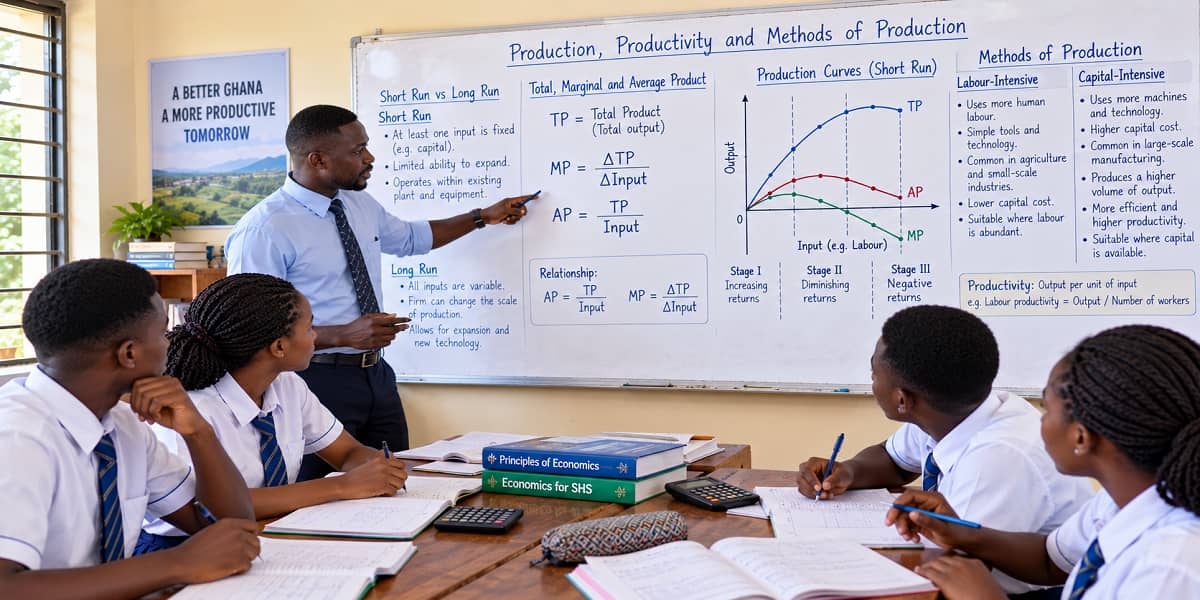
The two main time periods in production are the short run and the long run.
| Short Run | Long Run |
|---|---|
| At least one factor of production is fixed. | All factors of production are variable. |
| Firms can adjust variable inputs such as labour and raw materials. | Firms can adjust inputs including capital and labour. |
| Production capacity is constrained by fixed inputs. | Production capacity can be changed. |
| A factory may hire more workers without expanding its building. | A firm may build a new factory or purchase new machinery. |
3. Measuring Output: TP, MP and AP
Total Product (TP)
Total Product is the total quantity of output produced using a given quantity of inputs over a specified period.
TP = MP1 + MP2 + MP3 + … + MPn
Marginal Product (MP)
Marginal Product is the additional output produced when one more unit of a variable input is added while other inputs remain constant.
MP = ΔTP ÷ ΔQ
Therefore, when output changes from TP1 to TP2 as the variable input changes from Q1 to Q2:
MP = (TP2 − TP1) ÷ (Q2 − Q1)
Average Product (AP)
Average Product is the average output produced per unit of variable input.
AP = TP ÷ Q
A useful relationship is that AP rises while MP is greater than AP. When MP falls below AP, AP begins to decline.
4. Work Through the Numbers
Suppose capital is fixed at 10 units and the following production data are given:
| Labour (L) | Capital (K) | TP | MP | AP | TFP |
|---|---|---|---|---|---|
| 1 | 10 | 10 | 10 | 10 | 0.91 |
| 2 | 10 | 25 | 15 | 12.5 | 2.08 |
| 3 | 10 | 45 | 20 | 15 | 3.46 |
| 4 | 10 | 60 | 15 | 15 | 4.29 |
| 5 | 10 | 70 | 10 | 14 | 4.67 |
| 6 | 10 | 75 | 5 | 12.5 | 4.69 |
| 7 | 10 | 75 | 0 | 10.7 | 4.41 |
| 8 | 10 | 70 | -5 | 8.75 | 3.89 |
One Calculation
At labour = 5:
MP = TP5 − TP4
= 70 − 60 = 10
And:
AP = TP ÷ L = 70 ÷ 5 = 14
Total Factor Productivity
The given measure of Total Factor Productivity is:
TFP = TP ÷ (L + K)
For labour = 5 and capital = 10:
TFP = 70 ÷ (5 + 10) = 70 ÷ 15 = 4.67
5. The Three Stages of Production
| Stage | TP | MP | AP | Main feature |
|---|---|---|---|---|
| Stage I: Increasing Returns | Rises at an increasing rate | Rises | Rises | Additional units contribute increasingly to output. |
| Stage II: Decreasing Returns | Continues rising, but at a decreasing rate | Falls but remains positive | Falls after its maximum | Each additional unit contributes less than the previous one. |
| Stage III: Negative Returns | Falls | Negative | Continues falling | Additional input reduces total output. |
6. Labour-Intensive and Capital-Intensive Production
A production method can be classified according to the factor that plays the greater role in producing goods or services.
| Aspect | Labour-Intensive | Capital-Intensive |
|---|---|---|
| Primary input | Human labour | Machinery, equipment and technology |
| Initial investment | Lower investment in capital assets | High investment in capital assets |
| Flexibility | More adaptable to demand and customisation | Less flexible; suited to mass production |
| Cost structure | High proportion of labour costs | High proportion of fixed capital costs |
| Production scale | Small to medium-scale production | Large-scale production |
| Examples | Agriculture, textiles and handicrafts | Automobile manufacturing, oil refining and electronics |
7. Check Your Understanding
- What are the two time periods in production?
Short run and long run. - Calculate AP when TP = 75 and labour = 6.
AP = 75 ÷ 6 = 12.5. - Calculate MP when TP changes from 60 to 70 as labour rises from 4 to 5.
MP = (70 − 60) ÷ (5 − 4) = 10. - What happens when MP becomes negative?
Total Product begins to decline. - Which method relies more heavily on machinery and technology?
Capital-intensive production.
8. Bring It Together
Production decisions involve both time and input choices. In the short run, at least one input is fixed; in the long run, all inputs can vary. TP shows total output, MP shows additional output from an extra unit of variable input, and AP shows output per unit of variable input. These measures reveal the stages of production and help distinguish production methods that rely mainly on labour from those that rely mainly on capital.
Access NaCCA-aligned Support Packs
Download your structured NaCCA-aligned Teacher Support Pack and Student Learning Pack, designed for clarity, practicality, and reliable teaching and learning.