Literary Analysis Tools
When we read a story, poem or other literary work, we do more than follow the words. We ask questions about how the writing creates meaning. Literary analysis tools are techniques that help us understand ideas, unravel meaning, appreciate style and expose themes in literary works.
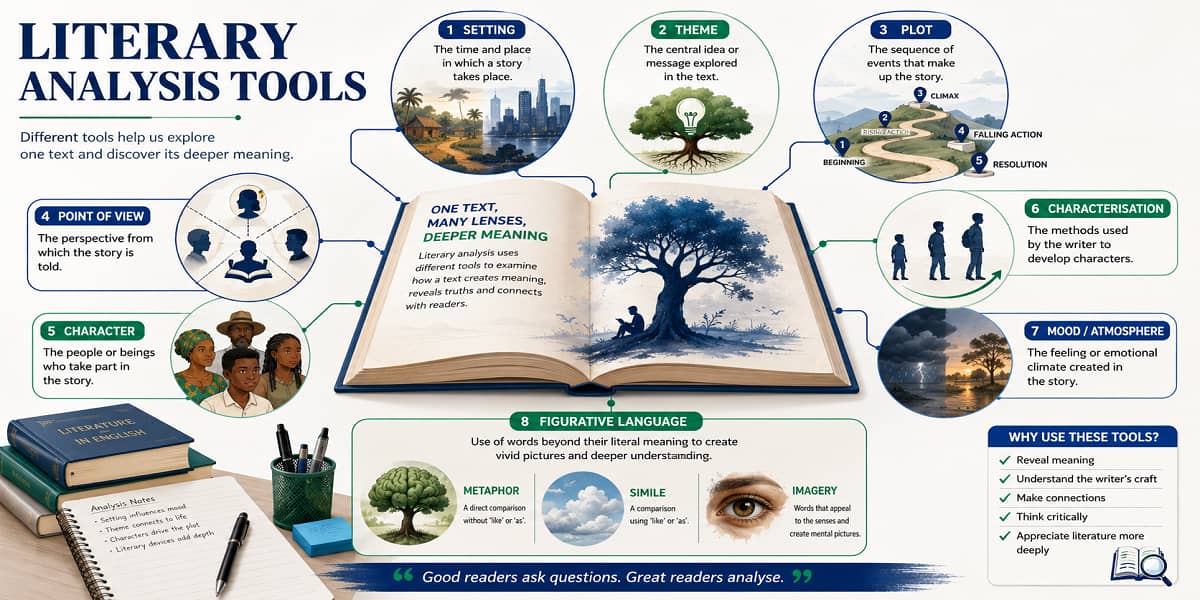
This lesson introduces some important tools that can help you look more closely at a literary work. The tools include setting, theme, plot, point of view, character, characterisation, atmosphere or mood, figurative language, metaphor, simile and imagery.
1. Start Thinking: What Do You Notice in a Story?
Imagine that you have just read a story about a young person who leaves home, faces a difficult situation and eventually makes an important decision.
Before thinking about literary terms, ask yourself:
- Where and when does the story happen?
- What events happen, and in what order?
- Who takes part in the story?
- Who tells the story?
- What feelings does the story create?
- What important idea does the story communicate?
- How does the writer describe people, places or experiences?
These questions lead us to literary analysis tools. Each tool gives us a different way of looking at the same literary work.
2. What Are Literary Analysis Tools?
Literary analysis tools are techniques used to help us examine a literary work and understand how meaning is created. They enable us to move beyond simply saying what happens in a story or poem and begin to consider how the writer presents ideas and experiences.
| Literary Tool | Meaning | Question to Ask |
|---|---|---|
| Setting | The time, place, culture, historical, geographical and occupational background of a story. | Where and when does the story take place? |
| Theme | The central idea of a story. | What important idea is the work communicating? |
| Plot | The sequence of events in a story. | What happens, and how do the events unfold? |
| Point of view | The different angles from which a story is told. | From whose angle is the story told? |
| Character | An individual who plays a role in the story. | Who takes part in the story? |
| Characterisation | The method used by the writer to develop and manage characters. | How does the writer develop the characters? |
| Atmosphere/Mood | The condition and emotions of the characters in a story. | What emotional condition or feeling is present? |
| Figurative language | Language used to communicate meaning beyond straightforward literal expression. | How does the writer make an idea or description more expressive? |
3. Setting: Where and When?
Setting provides the background of a story. It includes its time, place, culture, historical, geographical and occupational background.
For example, if a story takes place in a particular community, the description of the place, the period in which the events occur and the activities of the people can contribute to its setting.
When identifying setting, do not look only for a physical location. Consider the wider background that surrounds the events.
Try It
Read this short illustrative sentence:
“At dawn, the workers gathered beside the old workshop before beginning their day’s work.”
What clues about setting can you identify?
Answer: The sentence gives clues about time (“at dawn”), place (“beside the old workshop”) and occupation (“workers” and “work”).
4. Theme: What Is the Central Idea?
Theme is the central idea of a story. It is the important idea around which the literary work may be developed.
To identify a theme, look beyond individual events. Ask what larger idea connects important events, characters and experiences.
For example, a story may contain several events involving difficult choices. Instead of merely listing those events, a reader can ask what central idea those choices reveal.
Remember
Plot tells you what happens. Theme helps you consider the central idea behind what happens.
5. Plot: How Do the Events Unfold?
Plot is the sequence of events in a story. When you analyse plot, you pay attention to what happens and how one event relates to another.
A useful way to think about plot is as a movement from one event to the next. The order of events helps the reader understand how the story develops.
- An event begins the movement of the story.
- Further events develop from what happens.
- The sequence continues as the story unfolds.
The source material also asks learners to apply knowledge of plot structure to the exposition stage of a prescribed text. The exposition can therefore be examined as part of understanding how a plot begins and establishes the story.
Try It
Suppose a story presents these events:
- A student discovers a problem.
- The student investigates the problem.
- The student makes a decision.
What literary tool are you examining when you focus on the order of these events?
Answer: Plot, because plot concerns the sequence of events in the story.
6. Point of View: From Whose Angle?
Point of view refers to the different angles from which a story is told.
When analysing point of view, ask: Who is telling or presenting the story? The answer helps you understand the angle from which the events are presented.
Consider the difference between these two illustrative statements:
“I entered the room and immediately felt nervous.”
“Kojo entered the room and immediately felt nervous.”
The first statement presents the experience through the speaker’s own angle, while the second presents the character from an outside angle.
Quick Check
If you are asked to identify the angle from which a story is told, which literary tool should you examine?
Answer: Point of view.
7. Character and Characterisation
A character is an individual who plays a role in a story.
Characterisation is the method used by the writer to develop and manage characters in a story.
These two terms are closely connected, but they are not identical.
| Term | Focus |
|---|---|
| Character | The individual who plays a role in the story. |
| Characterisation | The writer’s method of developing and managing that character. |
Thus, when you ask “Who is this person in the story?”, you are considering character. When you ask “How has the writer developed this person in the story?”, you are considering characterisation.
8. Atmosphere and Mood
Atmosphere or mood concerns the condition and emotions of the characters in a story.
As you read, pay attention to emotional conditions presented in the work. A passage may create or communicate feelings that influence how readers experience the events.
For example, a description of a character sitting alone after receiving troubling news may create an atmosphere associated with sadness or tension. The important point is to connect the feeling to evidence in the literary work.
Think About It
If a passage focuses on characters experiencing fear and uncertainty, what literary tool would help you examine those emotions?
Answer: Atmosphere or mood.
9. Figurative Language, Metaphor, Simile and Imagery
Literary analysis also involves examining figurative language and comparative devices such as metaphor and simile, as well as imagery in poetry.
These tools help us pay attention to how writers express ideas and create vivid descriptions.
| Tool | What to Notice | Illustrative Example |
|---|---|---|
| Metaphor | A direct comparison used to express an idea vividly. | “The classroom was a furnace.” |
| Simile | A comparison that uses words such as like or as. | “The child ran like the wind.” |
| Imagery | Descriptive language that helps create a vivid experience, particularly in poetry. | “Silver moonlight spread across the quiet road.” |
These examples are illustrations of how the terms can be recognised. When analysing an actual literary work, identify the language used by the writer and explain what it contributes to the work.
10. One Text, Many Literary Tools
A single passage can contain several literary tools. Good analysis does not require you to choose only one tool. Instead, you can examine how different elements work together.
Read this short illustrative passage:
“At dawn, Ama stood outside the silent workshop. She remembered the warning she had received the previous evening. The road ahead seemed like a dark tunnel, but she took a deep breath and walked forward.”
Now examine it using different tools.
| Tool | Possible Observation |
|---|---|
| Setting | “At dawn” gives a time, while the “workshop” gives a place. |
| Character | Ama is an individual who plays a role in the passage. |
| Plot | The passage presents a sequence: Ama stands outside, remembers a warning, and walks forward. |
| Mood | The words “silent,” “warning” and “dark” contribute to a serious and uneasy emotional condition. |
| Metaphor | “The road ahead seemed like a dark tunnel” presents a comparison that makes the situation more vivid. |
| Point of view | The passage is presented from an outside angle, referring to Ama as “she”. |
11. A Simple Method for Analysing a Literary Text
When you receive a story, poem or excerpt, avoid trying to identify everything at once. Work through the text step by step.
- Read carefully. First understand what the text is presenting.
- Look for the setting. Identify clues about time, place and background.
- Trace the plot. Note the sequence of events where the text is narrative.
- Notice the characters. Identify individuals who play roles in the work.
- Examine characterisation. Consider how the writer develops and manages the characters.
- Identify the point of view. Ask from which angle the story is told.
- Consider mood or atmosphere. Look for the emotional condition presented.
- Look for the central idea. Ask what theme the work may communicate.
- Examine language. Look for figurative language, metaphor, simile and imagery where appropriate.
12. Group Analysis Challenge
Work with classmates to analyse a short story, poem or novel excerpt. Each group should identify as many of the introduced literary tools as the selected text supports.
Use this guide:
| Question | Tool to Investigate |
|---|---|
| Where and when does it happen? | Setting |
| What is the sequence of events? | Plot |
| Who takes part? | Character |
| How are the characters developed? | Characterisation |
| From whose angle is the story told? | Point of view |
| What emotions or conditions are presented? | Atmosphere/Mood |
| What central idea emerges? | Theme |
| What expressive comparisons or descriptions appear? | Figurative language, metaphor, simile or imagery |
After the group discussion, present your findings. Listen to other interpretations and ask questions about the evidence they used to identify each literary tool.
13. Snowball Review
Write one literary tool you remember on a piece of paper. Gather the papers together and form them into a ball. As the ball is passed around, each learner who receives it selects a layer and explains something about the literary tool written there.
Before you give your answer, think about three things:
- What does the tool mean?
- What question helps you identify it?
- What kind of evidence would you look for in a literary text?
14. Check Your Understanding
A. Recall
- What are literary analysis tools?
- Define setting.
- What is theme?
- What is plot?
- What is point of view?
- Who is a character?
- What is characterisation?
- What does atmosphere or mood refer to?
- Name three comparative or figurative tools introduced in this lesson.
Answers
- They are techniques used to help us understand ideas, unravel meaning, appreciate style and expose themes in literary works.
- Setting provides the time, place, culture, historical, geographical and occupational background of a story.
- Theme is the central idea of a story.
- Plot is the sequence of events in a story.
- Point of view is the different angle from which a story is told.
- A character is an individual who plays a role in a story.
- Characterisation is the method used by the writer to develop and manage characters in a story.
- Atmosphere or mood concerns the condition and emotions of the characters in a story.
- Metaphor, simile and imagery.
B. Application
Choose an excerpt from a literary piece and identify setting, plot and point of view. Present your findings clearly and support each identification with evidence from the excerpt.
Answer guide: A complete response should identify the setting and explain its clues, describe the sequence of events that establishes the plot, and state the angle from which the story is told. Each point should be connected to evidence from the selected text.
C. Strategic Thinking
Differentiate among plot, setting and point of view. You may present the differences in a pictorial demonstration and use examples from a prescribed text.
| Plot | Setting | Point of View |
|---|---|---|
| Focuses on the sequence of events. | Focuses on the background of the story. | Focuses on the angle from which the story is told. |
D. Extended Thinking
Apply your knowledge of plot structure to write a paragraph on the exposition stage of any prescribed text.
Answer guide: Your paragraph should focus on the exposition stage of the selected text and explain how this part contributes to the beginning and development of the plot. Use relevant details from the prescribed text.
15. Bring the Ideas Together
Literary analysis becomes easier when you see the tools as different questions about the same work.
- Setting: Where and when?
- Plot: What happens, and in what sequence?
- Character: Who plays a role?
- Characterisation: How are the characters developed?
- Point of view: From whose angle?
- Mood/Atmosphere: What emotional condition is presented?
- Theme: What is the central idea?
- Figurative language and imagery: How does the writer use expressive language?
These tools do not have to be studied in isolation. A reader can use several of them together to develop a fuller understanding of a literary work.
16. Final Reflection
Think about a story or poem you already know. Choose five literary tools from this lesson and explain what each one helps you notice in the work.
Then ask yourself: Which tool helped me understand the work most clearly, and what evidence led me to that conclusion?
As you continue studying literature, these introductory tools will provide a foundation for more detailed analysis of literary texts.
Access NaCCA-aligned Support Packs
Download your structured NaCCA-aligned Teacher Support Pack and Student Learning Pack, designed for clarity, practicality, and reliable teaching and learning.