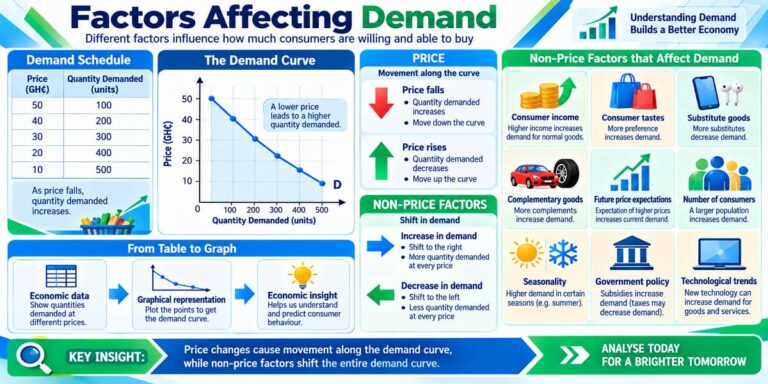

The Law of Demand and Types of Demand
Think about buying a cup of gari. If its price rises, would you normally buy the same quantity? If the price falls, would you be likely to buy more? This relationship between price and quantity demanded is the foundation of the law of demand.
1. The Law of Demand
Ceteris paribus is a Latin phrase meaning “all other things being equal” or “holding other things constant.”
The law of demand states that, ceteris paribus, there is an inverse relationship between the price of a good or service and its quantity demanded.
Therefore:
Price rises → Quantity demanded falls
Price falls → Quantity demanded rises
2. Demand Schedule
A demand schedule is a table showing the quantity demanded of a good or service at different prices.
Consider the demand for a cup of gari:
| Price of Gari (GH₵) | Quantity Demanded (Cups) |
|---|---|
| 2 | 20 |
| 4 | 10 |
| 5 | 8 |
| 8 | 5 |
| 10 | 4 |
Notice the pattern: as the price rises from GH₵2 to GH₵10, quantity demanded falls from 20 cups to 4 cups.
This is the law of demand in numerical form.
3. Demand Curve
A demand curve is a graphical representation of the relationship between price and quantity demanded.
To draw it:
- Put price on the vertical axis.
- Put quantity demanded on the horizontal axis.
- Plot the corresponding price and quantity combinations.
- Join the points to form the demand curve.
The curve is normally downward sloping.
4. Demand Function
A demand function is a mathematical equation expressing the relationship between price and quantity demanded.
It can be written generally as:
Q = f(P)
where Q represents quantity demanded and P represents price.
Worked Example
Given:
Qd = 50 − 0.25P
Find the quantity demanded when price is GH₵100.
Substitution:
Qd = 50 − 0.25(100)
Calculation:
Qd = 50 − 25
Answer:
Qd = 25 units
Second Calculation
Find the quantity demanded when price is GH₵120.
Substitution:
Qd = 50 − 0.25(120)
Calculation:
Qd = 50 − 30
Answer:
Qd = 20 units
As price rises from GH₵100 to GH₵120, quantity demanded falls from 25 units to 20 units. The inverse relationship is clear.
5. Generate a Demand Schedule
Use:
Qd = 50 − 0.5P
Calculate quantity demanded at selected prices.
| Price (P) | Working | Qd |
|---|---|---|
| 2 | 50 − 0.5(2) = 50 − 1 | 49 |
| 4 | 50 − 0.5(4) = 50 − 2 | 48 |
| 6 | 50 − 0.5(6) = 50 − 3 | 47 |
| 8 | 50 − 0.5(8) = 50 − 4 | 46 |
| 10 | 50 − 0.5(10) = 50 − 5 | 45 |
The completed schedule can then be plotted to obtain a demand curve.
6. Types of Demand
Demand can take different forms depending on the relationship between the goods or the uses for which a good is required.
7. Derived Demand
Derived demand occurs when demand for one good or service is derived from demand for another related good or service.
Example: Demand for gari, starch and cassava dough is derived from demand for cassava.
8. Joint or Complementary Demand
Joint demand occurs when two or more goods are demanded together because they are paired with each other.
Example: Toothbrushes and toothpaste are jointly demanded because they are used together.
9. Competitive Demand
Competitive demand exists when two or more goods or services are alternatives for satisfying the same consumer need or want.
An increase in the price of one product can lead to an increase in demand for its substitute.
Example: Milo and Richoco can be considered competitive goods.
10. Composite Demand
Composite demand occurs when a good or service is demanded for multiple uses or purposes.
Example: Palm nuts can be demanded for uses involving palm oil, palm nut soup or palm kernel.
11. Compare the Four Types
| Type | Key Idea | Example |
|---|---|---|
| Derived | Demand arises from demand for another related good. | Gari, starch and cassava dough from cassava. |
| Joint / Complementary | Goods are demanded together. | Toothbrush and toothpaste. |
| Competitive | Goods are alternatives for the same want. | Milo and Richoco. |
| Composite | One good is demanded for several uses. | Palm nuts. |
12. Check Your Understanding
1. State the law of demand.
Answer: Ceteris paribus, there is an inverse relationship between price and quantity demanded: as price rises, quantity demanded falls, and as price falls, quantity demanded rises.
2. What does ceteris paribus mean?
Answer: It means all other things being equal or holding other factors constant.
3. What happens when price rises from GH₵2 to GH₵10 in the gari schedule?
Answer: Quantity demanded falls from 20 cups to 4 cups.
4. What is a demand schedule?
Answer: It is a table showing quantity demanded at different prices.
5. What is a demand function?
Answer: It is a mathematical equation expressing the relationship between price and quantity demanded.
6. Identify the type of demand when goods are used together.
Answer: Joint or complementary demand.
7. What type of demand exists when goods are alternatives?
Answer: Competitive demand.
8. What type of demand occurs when one good has several uses?
Answer: Composite demand.
13. Apply the Idea
Given the demand schedule below, explain whether it demonstrates the law of demand:
| Price | Quantity Demanded |
|---|---|
| GH₵2 | 20 |
| GH₵4 | 15 |
| GH₵6 | 10 |
| GH₵8 | 5 |
| GH₵10 | 1 |
Answer: Yes. As price rises from GH₵2 to GH₵10, quantity demanded falls from 20 units to 1 unit. This shows the inverse relationship required by the law of demand.
14. Final Synthesis
The law of demand describes an inverse relationship between price and quantity demanded, ceteris paribus. A demand schedule shows the relationship in a table, a demand curve shows it graphically, and a demand function expresses it mathematically.
Demand can also be classified as derived, joint or complementary, competitive, and composite, depending on the relationship between the goods or their uses.
Remember: higher price generally means lower quantity demanded, while lower price generally means higher quantity demanded, when other factors remain constant.
Access NaCCA-aligned Support Packs
Download your structured NaCCA-aligned Teacher Support Pack and Student Learning Pack, designed for clarity, practicality, and reliable teaching and learning.