
The Law of Demand and Types of Demand Explained for SHS 1 Economics (Sem. 1 – Week 5)
Why might a consumer buy less of a product when its price rises?
This simple question takes us to one of the central relationships in Economics: the relationship between price and quantity demanded.
When Price Changes, Buyers Respond
The law of demand states that, ceteris paribus, price and quantity demanded have an inverse relationship.
Price increases → quantity demanded decreases.
Price decreases → quantity demanded increases.
Ceteris paribus means “all other things being equal” or “holding other factors constant.”
Gari Gives Us a Simple Illustration
Consider the following demand schedule for gari:
| Price of Gari (GH₵) | Quantity Demanded (Cups) |
|---|---|
| 2 | 20 |
| 4 | 10 |
| 5 | 8 |
| 8 | 5 |
| 10 | 4 |
At GH₵2, quantity demanded is 20 cups. When the price reaches GH₵10, quantity demanded falls to 4 cups.
The numbers move in opposite directions. That is the law of demand.
From a Table to a Curve
A demand schedule gives us the numerical relationship. A demand curve turns that relationship into a visual picture.
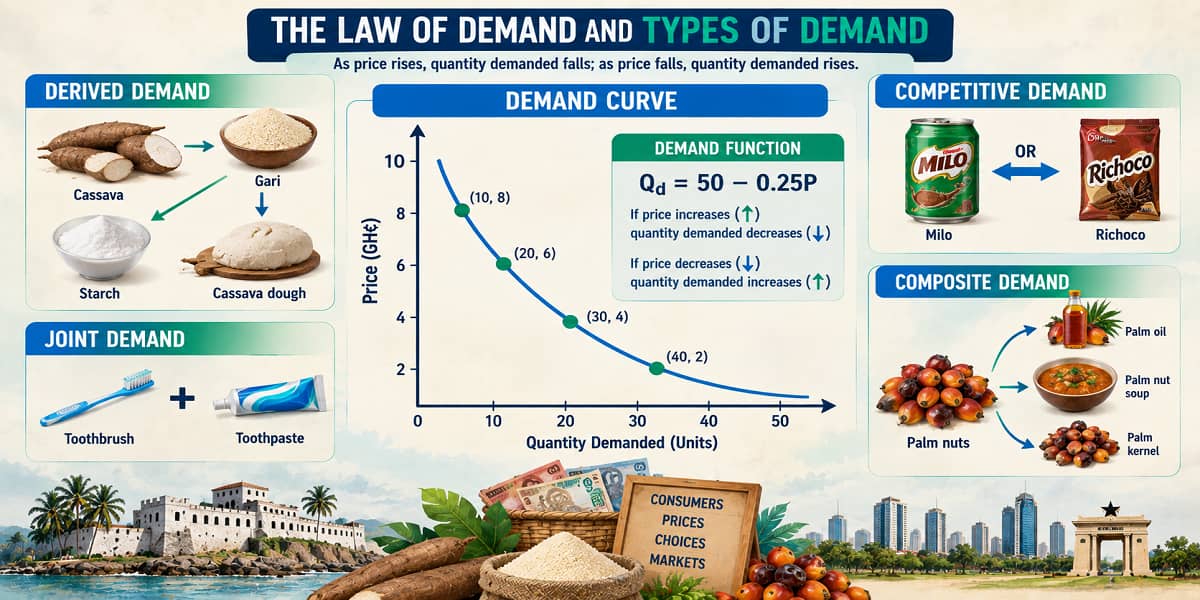
Price is placed on the vertical axis and quantity demanded on the horizontal axis. The resulting demand curve is generally downward sloping.
The downward slope gives a quick visual message: higher price is associated with lower quantity demanded, ceteris paribus.
From a Curve to an Equation
Economics can also express the relationship mathematically through a demand function.
The general form is:
Q = f(P)
Here, Q represents quantity demanded and P represents price.
A Worked Calculation
Suppose:
Qd = 50 − 0.25P
At a price of GH₵100:
Qd = 50 − 0.25(100)
= 50 − 25
= 25 units
At GH₵120:
Qd = 50 − 0.25(120)
= 50 − 30
= 20 units
So a GH₵20 increase in price is associated with a fall in quantity demanded from 25 units to 20 units in this function.
Turning a Function into a Schedule
Now consider:
Qd = 50 − 0.5P
At P = 2:
Qd = 50 − 0.5(2) = 49
At P = 4:
Qd = 50 − 0.5(4) = 48
At P = 6:
Qd = 50 − 0.5(6) = 47
At P = 8:
Qd = 50 − 0.5(8) = 46
At P = 10:
Qd = 50 − 0.5(10) = 45
These calculations produce a demand schedule that can then be plotted to form a demand curve.
Four Ways Demand Can Be Related
Not all demand relationships are the same. Four important types are derived, joint or complementary, competitive and composite demand.
1. Derived Demand
Demand is derived when demand for one good or service comes from demand for another related good or service.
A useful example is the relationship between cassava and products such as gari, starch and cassava dough. Demand for these products is derived from demand for cassava.
2. Joint or Complementary Demand
Some goods are demanded together because they are paired in use.
This is joint demand.
Toothbrushes and toothpaste provide a clear example. They are demanded together because they complement each other in use.
3. Competitive Demand
Sometimes two goods can satisfy the same need or want. They become alternatives to one another.
This is competitive demand.
For example, Milo and Richoco can be considered competitive goods. If the price of one rises, demand for its substitute may increase.
4. Composite Demand
A single good may have several uses.
This is composite demand.
Palm nuts, for example, can be demanded for uses involving palm oil, palm nut soup or palm kernel.
See the Difference
| Type | Think of It As | Example |
|---|---|---|
| Derived | Demand comes from another related good. | Cassava → gari, starch, cassava dough |
| Joint | Goods are demanded together. | Toothbrush + toothpaste |
| Competitive | Goods compete as alternatives. | Milo and Richoco |
| Composite | One good has several uses. | Palm nuts |
Why the Distinctions Matter
These categories help us understand why demand for one good may be connected to another good or to several uses.
Derived demand looks backward to a related good. Joint demand looks at goods used together. Competitive demand looks at alternatives. Composite demand looks at multiple uses of one good.
Test Yourself
A product’s price rises while all other factors remain constant. What does the law of demand predict?
Answer: Quantity demanded will decrease.
A good is demanded because another related good is demanded. Which type is this?
Answer: Derived demand.
Two goods are normally demanded together. Which type is this?
Answer: Joint or complementary demand.
Two goods can satisfy the same consumer want as alternatives. Which type is this?
Answer: Competitive demand.
One good is wanted for several different purposes. Which type is this?
Answer: Composite demand.
Final Takeaway
The law of demand gives Economics a clear rule for understanding the relationship between price and quantity demanded: when price rises, quantity demanded generally falls, and when price falls, quantity demanded generally rises, ceteris paribus.
A demand schedule shows this relationship in numbers, a demand curve shows it visually, and a demand function expresses it mathematically.
Demand also takes different forms. Derived demand comes from another related good, joint demand involves goods demanded together, competitive demand involves alternatives, and composite demand involves multiple uses of one good.
Understanding these relationships makes it easier to interpret how consumers behave in markets.
Access NaCCA-aligned Support Packs
Download your structured NaCCA-aligned Teacher Support Pack and Student Learning Pack, designed for clarity, practicality, and reliable teaching and learning.