Lifestyle of the First Hunter-Gatherers of Ghana Explained for SHS 1 History (Sem. 1 – Week 3)
What would happen if you had to find your food without a supermarket, farm shop or refrigerator? What if finding your next meal depended on knowing where animals moved and when useful plants were available?
For the first hunter-gatherers in Ghana, these were not classroom questions. They were part of everyday life.
These early communities lived approximately 10,000 years ago, and their way of life was closely connected to the environment. Understanding their lifestyle gives us an important window into the earliest human culture in Ghana.
A Life Built Around the Environment
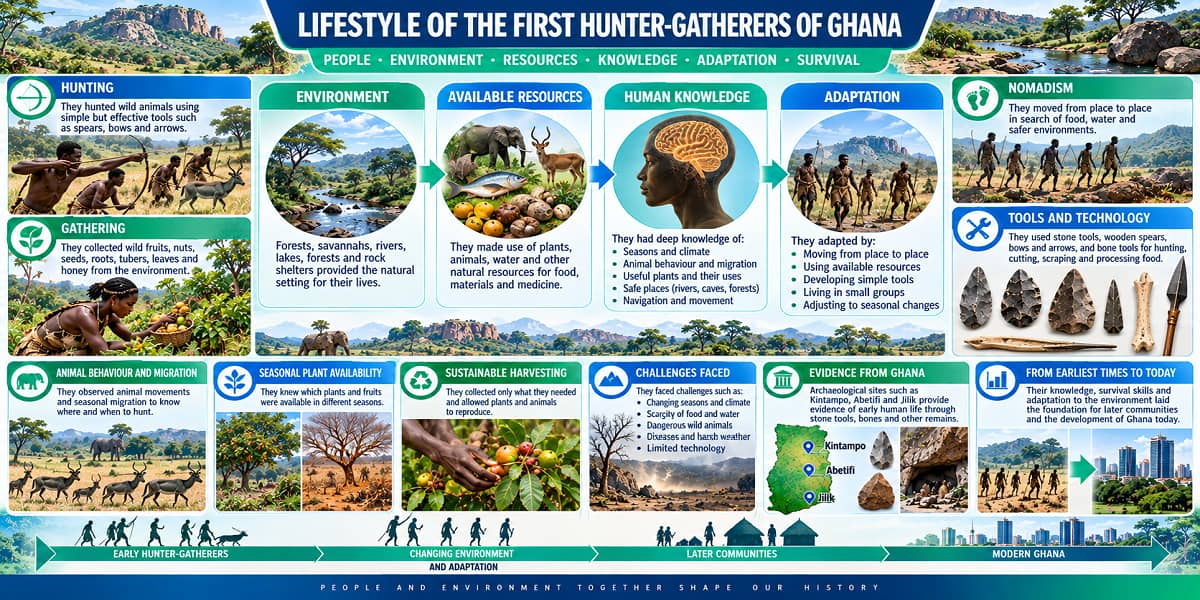
The first hunter-gatherers depended on their surroundings for food and other resources. Their lifestyle was centred on four closely connected features: hunting, gathering, nomadism and knowledge of the environment.
These were not four completely separate activities. Knowledge of the environment supported hunting and gathering. The availability of resources influenced movement. In turn, movement was part of the nomadic way of life.
Hunting Was a Knowledge-Based Activity
Hunting was an important way of obtaining food. But successful hunting required more than physical strength. Hunter-gatherer societies developed extensive knowledge about the behaviour and migration patterns of animals.
Knowing animal behaviour could help people understand where animals were likely to be found. Understanding migration patterns could help them respond to changes in animal movement.
This illustrates a wider principle of early human life: environmental knowledge was a survival resource.
Gathering Required an Understanding of Plants and Seasons
Gathering involved collecting wild plant resources. The first hunter-gatherers developed knowledge of the seasonal availability of different plant species.
Such knowledge allowed them to recognise useful resources and understand when those resources were available. Gathering therefore required observation and familiarity with the local environment.
Hunting and gathering worked together as important ways of obtaining food and resources.
Why Did They Move?
The first hunter-gatherers lived a nomadic lifestyle. Their movement was connected to the availability of food and other resources.
This makes sense when we consider their dependence on their environment. If the resources needed for survival were not equally available in every place or at every time, movement could form part of the response.
Nomadism should therefore be understood in relation to the wider lifestyle rather than as movement for its own sake.
Environmental Knowledge and Sustainable Harvesting
The first hunter-gatherers had a deep understanding of their local ecosystems. They also practised sustainable harvesting methods intended to preserve resources.
The combination of environmental knowledge and resource use reveals a close relationship between people and their surroundings. The environment provided resources, while human knowledge helped determine how those resources could be found and used.
What Made Life Difficult?
Life without modern infrastructure created challenges. Hunter-gatherers had to obtain food from their surroundings, find suitable shelter and respond to changes in resource availability.
Their adaptation can be understood as a relationship between challenge and response.
| Challenge | Response reflected in their lifestyle |
|---|---|
| Finding animal resources | Knowledge of animal behaviour and migration patterns. |
| Finding plant resources | Knowledge of seasonal plant availability. |
| Changing resource availability | Movement as part of nomadic life. |
| Dependence on natural resources | Knowledge of local ecosystems and sustainable harvesting methods. |
From Lifestyle to Archaeological Evidence
One of the fascinating problems in studying early human life is that people who lived thousands of years ago did not leave behind the same kinds of records available for recent history.
Archaeological evidence therefore becomes particularly important. Rock shelters and ancient sites in Ghana have provided evidence of human occupation and cultural development spanning thousands of years.
Important sites include Kintampo, Abetifi, Jilik, Kambago, Tusik, Kpatritinga, Gingana, Yilkpabongo and Begho.
Three Sites, Three Windows into the Past
| Site | Evidence | What the evidence suggests |
|---|---|---|
| Kintampo | Stone tools, pottery and animal bones | Early activities including hunting, gathering and pottery production; evidence of a complex Stone Age culture. |
| Abetifi | Pottery, grinding stones, other tools and iron artefacts | Early settlement, agricultural practices, plant processing and technological development in metalworking. |
| Jilik | Stone tools, pottery and evidence of iron smelting | Iron Age technology and the emergence of specialised craftspeople. |
Other sites, including Kambago, Tusik, Kpatritinga, Gingana, Yilkpabongo and Begho, have provided archaeological evidence that contributes to understanding cultural diversity, technological development, trade networks and socio-economic structures.
Why Does an Artefact Matter?
Consider a stone tool. It may look like a simple object, but it can lead to several historical questions.
- What was it made from?
- How was it produced?
- What might it have been used for?
- What skills did its production require?
- What does it reveal about the activities of its users?
These questions turn an object into historical evidence.
Archaeological evidence such as tools, artwork and pottery can be analysed for their function, creation process and potential cultural significance. Chronological reasoning can help establish how material culture changed over time, while cause-and-consequence reasoning can explore the factors influencing technological and cultural development.
The Wider Elements of Earliest Human Culture
The earliest human culture in Ghana was not limited to hunting. Several elements shaped the way of life.
| Element | Description |
|---|---|
| Food | Wild animals, edible plants, nuts and tubers; hunting, gathering and fishing. |
| Clothing and adornment | Use of locally available materials for clothing and adornment. |
| Tools and technology | Tools made from materials such as stone, wood and bone. |
| Foraging and hunting | Collection of wild resources and hunting of animals as means of obtaining food. |
Earliest Times and Today
One of the clearest ways to appreciate historical change is to compare early living conditions with those of modern-day Ghanaians.
| Area | Earliest times | Today |
|---|---|---|
| Shelter and housing | Nomadic or temporary shelters; caves, rock shelters and simple huts; branches, leaves and animal skins. | Permanent settlements and houses using bricks, concrete and wood, with access to electricity and plumbing. |
| Food and subsistence | Hunting game, collecting wild plants and fishing; wild animals, edible plants, nuts and tubers. | Agrarian-based activities, subsistence farming, fishing, livestock rearing and diverse local and imported foods. |
| Health and healthcare | Traditional medicine, herbal treatment and natural methods. | Medical facilities, trained professionals and vaccinations. |
| Technology | Tools made from stones, wood and bones. | Smartphones, computers, internet access and other modern technologies. |
This comparison demonstrates change and continuity. Housing, healthcare and technology have changed greatly. At the same time, activities such as fishing and the use of natural resources remain part of human life.
Seeing the Past Through Historical Skills
Understanding early human culture requires more than collecting facts. Historical skills help us interpret evidence and construct meaningful explanations.
Source Analysis
Archaeological evidence can be examined to understand function, production and possible cultural significance.
Chronological Reasoning
Timelines help us investigate the sequence of human habitation and cultural development and consider how tool types evolved over time.
Cause and Consequence
Environmental, technological, social and economic factors can be examined to understand influences on early material culture and adaptation.
Empathy and Perspective-Taking
Trying to understand early communities from their own circumstances helps us appreciate the challenges they faced without judging their lives solely by modern expectations.
Continuity and Change
Comparing early culture with present-day society helps identify practices that have changed and those that have remained.
Why Ghanaian Pre-History Matters
The study of early hunter-gatherer life reminds us that human societies have always had to respond to their circumstances. People observed their environments, developed knowledge, used resources and adapted their behaviour.
The archaeological record adds another dimension to this story. Stone tools, pottery, animal bones, grinding stones and evidence of ironworking provide physical clues about earlier communities and their technological and cultural development.
These clues also demonstrate why historical interpretation must be careful. An artefact is valuable evidence, but understanding its meaning requires attention to its context and comparison with other evidence.
Think About the Bigger Picture
The story of the first hunter-gatherers is not simply a story about people hunting animals. It is a story about the relationship between human beings, resources, knowledge, technology and adaptation.
When food resources changed, movement could become important. When people needed tools, locally available materials became important. When communities interacted with their environments, knowledge became essential.
That relationship between people and their surroundings is one of the most useful ideas to carry from the study of Ghanaian pre-history.
Questions for Reflection
- Why was knowledge of animal behaviour important to the first hunter-gatherers?
- How did gathering depend on knowledge of seasonal plant availability?
- Why was nomadism connected to resource availability?
- What can archaeological evidence reveal about early human culture?
- Why is Kintampo important in understanding Ghana’s early history?
- What does evidence from Abetifi reveal about early settlement and technology?
- What does Jilik tell us about ironworking and specialised crafts?
- What major changes can be seen when early living conditions are compared with life today?
Model answers:
- It helped hunter-gatherers understand animal behaviour and migration patterns, supporting their ability to obtain animal resources.
- They needed to know when different plant species were seasonally available so that they could collect useful wild resources.
- Movement was part of responding to the availability of food and other resources.
- It can reveal information about human occupation, activities, technology, skills and cultural development.
- Kintampo has yielded stone tools, pottery and animal bones that provide evidence of early activities such as hunting, gathering and pottery production.
- Abetifi has provided pottery, grinding stones, other tools and iron artefacts, suggesting early settlement, agricultural practices, plant processing and metalworking skills.
- Stone tools, pottery and evidence of iron smelting at Jilik provide information about Iron Age technology and specialised craftspeople.
- Housing, food systems, healthcare and technology have undergone major changes, although some activities such as fishing and resource use continue.
The Essential Idea
The first hunter-gatherers of Ghana lived approximately 10,000 years ago. Their lifestyle was shaped by hunting, gathering, nomadism and detailed knowledge of their environment.
Archaeological evidence from Ghanaian sites helps us investigate this early culture. The evidence shows that early human life included food gathering, hunting, clothing and adornment, toolmaking and technological development.
Studying these communities also reveals a fundamental feature of human history: people adapt. They respond to environmental conditions, develop knowledge, use available resources and create technologies suited to their circumstances.
Ghanaian pre-history therefore gives us more than a picture of the distant past. It helps us understand the long human experience of adapting, creating and living within an environment.
Access NaCCA-aligned Support Packs
Download your structured NaCCA-aligned Teacher Support Pack and Student Learning Pack, designed for clarity, practicality, and reliable teaching and learning.