Lifestyle of the First Hunter-Gatherers of Ghana
Imagine living in Ghana about 10,000 years ago. There are no supermarkets, modern farms, smartphones or permanent houses as we know them today. If you needed food, shelter and protection, you would have to depend heavily on your surroundings.
How would you survive? What would you eat? How would you obtain food? Where would you live? How would you respond when resources became scarce?
These questions help us understand the lifestyle of the first hunter-gatherers of Ghana. Their lives were closely connected to the environment, and their survival depended on knowledge, adaptation and the effective use of available resources.
1. Who Were the First Hunter-Gatherers?
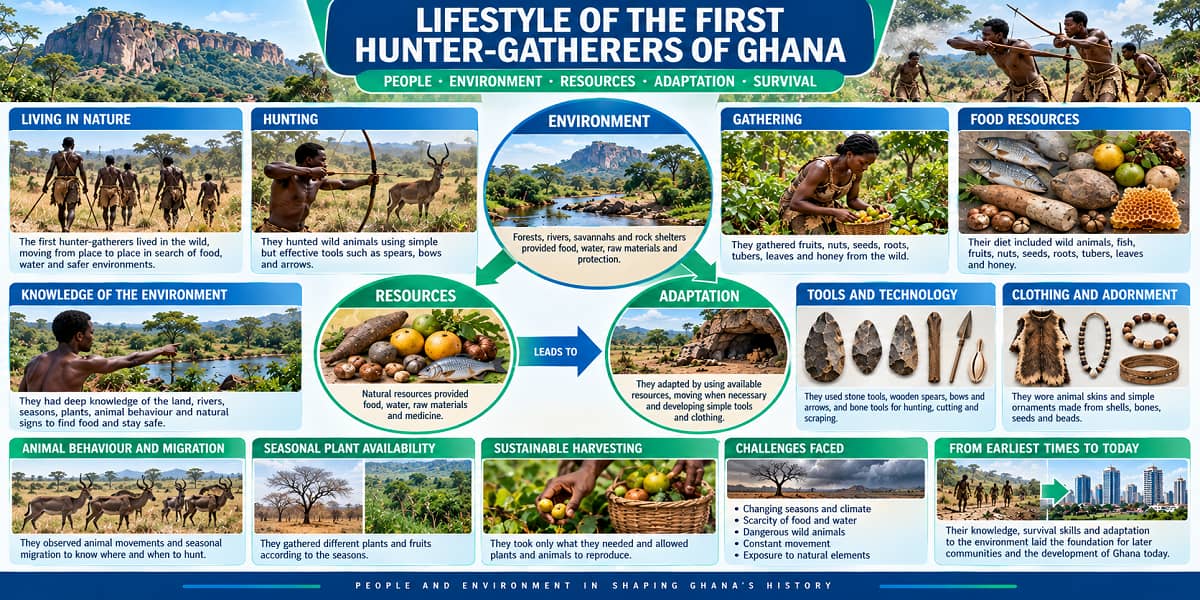
In Ghana, the first hunter-gatherers lived approximately 10,000 years ago. Their lifestyle was centred on four closely related features:
- Hunting
- Gathering
- Nomadism
- Knowledge of the environment
2. Hunting
Hunting involved obtaining animals for food. Hunter-gatherer societies developed extensive knowledge about the behaviour and migration patterns of animals.
This knowledge was important because successful hunting required an understanding of where animals could be found and how their movements changed.
Hunting was therefore not simply a physical activity. It involved observation, knowledge and adaptation to environmental conditions.
3. Gathering
Gathering involved collecting wild plant resources. The first hunter-gatherers developed knowledge about the seasonal availability of different plant species.
This meant that they could identify useful plant resources and understand when they were available. Gathering, like hunting, depended on close observation of the natural environment.
Remember: Hunting provided animal resources, while gathering provided plant resources. Together they formed important parts of the hunter-gatherer way of life.
4. Nomadism
Nomadism refers to a way of life involving movement rather than permanent settlement. The first hunter-gatherers moved as part of their response to the availability of food and other resources.
Movement was therefore connected to survival. When resources in one location became less available, movement could provide access to other resources.
5. Knowledge of the Environment
The first hunter-gatherers had a deep understanding of their local ecosystems. They knew about animals, plants and the availability of resources.
They also practised sustainable harvesting methods intended to help preserve resources. Their way of life demonstrates how closely human survival could depend on environmental knowledge.
| Lifestyle feature | What it involved |
|---|---|
| Hunting | Obtaining animals for food and using knowledge of animal behaviour and movement. |
| Gathering | Collecting wild plant resources and understanding their seasonal availability. |
| Nomadism | Moving in response to the availability of food and other resources. |
| Environmental knowledge | Understanding local ecosystems, animals, plants and resource availability. |
6. The Challenges They Faced
Life as a hunter-gatherer presented challenges. People depended heavily on what their environment could provide. They had to find food, respond to changes in resource availability and protect themselves within their surroundings.
Their responses demonstrate adaptation. They developed knowledge about animals and plants, used available resources and moved when necessary.
The important relationship is:
Environmental conditions → Human challenges → Adaptation → Continued access to resources.
7. How Did They Adapt?
The first hunter-gatherers adapted to their environment in several ways.
- They developed knowledge about animal behaviour and migration.
- They learned about the seasonal availability of plant species.
- They moved in response to available resources.
- They used materials and resources available in their surroundings.
- They practised harvesting methods intended to preserve resources.
These adaptations show that early human survival involved both knowledge and action.
8. Historical Skills for Understanding Their Lifestyle
Learning about people who lived approximately 10,000 years ago requires us to think like historians. Several historical skills are particularly useful.
Source Analysis
Archaeological evidence such as tools and artwork can be examined to understand their possible function, creation process and potential cultural significance.
Chronological Reasoning
Timelines and evidence can help us understand the sequence of events and developments in hunter-gatherer societies.
Cause and Consequence
We can examine factors such as the environment and technology and consider their consequences for adaptation and social organisation.
Empathy and Perspective-Taking
We can try to understand the challenges faced by hunter-gatherers from their own circumstances rather than judging their lives only by modern standards.
9. Let’s Think Like a Hunter-Gatherer
Imagine that your group has been living in one area. You know where certain animals can be found and when particular wild plants become available. After some time, the resources you depend on become less available.
Question: What could your group do?
Answer: The group could use its environmental knowledge to locate other available resources and move to another area when necessary. This illustrates the connection between environmental knowledge and nomadism.
Now consider another question:
Question: Why would knowing animal migration patterns be useful?
Answer: Knowledge of animal behaviour and migration patterns could help hunter-gatherers understand where and when animals might be available for hunting.
10. Early Life and Present-Day Life
The hunter-gatherer way of life can be compared with present-day society to identify differences and continuities.
| Aspect | Hunter-gatherer life | Present-day life |
|---|---|---|
| Food | Hunting, gathering and fishing; diets included wild animals, edible plants, nuts and tubers. | Farming, fishing, livestock rearing and a diverse range of local and imported foods. |
| Shelter | Nomadic or temporary shelters, caves, rock shelters and simple huts. | Permanent settlements and houses using materials such as bricks, concrete and wood. |
| Healthcare | Traditional medicine, herbal treatment and natural methods. | Medical facilities, trained professionals and vaccinations. |
| Technology | Tools made from stones, wood and bones. | Smartphones, computers, internet access and other modern technologies. |
The comparison shows substantial change, but it also reminds us that some activities, including fishing and the use of natural resources, continue to exist.
11. Evidence That Helps Us Understand Early Life
Our understanding of early human culture does not depend only on imagining what life might have been like. Archaeological evidence from Ghanaian rock shelters and ancient sites provides important clues.
Important sites include:
- Kintampo
- Abetifi
- Jilik
- Kambago
- Tusik
- Kpatritinga
- Gingana
- Yilkpabongo
- Begho
These sites have provided evidence of human occupation and cultural development spanning thousands of years. Such evidence helps us connect the lifestyle of early people with the material traces they left behind.
12. What the Archaeological Evidence Shows
| Site | Evidence | Historical insight |
|---|---|---|
| Kintampo | Stone tools, pottery and animal bones | Evidence of hunting, gathering and pottery production; associated with a complex Stone Age culture. |
| Abetifi | Pottery, grinding stones, other tools and iron artefacts | Evidence of early settlement, agricultural practices, plant processing and metalworking skills. |
| Jilik | Stone tools, pottery and evidence of iron smelting | Evidence of Iron Age technology and the emergence of specialised craftspeople. |
| Other sites | Archaeological evidence | Insights into cultural diversity, technological development, trade networks and socio-economic structures. |
13. Elements of Earliest Human Culture in Ghana
The earliest human culture in Ghana included several important elements that shaped people’s way of life.
Food
Food resources included wild animals, edible plants, nuts and tubers. Hunting, gathering and fishing were important means of obtaining food.
Clothing and Adornment
Early humans used locally available materials in forms of clothing and adornment. These practices formed part of their material culture.
Tools and Technology
Tools were made from materials such as stone, wood and bone. The development of tools provides evidence of human skills and technological change.
Foraging and Hunting
Foraging involved collecting wild resources, while hunting involved obtaining animals. Both were connected to knowledge of the environment.
14. Why Material Culture Matters
Material culture refers to physical objects associated with human life and activities. Archaeological evidence such as tools, pottery and other objects can help us investigate how earlier people lived.
When examining an artefact, we can ask:
- What material was used to make it?
- How might it have been produced?
- What could it have been used for?
- What skills might its production have required?
- What could it reveal about the activities of its users?
However, artefacts must be interpreted carefully. A single object cannot automatically tell us everything about the society that produced it. Its meaning becomes clearer when considered in its archaeological context and alongside other evidence.
15. Practice Questions
Question 1
State the four main features of the lifestyle of the first hunter-gatherers in Ghana.
Answer: Hunting, gathering, nomadism and knowledge of the environment.
Question 2
Why was knowledge of the environment important to hunter-gatherers?
Answer: It helped them understand animals, plant availability, seasons and local ecosystems, enabling them to obtain resources and adapt to environmental conditions.
Question 3
What is nomadism?
Answer: Nomadism is a way of life involving movement rather than permanent settlement, including movement in response to the availability of food and other resources.
Question 4
Name three archaeological sites in Ghana associated with early material culture.
Answer: Kintampo, Abetifi and Jilik. Other acceptable examples include Kambago, Tusik, Kpatritinga, Gingana, Yilkpabongo and Begho.
Question 5
What evidence was discovered at Kintampo?
Answer: Stone tools, pottery and animal bones were discovered. They indicate early activities such as hunting, gathering and pottery production.
Question 6
What does the evidence from Abetifi suggest?
Answer: Pottery, grinding stones and other tools suggest agricultural practices and plant-resource processing, while iron artefacts indicate technological advancement and metalworking skills.
Question 7
State four elements of the earliest human culture in Ghana.
Answer: Food; clothing and adornment; tools and technology; and foraging and hunting.
Question 8
Give two historical skills that can be used to study early hunter-gatherers.
Answer: Source analysis and chronological reasoning. Cause and consequence, and empathy and perspective-taking, are also appropriate.
16. Final Synthesis
The first hunter-gatherers in Ghana lived approximately 10,000 years ago. Their lifestyle centred on hunting, gathering, nomadism and knowledge of the environment.
They adapted to their surroundings by learning about animals and plants, responding to resource availability and using available materials. Archaeological evidence from sites such as Kintampo, Abetifi and Jilik provides important clues about early human occupation, technology and cultural development.
The wider elements of earliest human culture included food, clothing and adornment, tools and technology, and foraging and hunting. Comparing these with present-day living conditions reveals major changes in shelter, food, healthcare and technology while also showing some continuities.
The key idea is that the lifestyle of Ghana’s first hunter-gatherers was shaped by their close relationship with the environment. Their activities, adaptations and material culture provide important evidence for understanding the earliest human experience in Ghana.
Access NaCCA-aligned Support Packs
Download your structured NaCCA-aligned Teacher Support Pack and Student Learning Pack, designed for clarity, practicality, and reliable teaching and learning.