Fundamental Concepts of Economics II
Economic life involves constant decisions. People have wants, but the resources available to satisfy those wants are limited. This makes want, scarcity, choice, scale of preference and opportunity cost important concepts in everyday decision-making.
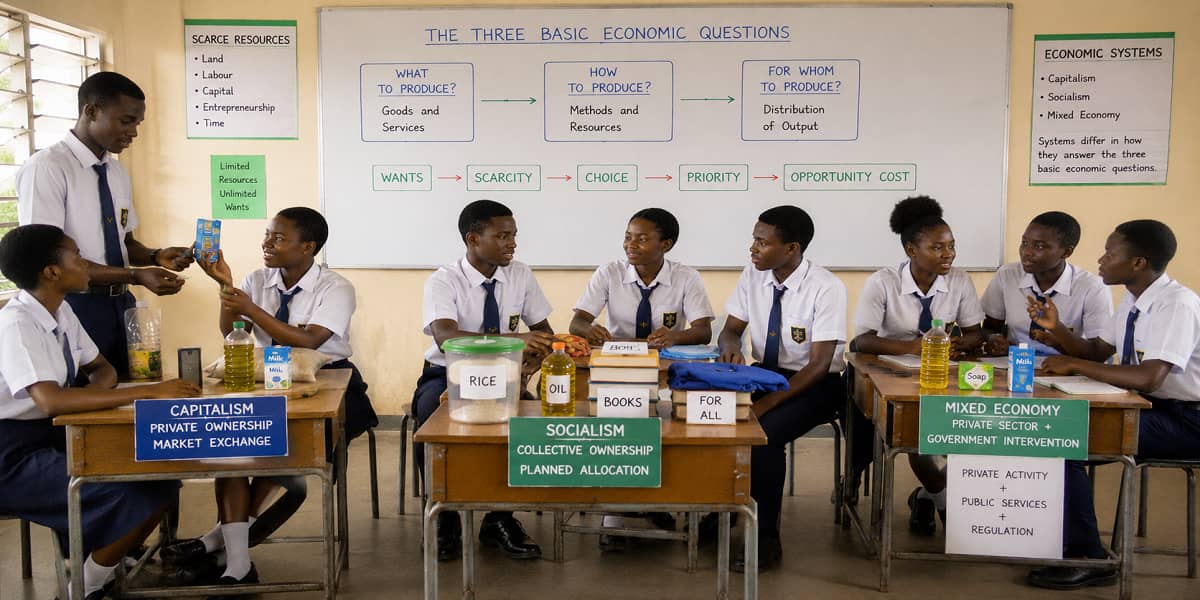
Economic decisions also take place within different economic systems. The three systems considered here are capitalism, socialism and the mixed economy.
1. Connecting Economics to Everyday Life
Think about a situation where you have several things you want but limited resources. You cannot satisfy all the wants at once, so you must decide which is more important.
That simple situation brings together several fundamental economic concepts.
- Want: something you desire.
- Scarcity: resources are limited compared with competing wants.
- Choice: deciding how limited resources will be used.
- Scale of preference: arranging wants according to priority.
- Opportunity cost: the cost of choosing one thing over another.
2. Why Scarcity Is Fundamental
Scarcity exists because resources are limited relative to the demand for them. Since available resources cannot satisfy all competing wants and needs, individuals and societies must make choices.
For example, if a community has limited resources but several important problems, it cannot address everything at the same time with the same resources. Some priorities must come before others.
This is why scarcity is described as a fundamental problem in the economy.
3. From Want to Opportunity Cost
A want creates a desire. Limited means create scarcity. Scarcity forces choice. A scale of preference helps establish which wants should receive priority. Once one option is chosen instead of another, there is an opportunity cost.
Example: If your available resources can satisfy only your first-priority want, choosing it means giving up the opportunity to satisfy another want with those same resources.
The opportunity cost is therefore connected directly to the decision made.
4. Economic Systems
An economic system is the structure and organisation through which the production, distribution and consumption of goods and services take place in a society or country.
It determines how resources are allocated and how decisions are made about:
- what to produce;
- how to produce; and
- for whom to produce.
5. Capitalism
Capitalism is an economic system in which the means of production are privately owned and economic decisions are largely driven by the pursuit of profit.
Market forces such as supply and demand play an important role in determining prices and allocating resources.
Competition is a key feature of capitalism. Individuals have the freedom to own property and engage in voluntary exchange.
6. Socialism
Socialism advocates collective or government ownership of the means of production.
Its goal is to achieve a more equitable distribution of wealth and resources.
Economic planning and centralised decision-making play a significant role. The emphasis is on meeting the needs of the entire society rather than maximising individual profit.
7. Mixed Economy
A mixed economy combines elements of capitalism and socialism.
There is a blend of private ownership and government intervention. Governments may regulate certain industries, provide public goods and services, and implement social welfare programmes while allowing market forces to operate in other sectors.
8. Comparing the Three Economic Systems
| Economic System | Ownership | Main Decision Pattern |
|---|---|---|
| Capitalism | Means of production are privately owned. | Market forces, including supply and demand, strongly influence decisions and resource allocation. |
| Socialism | Collective or government ownership. | Economic planning and centralised decision-making play a significant role. |
| Mixed Economy | Combination of private ownership and government involvement. | Market forces operate alongside government intervention. |
9. Capitalism in Practice
Imagine a system where individuals can own productive property and businesses compete to offer goods and services. Producers respond to market conditions, while supply and demand influence prices and resource allocation.
These features describe a capitalist approach.
10. Socialism in Practice
Now imagine a system in which productive resources are collectively or government owned, with economic planning used to guide production and allocation.
The focus is on achieving a more equitable distribution of wealth and resources and meeting society’s needs.
11. Mixed Economic Organisation
A mixed economy brings together private ownership and government intervention.
Private economic activity can operate through market forces, while government may regulate particular industries, provide public goods and services, and implement social welfare programmes.
12. Applying Economic Concepts to Society
Consider a community with several important needs but limited resources.
First, the community identifies its wants and needs. It then recognises the limited means available. This creates scarcity.
The community must make a choice. A scale of preference can help rank the problems according to importance. Once resources are committed to one priority, the alternative that is sacrificed represents the opportunity cost.
13. The Same Concepts Within an Economic System
The fundamental economic concepts do not disappear when society adopts an economic system. They remain relevant because every economic system has to deal with limited resources and competing needs.
What changes is the way economic decisions are organised.
| Question | Why It Matters |
|---|---|
| What to produce? | Resources are limited, so production priorities must be determined. |
| How to produce? | Available resources must be organised for production. |
| For whom to produce? | Decisions must be made about who receives the goods and services produced. |
14. Learning Through Drama
The concepts of want, scarcity, choice, scale of preference and opportunity cost can be explored through role-play.
Imagine a short drama in which people have different wants but access to limited resources. The characters must identify priorities, make choices and explain what they give up.
After the drama, the economic concepts become easier to connect with everyday decision-making.
15. Apply the Drama to Real Life
Take an event or situation in your community and ask:
- What wants or needs are involved?
- Which resources are limited?
- What choices must be made?
- How could priorities be arranged?
- What is sacrificed when one option is chosen?
Complete answer: The situation demonstrates Economics when competing wants or needs must be addressed with limited resources, requiring priorities, choices and an opportunity cost.
16. Practice: Fundamental Concepts
Question: Why is scarcity a fundamental economic problem?
Answer: Resources are limited relative to competing wants and needs. Therefore, not every want can be satisfied at the same time, making choice and allocation necessary.
Question: How does a scale of preference help with scarcity?
Answer: It ranks wants according to importance or priority, helping limited resources to be directed towards higher-priority wants.
Question: Why does choice involve opportunity cost?
Answer: Choosing one alternative means giving up another alternative with the available resources.
17. Practice: Economic Systems
Question: Which system is strongly associated with private ownership, competition and market forces?
Answer: Capitalism.
Question: Which system emphasises collective or government ownership and economic planning?
Answer: Socialism.
Question: Which system combines private ownership with government intervention?
Answer: A mixed economy.
18. Strategic Reasoning
Question: A society has limited resources and many problems requiring attention. Explain how the fundamental concepts of Economics can guide its decisions.
Answer: The society identifies its wants and needs, considers the means available and recognises scarcity. It then makes choices and ranks priorities through a scale of preference. The resources are allocated to selected priorities, while the alternatives given up represent opportunity costs.
19. Extended Thinking
Question: How can the fundamental economic concepts influence decision-making within an economic system?
Answer: Every economic system must deal with scarcity and competing wants. The system therefore needs a way to organise choices about what to produce, how to produce and for whom to produce. Wants, scarcity, choice, priorities and opportunity cost remain relevant, while the economic system determines how these decisions are organised through market forces, government or a combination of both.
20. Quick Review
- An economic system organises production, distribution and consumption.
- Capitalism emphasises private ownership and market forces.
- Socialism emphasises collective or government ownership and economic planning.
- A mixed economy combines private ownership with government intervention.
- Scarcity makes economic choice necessary.
- A scale of preference helps establish priorities.
- Opportunity cost arises when one option is chosen over another.
21. Final Synthesis
Economic decisions begin with the problem of scarcity. People and societies have competing wants and needs, but resources are limited.
They therefore make choices, establish priorities and accept opportunity costs. These decisions occur within economic systems that organise production, distribution and consumption.
Capitalism relies strongly on private ownership and market forces. Socialism emphasises collective or government ownership and economic planning. A mixed economy combines private ownership with government intervention.
Understanding these systems helps us see that economic choices are not isolated events. They are part of the way societies organise their scarce resources to meet human needs.
Access NaCCA-aligned Support Packs
Download your structured NaCCA-aligned Teacher Support Pack and Student Learning Pack, designed for clarity, practicality, and reliable teaching and learning.