The Structure of a Plot
Introduction
A plot is the sequence of events in a story. Understanding how events are arranged helps readers trace the development of a story and understand how meaning is created through the progression of events.
Key Concepts
- Plot: The sequence of events in a story.
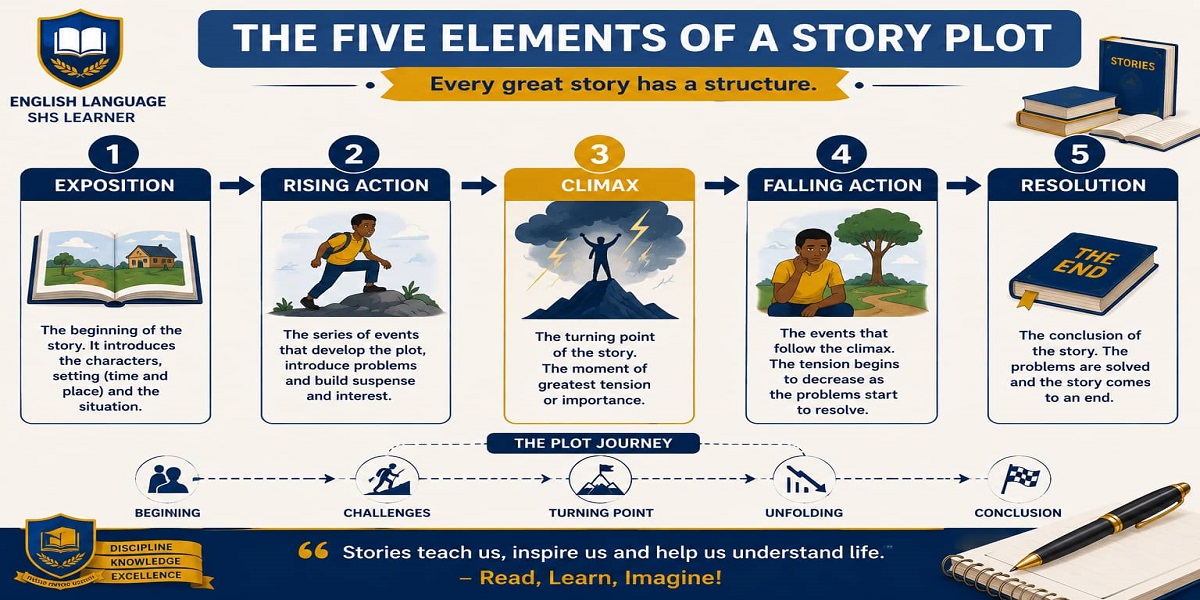
- Exposition: Introduces the main characters, setting, themes, and the author’s style.
- Rising Action: Develops after the inciting incident and builds the main conflict through cause-and-effect events.
- Climax: The highest point of conflict where the fate of the main characters becomes clear.
- Falling Action: Shows how characters respond to the climax and its effects.
- Resolution (Denouement): Brings the story to an ending by resolving remaining issues. Some endings remain open-ended.
Explanation
Every story follows a sequence of events that guides readers from the beginning to the end. The exposition establishes the setting, introduces important characters, presents the themes, and reflects the author’s style. After the exposition comes the rising action, which begins after the inciting incident and develops the central conflict through connected events. The climax is the turning point where the conflict reaches its highest intensity and the fate of the main characters becomes known. Following the climax is the falling action, where the consequences of the climax are explored and the characters adjust to what has happened. Finally, the resolution or denouement concludes the story by tying up loose ends, although some stories intentionally leave the ending open for readers to interpret.
| Element of Plot | Purpose | Contribution to the Story |
|---|---|---|
| Exposition | Introduces characters, setting, themes and style | Provides the background for the story |
| Rising Action | Develops the conflict | Builds suspense through connected events |
| Climax | Presents the highest point of conflict | Determines the fate of the main characters |
| Falling Action | Shows reactions to the climax | Leads the story toward its ending |
| Resolution | Concludes the story | Resolves remaining issues or leaves an open ending |
Examples
Example 1
Problem: Identify the sequence of events in a story.
- Identify the exposition.
- Locate the events that develop the conflict.
- Identify the climax.
- Describe the falling action.
- State how the story ends in the resolution.
Final Answer: The events are organized into exposition, rising action, climax, falling action, and resolution.
Example 2
Problem: Classify different events from a film into the correct plot elements.
- List the major events.
- Arrange them in chronological order.
- Assign each event to the appropriate plot element.
Final Answer: Each event is classified according to its role in developing the complete plot.
Application and Activities
- Trace at least three sequences of a film or story.
- Discuss and present the elements of a plot.
- Play a plot-building game by taking turns to create a story from a given title.
- Outline the sequence of events in a film or story and identify each plot element.
- Create original storylines using the elements of plot.
Practice
- State the five main elements of a plot.
- Explain the difference between the rising action and the climax.
- Use the sequence of events from a film or story to create your own storyline.
Summary
The structure of a plot organizes the events of a story into exposition, rising action, climax, falling action, and resolution. Understanding these stages helps readers follow the sequence of events and appreciate how each stage contributes to the overall meaning of the story.
Access NaCCA-aligned Support Packs
Download your structured NaCCA-aligned Teacher Support Pack and Student Learning Pack, designed for clarity, practicality, and reliable teaching and learning.