Introduction and Importance of Studying History
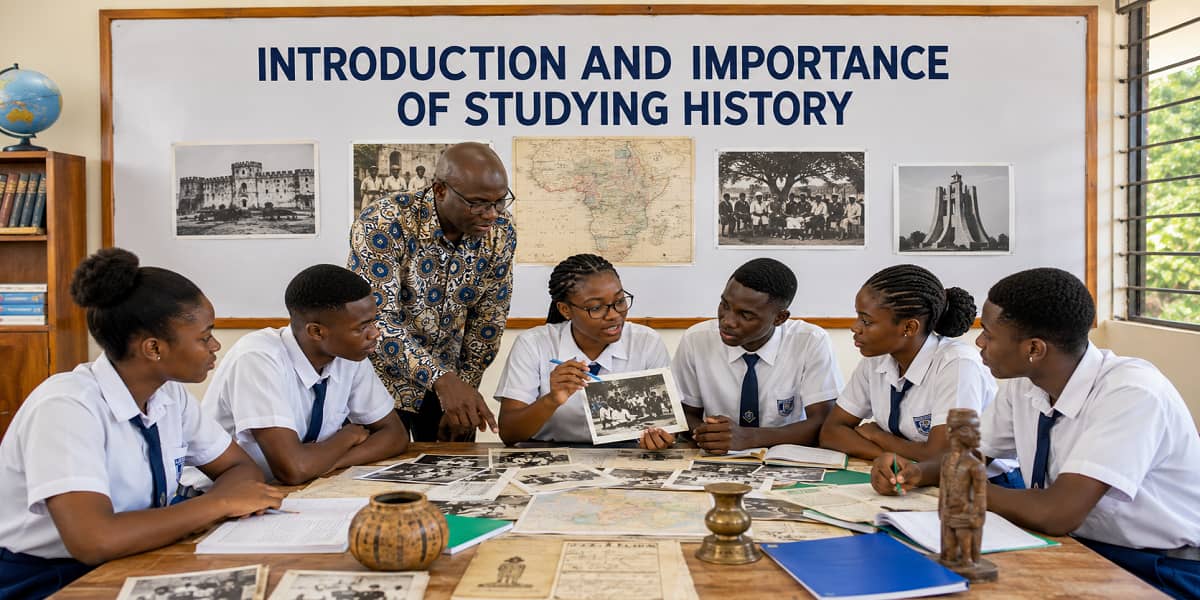
Think about this: How do you know what happened in your family before you were born? You may hear stories from parents or grandparents, see old photographs, read documents, or visit places connected with important events. All these help us connect the present with the past.
That connection is at the heart of History. History helps us investigate significant human activities in the past, understand how societies have changed, and appreciate how the past continues to influence the present.
1. What Does the Word “History” Mean?
The word history has both conventional and non-conventional origins.
The Conventional Origin
Conventionally, the word “history” comes from the Greek word historia, meaning “inquiry.” The term became prominent in the 5th Century BCE/BC when Herodotus used it in connection with his inquiry into past events, particularly events associated with the Persian Wars.
Local Expressions for History
Different Ghanaian communities use their own words or expressions to describe history. These expressions reflect the importance of language and culture in understanding the past.
| Language/Community | Expression for History |
|---|---|
| Akan | Abakɔsɛm |
| Dagbani | Taarihi |
| Ga | Blemasaji |
| Ewe | Gbeɠenyawo |
| Gonja | Adrashɔŋ |
Notice: The expressions differ because languages and communities express ideas in different ways. Yet they all relate to understanding events of the past.
2. What Is History?
History is the study of significant human past activities through time.
This definition contains three important ideas:
- Significant: History is concerned with events and activities that are important enough to help us understand human life and change.
- Human: History is mainly concerned with the activities and experiences of people.
- Through time: History examines what happened in the past and the changes that occurred over different periods.
History is therefore more than a list of dates, names and places. It involves the interpretation and analysis of events within their social, political and cultural contexts. Historians ask questions such as what happened, why did it happen, and how did it happen?
3. History and the Past: Are They the Same?
The past refers broadly to what has already happened. History is the study of significant human activities in that past.
For example, an old family photograph may show that an event occurred. Studying the photograph together with other accounts can help us investigate what happened, why it happened and what it meant to the people involved.
History therefore requires us to think about the past rather than simply remember it.
4. Misconceptions About Studying History
A misconception is an incorrect or mistaken idea. Several misconceptions are commonly associated with the study of History.
| Misconception | A better understanding |
|---|---|
| History is a dry and boring subject. | History involves inquiry, interpretation, analysis and understanding human experiences. |
| History is just the memorisation of facts and dates. | Dates and facts are useful, but History also requires critical thinking and interpretation. |
| History is static and unchanging. | History examines change and continuity over time. |
| History is an abstract subject with little relevance to real life. | History helps people understand the present, society, identity and development. |
| History provides limited job opportunities. | The study of History develops skills that can be useful in different areas of life and work. |
| History is simply subjective and biased. | Historical accounts require careful examination of sources, perspectives, limitations and evidence. |
How Can Misconceptions Be Addressed?
Historical understanding becomes stronger when learners:
- Analyse sources: examine historical sources critically, considering their accuracy, authenticity, bias and limitations.
- Consider multiple perspectives: recognise that different people may interpret an event differently.
- Examine cause and effect: look for the different factors that may contribute to an event rather than assuming there is always one cause.
- Study change and continuity: identify what has changed and what has remained over time.
5. Why Is History Important?
History is relevant to both individuals and society. It helps people understand where they come from, appreciate different experiences and make sense of changes over time.
History Promotes National Harmony and Integration
Learning about the experiences and histories of different groups can help people appreciate their shared society. This can contribute to national harmony and integration.
History Promotes Tolerance
History exposes learners to the diversity that exists within society. Understanding different experiences can encourage respect for people whose backgrounds, cultures or perspectives differ from one’s own.
History Encourages Patriotism
Knowledge of a country’s past can contribute to a sense of national pride and identity. It can help learners appreciate important experiences connected with the nation.
History Sustains Customs, Traditions and Values
History helps people understand how customs, traditions and values have been transmitted through generations. This knowledge contributes to cultural continuity and development.
History Provides Self-Identity
Individuals often understand themselves partly through their family, community and national histories. Knowing these histories can contribute to a stronger sense of identity.
History Supports Other Academic Disciplines
History provides a basis for understanding human development and change. Its concern with society, people, events, evidence and interpretation makes historical knowledge relevant to other areas of academic study.
History Develops Useful Skills
The study of History develops skills such as:
- critical thinking;
- source analysis;
- interpretation;
- understanding different perspectives;
- analysing cause and effect;
- recognising change and continuity; and
- connecting knowledge of the past with the present.
6. Let Us Apply What We Have Learned
Activity 1: Think and Explain
Question: Why is History more than memorising dates and names?
Answer: History is more than memorisation because it involves investigating significant human activities, analysing evidence, interpreting events and asking what happened, why it happened and how it happened.
Activity 2: Correct the Misconception
Statement: “History is a static subject because everything in the past has already happened.”
Answer: The statement is incorrect. History examines change and continuity over time. Studying the past helps us understand how societies have changed and what has continued.
Activity 3: Complete the Thought
- The Greek word associated with the conventional origin of “history” is historia.
- Historia means inquiry.
- History is the study of significant human past activities through time.
- One way of addressing historical misconceptions is source analysis.
- History can promote tolerance, patriotism, national harmony and integration.
Activity 4: Short Response
Question: Give three reasons why the study of History is important to an individual.
Answer: History can provide an individual with a sense of self-identity, develop critical and analytical skills, and help the individual understand the relationship between the past and the present.
7. Bring the Ideas Together
We can now connect the three major ideas in this lesson:
| Idea | What to remember |
|---|---|
| Meaning | History is the study of significant human past activities through time. |
| Misconceptions | History is not simply memorising dates; it involves inquiry, analysis, interpretation and perspectives. |
| Importance | History contributes to identity, tolerance, patriotism, national harmony, cultural continuity and useful skills. |
8. Quick Check Before You Finish
- What does historia mean?
- State the meaning of History.
- Give two local expressions used to describe History.
- State two misconceptions about the study of History.
- Mention two ways of addressing misconceptions about History.
- Explain one way History promotes national development.
Answers:
- Historia means inquiry.
- History is the study of significant human past activities through time.
- Examples include abakɔsɛm in Akan and Taarihi in Dagbani. Other examples are blemasaji in Ga, gbeɠenyawo in Ewe and Adrashɔŋ among the Gonja.
- Examples include the belief that History is boring and the belief that it is only about memorising dates and facts.
- Examples include source analysis, considering multiple perspectives, analysing cause and effect, and studying change and continuity.
- History can promote national development by encouraging national harmony, tolerance, patriotism, cultural continuity and useful critical-thinking skills.
Key takeaway: History is an inquiry into significant human activities of the past. It does not merely preserve memories; it helps us interpret human experiences, understand change, appreciate diversity and develop knowledge and skills that matter to individuals and society.
Access NaCCA-aligned Support Packs
Download your structured NaCCA-aligned Teacher Support Pack and Student Learning Pack, designed for clarity, practicality, and reliable teaching and learning.