Relationships Between Genres in Oral and Written Literature
Literature can be expressed in different genres. A genre is a type or form of literature distinguished by the way it is presented and the features it commonly uses. Literature may occur in oral or written forms, and the two are related because literary ideas, forms and features can exist across both modes.
Let’s Begin: What Forms of Literature Do You Know?
Think about a story told to you, a song sung at a gathering, a poem you have read, a biography, a news report or a play you have watched. These are all examples of ways in which language can communicate experiences, ideas, emotions and knowledge.
Some literary forms are mainly encountered through writing, while others have strong oral traditions. Some forms can also move between oral and written expression. For example, poetry can be written and can also be performed orally through forms such as lamentations, chants and prayers.
The Main Genres of Literature
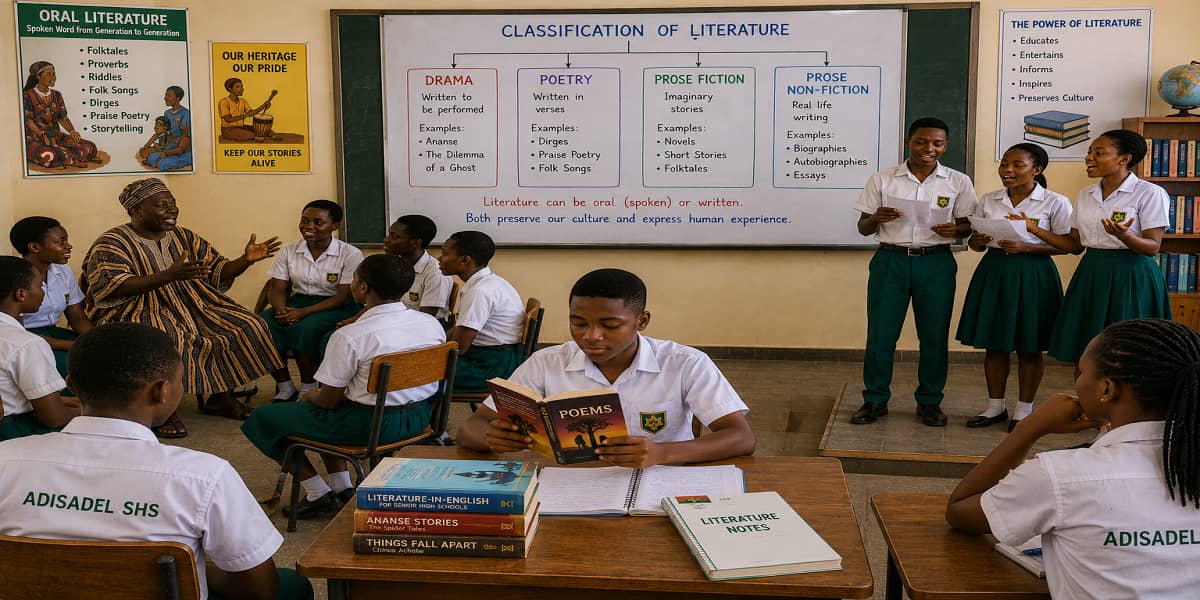
The main genres identified in this lesson are drama, poetry, prose fiction and prose non-fiction.
| Genre | Key Features | Examples |
|---|---|---|
| Drama | Made of dialogue and stage directions; designed to be performed. | Plays |
| Poetry | Relies on the interplay of words and rhythm and commonly employs rhyme and metre; it can be performed orally. | Poems, lamentations, chants and prayers |
| Prose fiction | Uses narrative forms to present creative or imaginative stories. | Myths, fables, novels and short stories |
| Prose non-fiction | Presents factual or life-based material in prose form. | News, reports, journals, articles, essays, textbooks and biographies |
Written Literature
Written literature includes forms such as novels, biographies, novellas, poetry, plays, short stories, epics and science fiction.
Biography
A biography is a non-fiction account of one person’s life written by another person. It may be written whether the person is alive or dead and usually includes details such as childhood, education, career and relationships.
Short Story
A short story is a short narrative that has some of the features of a novel.
Novel
A novel is a long creative story that describes human experiences in narrative form. It has features such as plot, character and setting. Redemption Road is given as an example.
Oral Literature
Oral literature consists of forms communicated through speech, song, performance and other oral expressions. Examples include jokes, songs, riddles, folktales, dirges, fables, legends, myths, proverbs, sayings and anecdotes.
| Oral Form | Meaning or Characteristic |
|---|---|
| Folktale | An oral narrative that generally has moral lessons and is passed from generation to generation. It is traditionally told by the fireside and may be interspersed with folk songs. |
| Dirge | A song of lamentation and grief used to praise, honour and mourn the dead, usually performed at a funeral. |
| Proverb | A short, well-known, wise saying representing a general truth or piece of advice. |
| Folk song | A traditional or composed song usually associated with a community and characterised by features such as stanzas, refrain and melody. It does not usually have a known composer and may have many versions. |
How Oral and Written Literature Are Related
1. Both Communicate Human Experiences
Both oral and written literature can communicate experiences, ideas, emotions and observations. An orally told folktale and a written narrative can both use storytelling to communicate meaning.
2. Some Forms Can Exist in Both Modes
The distinction between oral and written literature is not always absolute. Poetry, for example, can be written and can also be performed orally through lamentations, chants and prayers.
3. Oral Forms Can Appear in Written Literature
Myths, fables, legends, folktales, proverbs and songs are examples of oral forms that can be represented or preserved in written literary expression. This creates an important connection between oral tradition and written literature.
4. Performance Connects the Two
Drama provides another clear connection. A play is written using dialogue and stage directions, but it is designed to be performed. The written text therefore becomes a basis for spoken and physical performance.
5. Sound and Rhythm Can Be Important
Oral literature often depends on sound, voice and performance. Written poetry can also preserve features such as rhythm, rhyme and metre. A poem can therefore be read on the page and experienced through oral performance.
A Closer Look at The Weaver Bird
The poem The Weaver Bird provides an example of written poetry that can also be approached through oral performance. It uses poetic language, imagery and figurative expression.
The poem begins:
The weaver bird built in our house
And laid its eggs on our only tree.
As the poem develops, the weaver bird is associated with ideas of ownership, salvation, prayers, homes, altars and old shrines.
The closing lines state:
We look for homes every day,
For new altars we thrive to rebuild
The old shrines defiled by the weaver’s excrement.
The poem shows how a written literary form can contain language that is also suitable for oral delivery and performance. It therefore helps us think about the relationship between the written and oral dimensions of poetry.
Comparing a Folktale and a Short Story
| Feature | Folktale | Short Story |
|---|---|---|
| Form | Oral narrative | Short narrative |
| Traditional mode | Passed from generation to generation | Presented as a written literary work |
| Content | Generally carries moral lessons | Has some of the features of a novel in a shorter narrative form |
| Relationship | Both are narrative forms and can communicate experiences through storytelling. | |
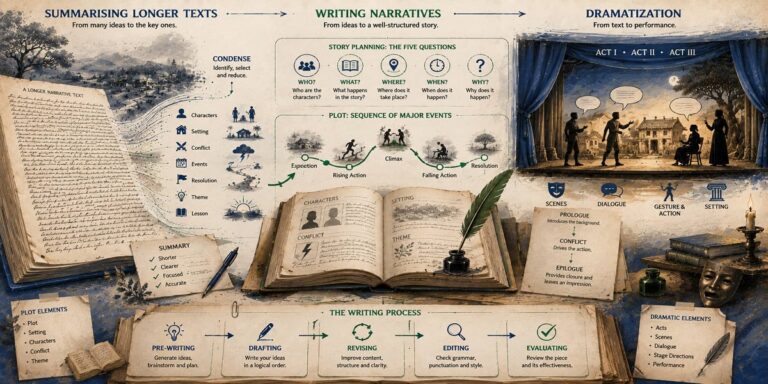
Drama: From Written Text to Performance
Drama demonstrates particularly clearly how written and oral expression can work together. A play contains dialogue and stage directions. The dialogue provides words to be spoken, while the stage directions guide aspects of performance.
When learners enact a written scene, the words on the page become spoken language and performance. The written genre is therefore closely connected with oral expression.
Poetry, Rhythm and Parody
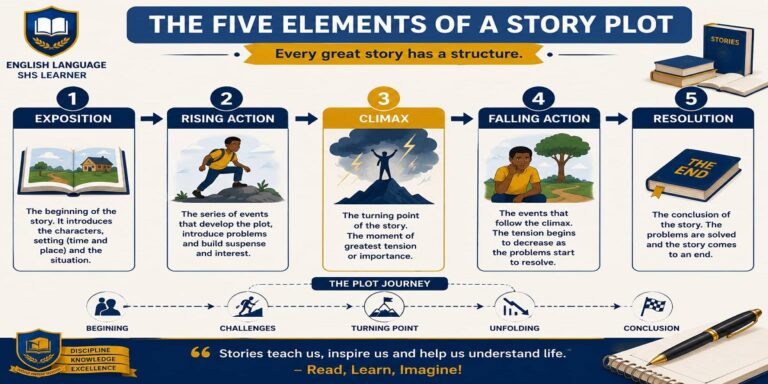
The lesson also introduces an extract from Henry Wadsworth Longfellow’s Song of Hiawatha and the parody The Modern Hiawatha. The parody uses the rhythm and rhyme of the original while changing the language to create humour.
This demonstrates that a writer can respond creatively to an existing literary form by paying attention to sound, rhythm and word choice.
Creative Challenge
Write a one-stanza poem or create a short parody. As you work, pay attention to the sound and rhythm of your words as well as the humour or effect you want to produce.
Let’s Practise
Activity 1: Identify the Genre
- A long creative narrative describing human experiences through plot, character and setting.
- A traditional oral narrative generally associated with moral lessons.
- A short, wise saying representing a general truth or advice.
- A literary form using dialogue and stage directions and designed to be performed.
- A non-fiction account of a person’s life written by another person.
Answers
- Novel
- Folktale
- Proverb
- Drama
- Biography
Activity 2: Compare and Contrast
Compare oral literature and written literature in a coherent paragraph. State at least one similarity and one difference.
Model Answer
Oral and written literature are both forms through which literary ideas and human experiences can be communicated. They may share features and even some genres, such as poetry. However, oral literature is traditionally communicated through spoken or performed forms, while written literature is presented in written texts. The two are connected because poetry can be performed orally and drama can move from written text to performance.
Activity 3: Explore Two Forms
Select one oral form and one written form. Describe their features and explain their relationship.
Model Answer
A dirge is an oral song of lamentation and grief used to praise, honour and mourn the dead. A biography is a non-fiction account of a person’s life written by another person. They differ in form, but both can communicate important experiences concerning human life. The dirge uses song and lamentation, while the biography uses written narrative.
Performance Activity
Select a suitable genre of written literature and enact it. You may add your own creative twist while maintaining the essential characteristics of the genre.
If you select a poem, consider its rhythm, sound and word choice. If you select drama, consider how dialogue and stage directions can guide the performance.
Quick Check
- What is a genre?
- Name the four broad genres identified in this lesson.
- Give three examples of oral literature.
- What is a folktale?
- What is a proverb?
- Why is drama connected to performance?
- How can poetry connect oral and written literature?
- State one similarity between a folktale and a short story.
Answers
- A genre is a type or form of literature with recognisable features.
- Drama, poetry, prose fiction and prose non-fiction.
- Any three of jokes, songs, riddles, folktales, dirges, fables, legends, myths, proverbs, sayings and anecdotes.
- A folktale is an oral narrative generally carrying moral lessons and traditionally passed from generation to generation.
- A proverb is a short, well-known, wise saying representing a general truth or piece of advice.
- Drama uses dialogue and stage directions and is designed to be performed.
- Poetry can exist as a written text and can also be performed orally through forms such as lamentations, chants and prayers.
- Both are narrative forms that can communicate experiences through storytelling.
Key Takeaways
- Literature can be expressed through different genres and through oral or written modes.
- The major genres covered are drama, poetry, prose fiction and prose non-fiction.
- Oral literature includes folktales, dirges, folk songs, proverbs, myths, legends and other forms.
- Written literature includes novels, biographies, novellas, poetry, plays, short stories, epics and science fiction.
- Oral and written literature are related because some forms and features overlap.
- Poetry can be written and performed orally.
- Drama connects written text with performance through dialogue and stage directions.
- Understanding genre relationships helps learners compare, interpret and perform literature.
Closure
Genres help us recognise how literature is formed and communicated. Oral and written literature have differences, but they also share important connections. By examining those relationships, we can understand literature more deeply and appreciate how a literary form can move between reading, speaking, listening and performance.
Access NaCCA-aligned Support Packs
Download your structured NaCCA-aligned Teacher Support Pack and Student Learning Pack, designed for clarity, practicality, and reliable teaching and learning.