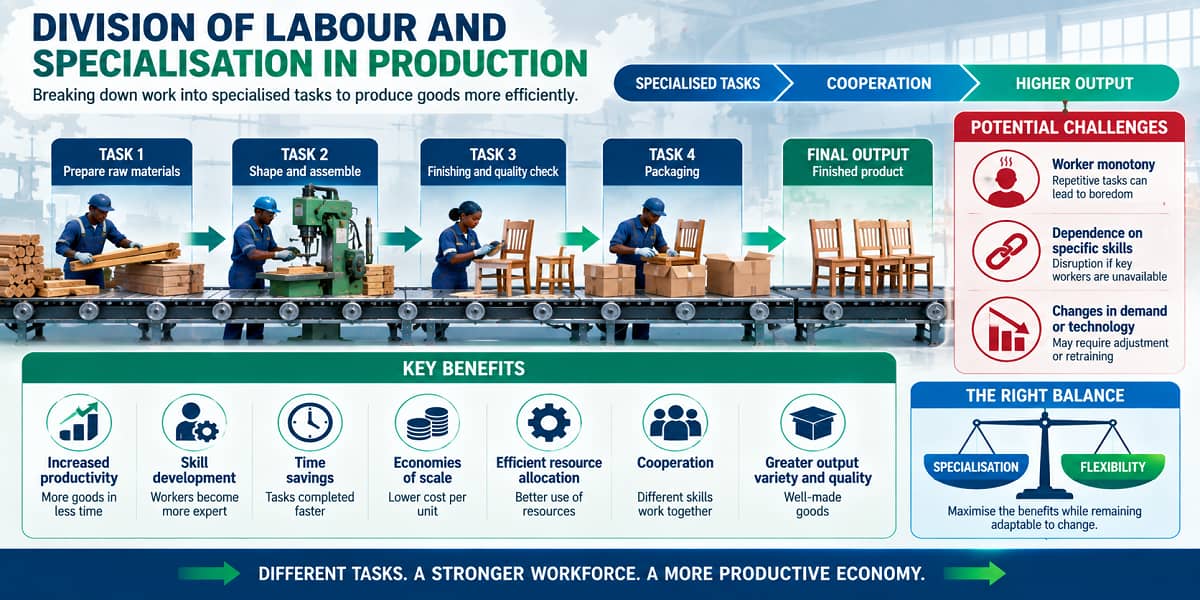
Division of Labour and Specialisation in Production
Imagine a production process in which one person performs every task from beginning to end. Now imagine the same process divided into several tasks, with different people responsible for different parts. What might happen to efficiency, skill and output?
This leads to two closely related economic concepts: division of labour and specialisation.
1. Division of Labour
Division of labour is the process of breaking down the production of goods or services into smaller tasks, with each task assigned to specific individuals or groups.
Instead of one person carrying out the entire production process, the work is separated into stages.
The basic pattern is:
Whole production process → smaller tasks → different individuals or groups perform specific tasks.
2. Specialisation
Specialisation occurs when different tasks are assigned to specific individuals or groups to improve efficiency and productivity.
A specialised worker or group concentrates on a particular task or set of tasks and develops greater ability in that area.
Therefore, the two ideas are closely connected:
| Division of Labour | Specialisation |
|---|---|
| Breaks production into smaller tasks. | Assigns particular tasks to specific individuals or groups. |
| Creates separate stages of work. | Allows workers to focus on particular tasks. |
| Creates the structure for specialised work. | Aims to improve efficiency and productivity. |
3. How the Process Works
Consider a production process involving several activities.
- The complete production process is identified.
- The process is broken into smaller tasks.
- Each task is assigned to a particular individual or group.
- Workers concentrate on their assigned tasks.
- The different tasks are coordinated to complete production.
This arrangement means that the output of one worker or department can become a necessary input for another. The workers therefore become interdependent.
4. Increased Productivity
One major benefit of division of labour and specialisation is increased productivity.
When workers focus on particular aspects of production, they can become more skilled and efficient in those areas. They may perform their tasks more quickly and accurately, contributing to higher overall output.
5. Skill Development
Repeated concentration on a particular task allows individuals to develop specialised skills and knowledge.
With time and practice, workers can develop efficiencies, innovative techniques and problem-solving abilities that can improve productivity and quality.
6. Time Savings
Division of labour can save time because workers concentrate on specific tasks rather than repeatedly moving between different activities.
Specialised workers become more adept at performing their assigned tasks, helping the production process move more efficiently.
7. Economies of Scale
Specialisation can enable businesses to achieve economies of scale by focusing on producing a limited range of goods or services and producing on a larger scale.
This makes large-scale production an important context in which specialisation can operate.
8. Efficient Resource Allocation
Different tasks require different levels of expertise, equipment and resources.
Specialisation allows resources to be assigned to tasks where they can be used appropriately, helping to maximise their utilisation.
9. Interdependence and Cooperation
Division of labour creates interdependence. Each worker or department may depend on the output of another.
This encourages:
- cooperation;
- coordination; and
- teamwork.
The production process therefore becomes a connected system rather than a collection of completely independent activities.
10. Greater Variety and Quality
Specialisation can allow businesses to diversify their production and offer a wider range of products or services.
At the same time, specialised workers can contribute to higher quality because they concentrate on perfecting particular tasks and processes.
11. The Benefits at a Glance
| Benefit | How it helps production |
|---|---|
| Increased productivity | Workers become more skilled and efficient in specific tasks. |
| Skill development | Repeated practice develops specialised knowledge and abilities. |
| Time savings | Workers spend less time changing between activities. |
| Economies of scale | Specialisation supports production on a larger scale. |
| Efficient resource allocation | Resources can be assigned according to task requirements. |
| Cooperation | Workers become interdependent and coordinate their activities. |
| Variety and quality | Specialisation can support wider production and higher-quality output. |
12. The Limitations
Division of labour and specialisation are not without problems. Excessive specialisation can create several challenges.
Worker Monotony
Repeating the same task continuously can make work monotonous for a worker.
Dependence on Specific Skills
Highly specialised production can create dependence on particular skill sets.
Disruption
Changes in demand or technology can disrupt a production system that depends heavily on specialised tasks.
For long-term success, production therefore needs an appropriate balance between specialisation and flexibility.
13. Division of Labour and Specialisation: The Relationship
Division of labour creates the separation of tasks, while specialisation enables individuals or groups to focus on particular tasks.
They therefore reinforce each other:
Division of labour → tasks are separated → workers specialise → skills and efficiency develop → production can become more productive.
14. Apply the Idea
Suppose a production process contains four major tasks. Instead of one person performing all four, four workers each concentrate on one task.
Question: What economic idea is being demonstrated?
Answer: Division of labour, because the production process has been broken into smaller tasks and each task has been assigned to a specific worker.
Question: What happens when each worker develops expertise in the assigned task?
Answer: Specialisation occurs. The workers become more skilled in their particular areas, potentially improving efficiency and productivity.
15. Check Your Understanding
1. Define division of labour.
Division of labour is the process of breaking production into smaller tasks and assigning each task to specific individuals or groups.
2. Define specialisation.
Specialisation is the assignment of different tasks to specific individuals or groups to improve efficiency and productivity.
3. State four benefits.
Increased productivity, skill development, time savings and efficient resource allocation.
4. State two more benefits.
Interdependence and cooperation, and increased output variety and quality.
5. State three limitations.
Worker monotony, dependence on specific skill sets, and possible disruption when demand or technology changes.
6. Why must production balance specialisation with flexibility?
Because while specialisation can improve efficiency and productivity, excessive dependence on specialised tasks can make production vulnerable to changes in demand or technology.
16. Real-World Application
Look at any production process and ask:
- Can the process be broken into smaller tasks?
- Who performs each task?
- Which workers become specialised?
- How does one worker’s output connect with another worker’s task?
- What benefits arise from the arrangement?
- What problems could arise if the system becomes too specialised?
These questions help you analyse division of labour and specialisation rather than simply memorising their definitions.
17. Final Synthesis
Division of labour breaks production into smaller tasks. Specialisation allows individuals or groups to focus on particular tasks.
Together, they can increase productivity, develop skills, save time, support economies of scale, improve resource allocation, encourage cooperation and increase variety and quality.
However, they may also create worker monotony, dependence on specific skills and vulnerability to changes in demand or technology.
The key is not simply to specialise, but to achieve the right balance between specialisation and flexibility.
Access NaCCA-aligned Support Packs
Download your structured NaCCA-aligned Teacher Support Pack and Student Learning Pack, designed for clarity, practicality, and reliable teaching and learning.