Location and Localisation of Industries Explained for SHS 1 Economics (Sem. 1 – Week 11)
A factory does not appear in a particular place by accident. The choice of an industrial site can affect access to resources, workers, markets, infrastructure and other conditions needed for successful operation.
At the same time, industries do not always operate in isolation. Businesses in the same or related industries may become concentrated in one geographical area. This is known as localisation of industry.
Two Ideas, One Important Difference
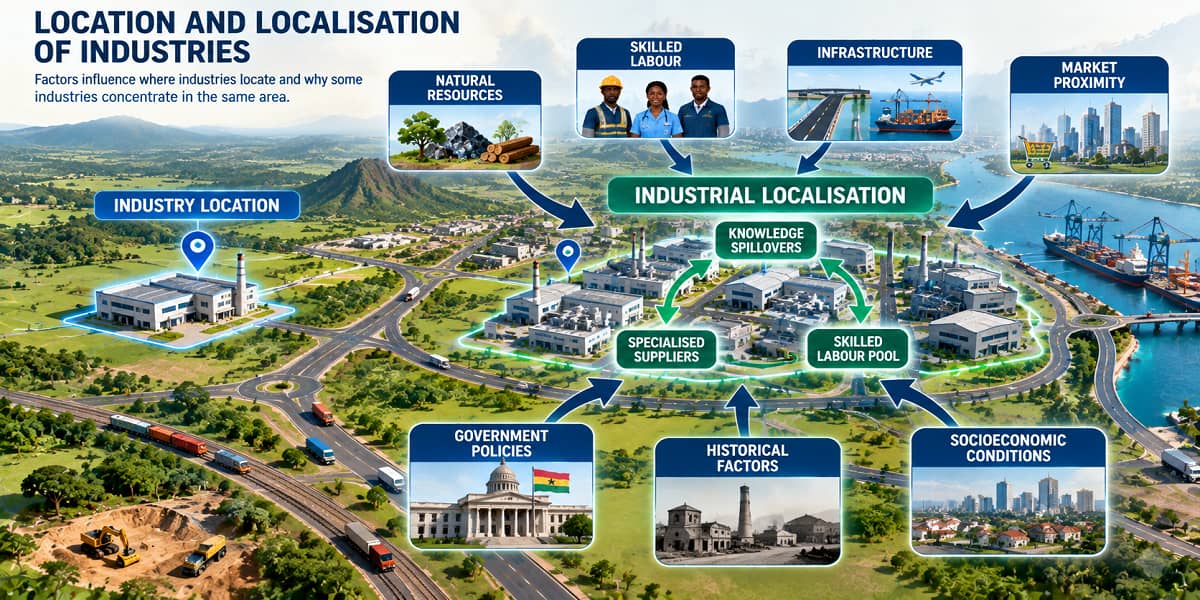
Location of industry is concerned with the physical site where an industrial or manufacturing facility is established.
Localisation of industry is concerned with the concentration of businesses in the same or related industries within a particular geographical area.
A useful way to remember the distinction is:
Location asks “Where is this industry?”
Localisation asks “Why are related industries concentrated here?”
Natural Resources Can Shape Industrial Geography
Some industries depend heavily on particular natural resources.
Mining companies, for example, may establish themselves close to mineral deposits. Power plants may locate near water sources used for hydroelectricity.
The availability and accessibility of natural resources can therefore influence industrial location.
People Matter Too
An industry needs workers, and some industries require specialised skills.
The presence of a skilled labour force can make an area attractive. Businesses may therefore consider educational institutions, training programmes and the characteristics of the available workforce.
This makes labour an important part of industrial geography.
Infrastructure Connects Industry to the Economy
Even when resources and workers are available, an industry needs ways to move materials and products.
Roads, railways, ports and airports can therefore influence industrial location.
Good infrastructure can make it easier for an industry to connect with suppliers and markets.
Markets Influence Location
An industry may choose to operate close to its target market.
Market proximity can help reduce transportation costs and improve the supply of goods.
The location decision is therefore not only about production. It is also about the relationship between production and the market.
Government Can Influence Industrial Geography
Government policies and incentives can attract industries to particular regions.
Businesses may consider tax incentives, subsidies, regulations and trade agreements when making location decisions.
This means industrial geography can be shaped not only by natural and economic conditions but also by policy.
Why Industries Cluster
One of the most interesting features of industrial geography is clustering.
Industries of the same or related types may group together because being near one another can create advantages.
| Clustering Advantage | Meaning |
|---|---|
| Knowledge spillovers | Knowledge can spread among businesses within the concentration. |
| Specialised suppliers | Industries can gain access to suppliers serving their particular needs. |
| Skilled labour pool | Businesses can benefit from a concentration of workers with relevant skills. |
These advantages are associated with agglomeration economies.
History Can Leave a Lasting Mark
Industrial concentration can sometimes be explained by the history of a region.
A legacy of industrialisation or established industrial infrastructure can influence where industries continue to locate.
This means that today’s industrial geography can partly reflect the productive development of the past.
The Socioeconomic Environment
Businesses may also consider the wider socioeconomic conditions of a region.
Factors such as cost of living, labour market dynamics and quality of life can influence how attractive an area is to industry.
Ghana: Thinking Through Tema
Tema Oil Refinery provides an example for studying the location of an industry, while the Tema Industrial Area provides an example of industrial localisation.
GHACEM Cement Production provides another example for examining industrial location.
These examples are useful because they allow us to separate two questions that are often confused: the question of where a particular industry is located and the question of why several industries become concentrated in a particular area.
Location Decisions Are Multi-Dimensional
Imagine an industry choosing between two areas.
One area has suitable infrastructure, skilled workers and good access to the target market. Another has weaker transportation networks and less access to specialised labour.
The first area may appear more attractive because several location factors work in its favour.
This illustrates an important point: industrial location is rarely determined by a single consideration. Several factors can interact.
From One Factory to an Industrial Area
There is a natural progression in the way we can think about industrial geography:
- An industry chooses a suitable location.
- Other related industries may also find the area attractive.
- Businesses begin to concentrate.
- The concentration can create advantages such as specialised suppliers, knowledge spillovers and a skilled labour pool.
- The area develops a stronger industrial identity.
This helps explain how localisation and clustering can emerge.
Why Industrial Clustering Matters
Industrial clustering can have implications for both regional and national economies.
Concentration can support access to specialised suppliers and labour, encourage knowledge spillovers and contribute to productive activity.
At the national level, industrial concentration can therefore form part of wider patterns of economic development and industrial organisation.
Think Like an Economic Geographer
When you encounter an industrial area, do not stop at identifying the businesses located there.
Ask:
- What resources are available?
- What kind of labour is present?
- How good is the infrastructure?
- How close is the market?
- What government policies may influence the area?
- Are related industries clustering together?
- What historical factors may have shaped the area?
- What socioeconomic conditions make the area attractive?
These questions turn observation into economic analysis.
Key Ideas at a Glance
| Concept | Core Idea |
|---|---|
| Location of industry | The physical site where an industrial facility is established. |
| Localisation of industry | The concentration of the same or related industries in a geographical area. |
| Clustering | Grouping of industries that can create agglomeration advantages. |
Final Takeaway
The geography of industry is shaped by a combination of forces.
Natural resources, labour, infrastructure, market proximity, government policies, clustering effects, historical factors and socioeconomic conditions can influence where industries locate and why related industries become concentrated.
The distinction remains fundamental:
Location concerns the physical site of an industry.
Localisation concerns the concentration of industries of the same or related types in an area.
Understanding this difference helps us examine industrial areas such as Tema and think more deeply about how regional industrial patterns develop.
Access NaCCA-aligned Support Packs
Download your structured NaCCA-aligned Teacher Support Pack and Student Learning Pack, designed for clarity, practicality, and reliable teaching and learning.