Location and Localisation of Industries
Why do some industries choose particular places to establish their factories? And why do several businesses in the same or related industries sometimes become concentrated in one area?
These questions lead to two related economic concepts: location of industry and localisation of industry.
1. Understanding the Two Concepts
Location refers to a specific point or area in physical space where something exists or occurs.
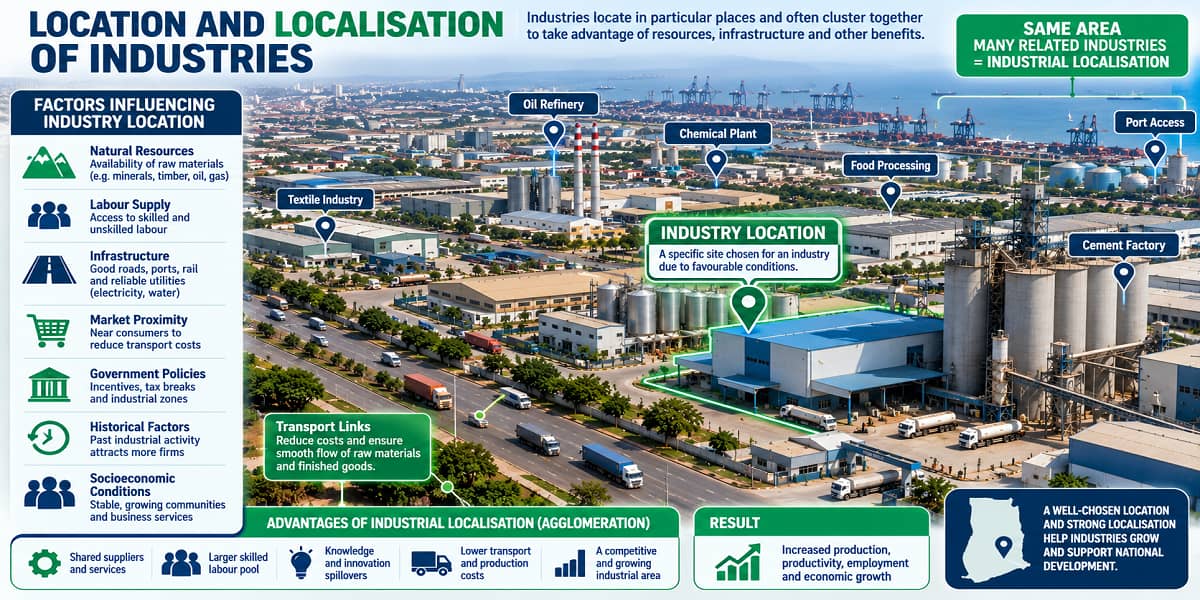
Location of industry refers to the physical site chosen for an industrial or manufacturing facility. It is concerned with where an industry is established.
Localisation of industry refers to the concentration of industries or businesses of the same or related types in a particular geographical area.
So the easiest distinction is:
Location = where an individual industry is situated.
Localisation = why industries of the same or related types become concentrated in an area.
2. Why Does Location Matter?
Choosing where to establish an industry can affect its productivity and performance.
A business therefore considers conditions that can make production and distribution more suitable in one area than another.
3. Natural Resources
Industries often locate close to natural resources needed for production.
For example, mining companies may locate near mineral deposits, while power plants may locate near water sources for hydroelectricity.
The availability of necessary natural resources can therefore influence industrial location.
4. Labour Force
The availability of a skilled or specialised labour force can attract industries to a particular area.
Businesses may consider the educational institutions, training programmes and characteristics of the available workforce when choosing a location.
5. Infrastructure
Industries need infrastructure to move inputs, workers and finished products.
Important transportation networks include:
- roads;
- railways;
- ports; and
- airports.
The quality and extent of infrastructure can therefore influence where industries choose to operate.
6. Market Proximity
Industries may locate near their target markets.
Being close to customers can reduce transportation costs and improve the supply of goods to the market.
7. Government Policies
Government policies and incentives can significantly influence industrial location.
Businesses may consider:
- tax incentives;
- subsidies;
- regulations; and
- trade agreements.
Such policies may attract industries to a region or discourage them from operating there.
8. Clustering Effects
Industries sometimes group together because concentration can create agglomeration economies.
Benefits may include:
- knowledge spillovers;
- access to specialised suppliers; and
- access to a skilled labour pool.
Once related industries become concentrated, the advantages of being near other businesses can reinforce the concentration.
9. Historical Factors
The past development of a region can influence where industries are found today.
A legacy of industrialisation or established industrial infrastructure can encourage industries to remain concentrated in a particular area.
10. Socioeconomic Factors
Industries also consider the socioeconomic conditions of an area.
Relevant factors include:
- cost of living;
- labour market conditions; and
- quality of life.
These conditions can affect the attractiveness of a region to industries.
11. Location or Localisation?
| Question | Concept |
|---|---|
| Where is a particular factory established? | Location |
| Why are related businesses concentrated in one area? | Localisation |
| What natural resources are available at the site? | Location factor |
| What advantages arise from several related industries being together? | Localisation / clustering |
12. Ghanaian Examples
Tema Oil Refinery provides an example of the location of an industry.
Tema Industrial Area illustrates the localisation of industries, where industrial activities are concentrated in the same area.
GHACEM Cement Production is another example used to examine the location of an industry.
These examples allow us to ask two different questions: where is the industry located? and what factors explain the concentration of industries in an area?
13. Apply the Factors
Suppose an industry is considering two possible sites.
Site A has good roads, access to skilled workers and proximity to its target market. Site B has poor transportation infrastructure and limited access to specialised labour.
Which site is more attractive?
Answer: Site A is likely to be more attractive because infrastructure, skilled labour and market proximity are factors that can influence industrial location.
14. Think About Industrial Clustering
Why might related industries prefer to be close to one another?
Answer: Concentration can provide advantages such as knowledge spillovers, specialised suppliers and access to a skilled labour pool.
However, the important economic question is not simply whether industries are together. It is what advantages the concentration creates.
15. Quick Review
What is location of industry?
It is the physical location or site where an industrial facility is established.
What is localisation of industry?
It is the concentration of industries or businesses of the same or related types in a particular geographical area.
Name six factors that can influence location and localisation.
Natural resources, labour force, infrastructure, market proximity, government policies and clustering effects.
Name two additional factors.
Historical factors and socioeconomic factors.
16. Final Synthesis
The location of an industry is influenced by the conditions surrounding a potential site. Natural resources, labour, infrastructure, markets, government policies, clustering effects, history and socioeconomic conditions can all matter.
Localisation occurs when industries of the same or related types become concentrated in a particular area. Such clustering can create advantages through knowledge spillovers, specialised suppliers and skilled labour.
Remember: location focuses on the site of an industry; localisation focuses on the concentration of related industries.
Access NaCCA-aligned Support Packs
Download your structured NaCCA-aligned Teacher Support Pack and Student Learning Pack, designed for clarity, practicality, and reliable teaching and learning.