Production and Productivity Explained for SHS 1 Economics (Sem. 1 – Week 10)
When we see a finished chair, dress or bottle of water, we see the result of production. Economics goes one step further: it asks how effectively the resources used to create that product were utilised.
That distinction gives us two closely related ideas: production and productivity.
Production: Creating Goods and Services
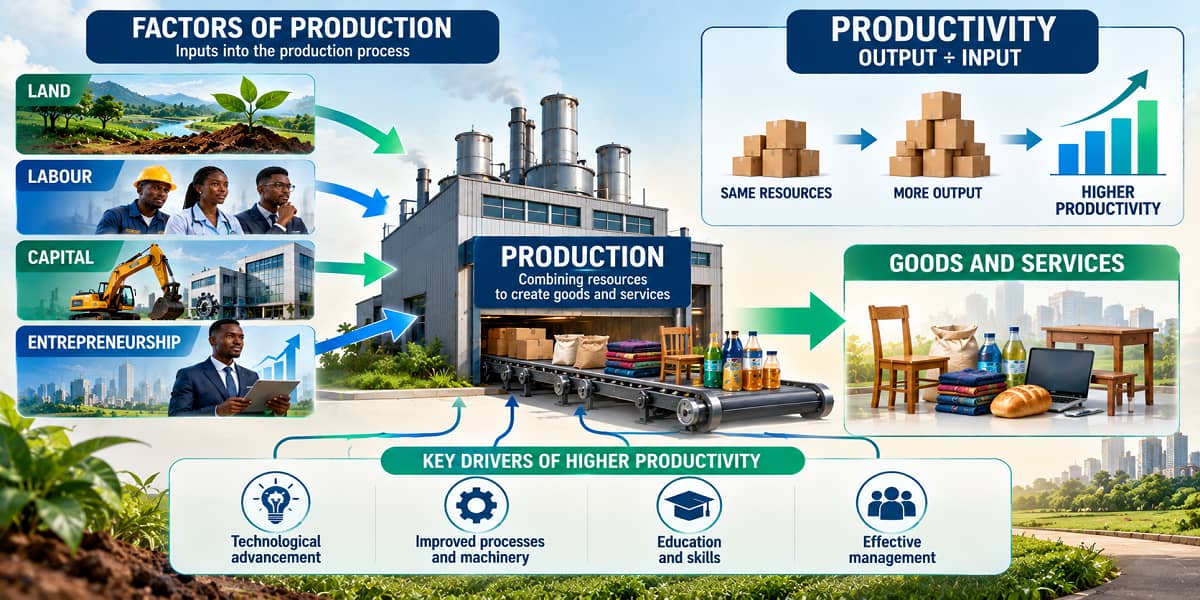
Production is the process of creating goods and services using inputs or factors of production such as land, labour, capital and entrepreneurship.
Raw materials or intermediate goods may be transformed into final products ready for consumption or use.
Making dresses, making tables and chairs, producing bottled or sachet water, and moulding blocks are examples of production.
Productivity: Looking at Efficiency
Now consider two producers that both make goods.
Simply knowing how much each produces does not tell us which one uses resources more efficiently. We need to relate the output to the inputs used.
That is what productivity does.
Productivity refers to the efficiency with which resources such as labour, capital and materials are utilised to produce goods and services.
It can be expressed simply as:
Productivity = Output ÷ Input
So productivity tells us how much output is generated per unit of input.
A Small Calculation
Suppose a production activity generates 150 units of output using 30 units of input.
Productivity = 150 ÷ 30
= 5 units of output per unit of input.
The calculation gives meaning to the idea of efficiency by connecting what was produced with the resources used.
Production Is Not the Same as Productivity
| Question | Concept |
|---|---|
| What goods or services are being created? | Production |
| How efficiently are resources being used? | Productivity |
| How much output is generated per unit of input? | Productivity |
This distinction is important because an increase in production does not automatically mean that productivity has increased.
The Same Resources, Greater Output
One of the clearest ways to recognise an improvement in productivity is to look for more output from the same amount of resources.
If a production process becomes more efficient and produces a larger quantity of goods and services without increasing the number of resources used, productivity increases.
What Can Improve Productivity?
Productivity can be influenced by several factors.
Technology
Technological advancement can improve the efficiency with which resources are used.
Processes and Machinery
Improvements in production processes and machinery can make resource use more effective.
Human Capital
Education and workers’ skills increase human capital and can contribute to higher productivity.
Management
Effective management practices can improve the organisation and utilisation of resources.
| Factor | Connection with productivity |
|---|---|
| Technological advancement | Can make resource use more efficient. |
| Improved processes and machinery | Can strengthen production efficiency. |
| Education and skills | Build human capital and support productive work. |
| Effective management | Can improve organisation and utilisation of resources. |
From a Workshop to a Factory
Production and productivity can be observed in different settings.
A carpentry workshop produces items such as chairs and tables. A tailoring shop produces dresses. A water factory produces bottled or sachet water.
In each case, production involves using resources to create output. Productivity asks us to examine how efficiently those resources are being used.
Connecting Resources to Factors of Production
When examining a productive activity, the resources can be related to the four factors of production:
- Land — natural resources.
- Labour — human effort, skills and abilities.
- Capital — man-made resources used in production.
- Entrepreneurship — organisation and combination of resources.
The next question is not merely, “What resources are present?” It is, “How efficiently are these resources being used?”
Productivity and Competitiveness
Productivity matters beyond individual producers.
High productivity is important for economic growth, competitiveness and improving the overall standard of living.
When an economy becomes more productive, it can achieve higher levels of prosperity and well-being by making more effective use of its available resources.
Try This Analysis
Imagine visiting a carpentry workshop.
Instead of merely listing what you see, analyse the activity through four questions:
- What goods are being produced?
- What inputs are being used?
- How efficiently are those inputs being converted into output?
- What factors could improve productivity?
The first two questions help identify the production process. The final two move the analysis towards productivity.
A Second Calculation
Suppose one activity produces 200 units using 40 units of input.
Productivity = 200 ÷ 40 = 5 units per unit of input.
Now suppose the same amount of input produces 240 units.
Productivity = 240 ÷ 40 = 6 units per unit of input.
Productivity has increased from 5 to 6 units per unit of input because greater output is being generated from the same input.
Think Beyond “More Output”
It is tempting to assume that producing more always means becoming more productive.
But productivity requires us to consider the resources used.
A producer that increases output while also using proportionately more resources may not necessarily have improved productivity. The key question is the relationship between output and input.
Final Takeaway
Production is about creating goods and services. Productivity is about the efficiency with which the resources used in that production process generate output.
Technological advancement, better processes and machinery, education and skills, and effective management can influence productivity.
Higher productivity is important because it can contribute to economic growth, competitiveness, prosperity and improved standards of living.
Production tells us what is produced. Productivity tells us how efficiently it is produced.
Access NaCCA-aligned Support Packs
Download your structured NaCCA-aligned Teacher Support Pack and Student Learning Pack, designed for clarity, practicality, and reliable teaching and learning.