The Concept of Utility Explained for SHS 1 Economics (Sem. 1 – Week 6)
Why can a simple glass of water become extremely valuable to someone who is thirsty, while another person may feel little need for it?
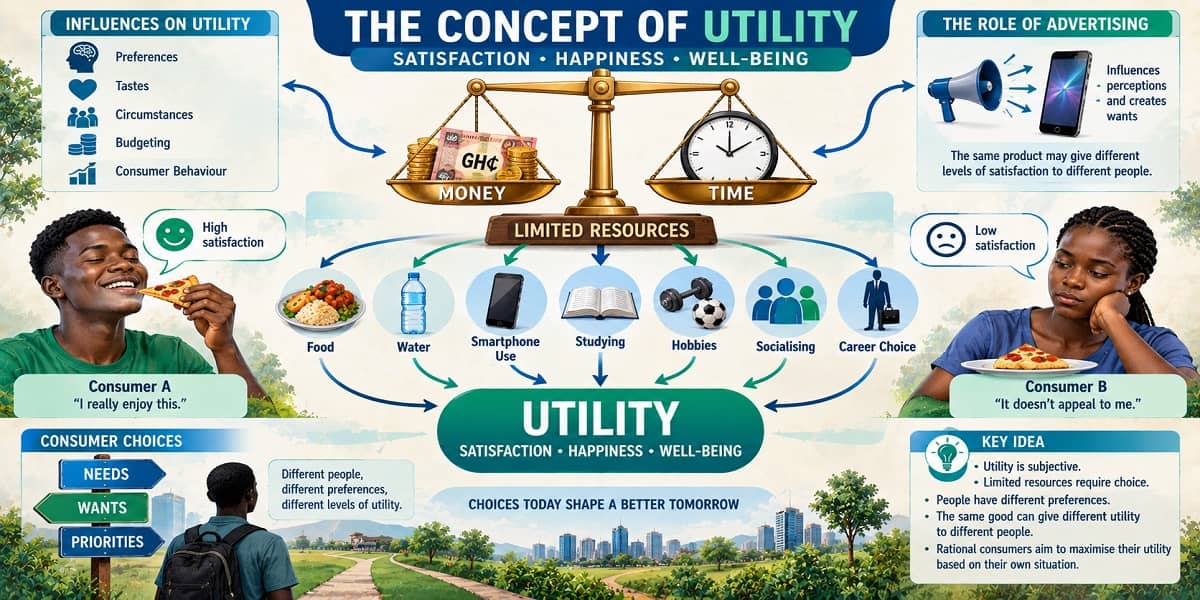
The answer takes us into the economic idea of utility: the satisfaction, happiness or well-being people derive from consuming goods and services.
Utility Is About the Consumer’s Experience
Economics is not concerned only with what people buy. It also asks why they choose particular goods and services.
Utility helps explain this behaviour by focusing on the satisfaction a consumer receives.
Imagine two people consuming the same product. Their experiences may not be identical. One may obtain considerable satisfaction, while the other may obtain much less.
That difference exists because utility is subjective.
Why the Same Product Can Mean Different Things
People have different:
- preferences;
- tastes; and
- circumstances.
These differences affect the satisfaction they derive from goods and services.
So, when two consumers make different choices, it does not necessarily mean that one understands the market better. They may simply attach different levels of utility to the available alternatives.
Utility and Limited Resources
Consumers do not have unlimited money or time.
Because these resources are limited, choices have to be made.
Utility provides a useful way to think about those choices: Which option is likely to provide greater satisfaction?
This question can influence spending, time allocation and other everyday decisions.
Utility Can Improve Budgeting Decisions
Suppose you have limited money and several possible purchases.
Instead of considering price alone, you can consider the satisfaction you expect from each purchase.
The idea of utility encourages consumers to allocate money towards goods or experiences that provide higher utility per Ghana Cedi spent.
The central idea is not simply to buy the cheapest product or spend the most money. It is to make thoughtful choices with limited resources.
Utility Is Not Limited to Shopping
Time is another valuable resource.
A learner may have to divide available time among:
- studying;
- extracurricular activities;
- hobbies; and
- socialising.
Each activity may provide a different level of satisfaction. Thinking about utility can help the learner decide how to allocate time in a way that supports overall well-being.
Career Choices Can Also Involve Utility
Career decisions are another area in which expected satisfaction can matter.
When considering different career paths, an individual may think about the utility expected from each one.
This places career choice within the wider economic problem of making decisions with limited resources and competing alternatives.
Utility and Consumer Behaviour
Utility helps explain why consumers behave differently.
Suppose two consumers see the same product. One may consider it highly valuable, while the other may not be interested.
Their different responses can be understood partly through their different preferences, tastes and circumstances.
Utility therefore gives Economics a way to connect personal satisfaction with consumer choice.
What About Advertising?
Marketing and advertising often try to influence how consumers perceive products.
Understanding utility encourages consumers to examine those messages critically.
A useful consumer might ask:
- What satisfaction is the product promising?
- Is that satisfaction genuinely important to me?
- Would another choice give me greater satisfaction?
These questions can help separate a genuine preference from a perception created by marketing.
A Glass of Water Explains the Idea
Consider a person who is thirsty.
Drinking water may provide a strong feeling of satisfaction because it addresses the person’s immediate need.
That satisfaction represents utility.
The example also demonstrates why utility is subjective. The value of the experience depends on the individual’s circumstances.
The Smartphone Question
What satisfaction can a consumer derive from using a smartphone?
There is no single answer for everyone.
The level of utility depends on the individual’s preferences, tastes and circumstances. The same smartphone can therefore provide different levels of satisfaction to different consumers.
Utility in Everyday Decisions
| Decision | Utility Perspective |
|---|---|
| Purchase | How much satisfaction is expected? |
| Budget | Which use of money provides greater utility per Ghana Cedi spent? |
| Time | Which activity contributes more to overall well-being? |
| Career | Which path may provide greater expected satisfaction? |
A Simple Consumer Test
Before making a choice, ask three questions:
- What do I want?
- How much satisfaction will this choice provide?
- How should I use my limited money or time?
The questions connect personal decision-making with the economic concept of utility.
Utility and Well-Being
The concept extends beyond individual purchases.
People also make choices about experiences and activities. Studying, participating in extracurricular activities, pursuing hobbies and socialising can all provide different forms of satisfaction.
Thinking about utility helps individuals consider how their choices contribute to their overall well-being.
Why Utility Matters in Economics
Consumer behaviour is not random. People make choices based on what they value, their circumstances and the resources available to them.
Utility provides a framework for understanding the satisfaction behind those choices.
It also helps explain why demand for goods and services can differ among consumers.
Think About Your Own Choices
Identify two things from which you derive satisfaction.
Now ask:
- Why do they satisfy you?
- Would another person necessarily feel the same way?
- How do your available money and time affect your choices?
Model explanation: The satisfaction obtained from consuming a good or participating in an activity represents utility. Another person may experience a different level of satisfaction because utility is subjective and influenced by preferences, tastes and circumstances.
Final Takeaway
Utility is the satisfaction, happiness or well-being derived from consuming a good or service.
Its importance lies in what it tells us about consumer choice. People have limited money and time, yet they face many possible uses for those resources. They therefore have to decide which choices are likely to provide the greatest satisfaction.
Because utility is subjective, consumers can respond differently to the same product. Understanding this helps us interpret purchasing decisions, budgeting, time management, career choices and responses to marketing.
Utility puts the consumer’s experience at the centre of understanding economic choice.
Access NaCCA-aligned Support Packs
Download your structured NaCCA-aligned Teacher Support Pack and Student Learning Pack, designed for clarity, practicality, and reliable teaching and learning.