Accounts of the Origin of the Akan and Major Ethnic Groups in the Coastal Zone
Let’s Begin with a Historical Question
When a people explain where they came from, they are not simply describing a journey. Their accounts can also express identity, memory and how they understand their place in society.
For the Akan, Ga-Adangbe and Ewe, different accounts explain their origins and migrations. These accounts do not always agree. A historian therefore needs to compare accounts, examine the kinds of evidence behind them and recognise possible differences in perspective.
1. Accounts of the Origin of the Akan
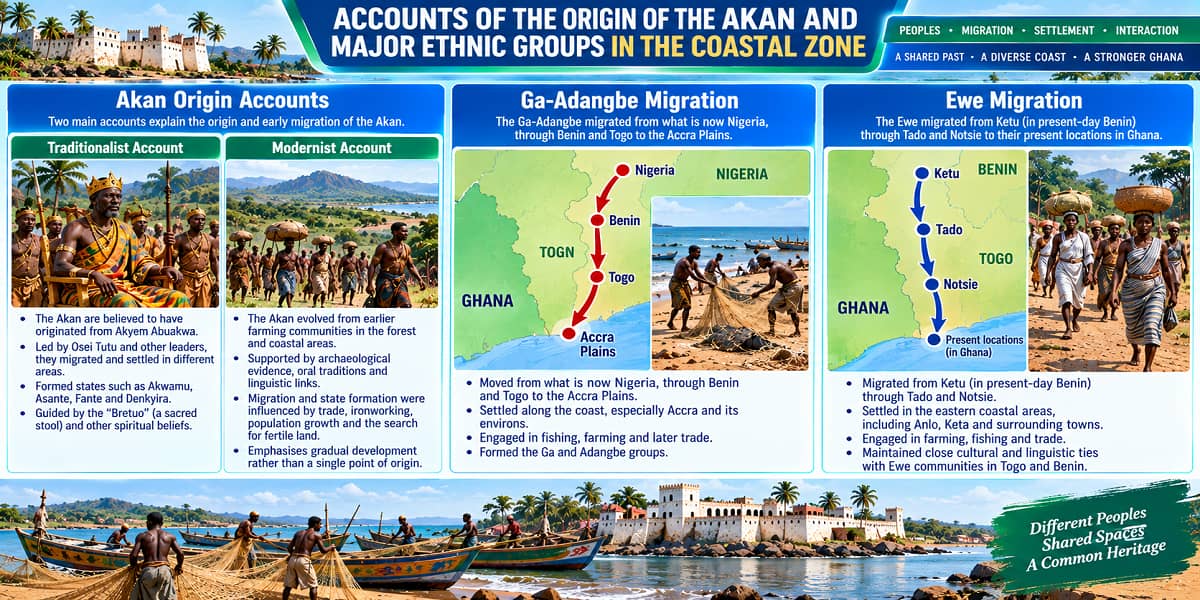
There is no single account that sufficiently explains exactly where the Akan originated. Two major schools of thought presented in this topic are the traditionalist account and the modernist account.
| Account | Main migration narrative |
|---|---|
| Modernist account | The Akan first lived in Yorubaland in modern Nigeria. They crossed the Mono and Volta Rivers and entered the Afram Plains. They later travelled northwards before turning southwards to settle in the Pra-Offin basin. From there, different Akan groups migrated to their present locations. |
| Traditionalist account | The Akan first lived in Ethiopia. They later moved to Egypt and then settled in the Ancient Ghana Empire of Western Sudan. From Ancient Ghana, they migrated into their present-day locations in Ghana. |
The traditionalist account was led by J. B. Danquah and Eva Meyerowitz, while the modernist theory was led by historians Prof. Albert Adu Boahen and Harry Johnston.
Think Like a Historian
Neither account should simply be accepted because it is presented as a story of origin. Historical investigation asks: Where did the account come from? What evidence supports it? What are its strengths and limitations? Are there contradictions or variations?
2. Akan Origins and Multiple Perspectives
Different Akan subgroups may have their own migration traditions. Examples identified for further investigation include the Akwamu, Fante, Denkyira, Asante and Akyem.
This means that an account of Akan origins can be studied at more than one level: the broader Akan story and the particular traditions of individual Akan groups.
Five Useful Historical Skills
- Source analysis: examine oral traditions, linguistic evidence and archaeological data for their strengths and limitations.
- Evaluating bias: consider how cultural context can influence an account or interpretation.
- Reconciling conflicting narratives: compare different stories and consider why inconsistencies may exist.
- Considering multiple perspectives: recognise that different Akan subgroups may preserve different origin narratives.
- Building a tentative timeline: arrange available evidence into a possible sequence while recognising uncertainties and gaps.
3. Accounts of Major Ethnic Groups in the Coastal Zone
The coastal-zone focus in this lesson is on the Ga-Adangbe and Ewe. Their migration accounts contain routes, settlements and group relationships that can be compared historically.
The Ga-Adangbe
The Ga and Adangbe were originally one group but later became divided into two groups: the Ga and the Adangbe (Dangme).
| Ga | Adangbe (Dangme) |
|---|---|
| Osu, La, Ga Mashi, Teshie, Nungua and Tema | Ada, Krobo, Osudoko, Shai, Gbugla (Prampram), Kpone and Ningo |
The migration account presented here states that the Ga-Adangbe claim to have migrated from what is now Nigeria. They made a number of stops in present-day Benin and the Republic of Togo before eventually settling throughout the Accra Plains in southern Ghana.
The Ewe
The Ewe can mainly be found in the Volta Region of present-day Ghana, south-east of the Volta River. They can also be found in the Republic of Togo.
The migration account gives the following sequence:
- Ketu — the Ewe originated from Ketu.
- Tado — they made a stop at Tado.
- Notsie — they moved to Notsie.
- Present locations — they eventually settled in different groups in their present locations.
4. Compare the Migration Accounts
A useful historical comparison does not ask only, “Which story is correct?” It also asks what each account says, how the accounts differ, and what evidence or perspectives may have shaped them.
| Focus | Akan | Ga-Adangbe | Ewe |
|---|---|---|---|
| Migration account | Two major accounts give different routes of origin. | Migration from what is now Nigeria, with stops in Benin and Togo, followed by settlement in the Accra Plains. | Migration from Ketu through Tado and Notsie before settlement in different groups. |
| Historical challenge | Different accounts and variations require comparison and evaluation. | Different perspectives and possible variations require investigation. | Different variations require investigation and comparison. |
| Useful evidence | Oral traditions, linguistic evidence and archaeological data. | Oral traditions, linguistic evidence and archaeological data. | Oral traditions, linguistic evidence and archaeological data. |
5. Work Through a Historical Investigation
Question: How should you approach two conflicting accounts of origin?
- Identify what each account claims.
- Identify the route, places, people and major events mentioned.
- Ask where each account comes from.
- Compare similarities and differences.
- Consider strengths and limitations of the evidence.
- Look for possible bias and cultural context.
- Recognise uncertainties rather than presenting an uncertain conclusion as a fact.
Example: Comparing the Two Akan Accounts
Similarity: Both accounts attempt to explain the movement of the Akan from an earlier place of settlement to their present locations.
Difference: The modernist account begins in Yorubaland in modern Nigeria and describes movement through the Mono and Volta Rivers, Afram Plains and Pra-Offin basin. The traditionalist account begins in Ethiopia, continues through Egypt and the Ancient Ghana Empire of Western Sudan, and then describes migration into present-day Ghana.
Historical conclusion: The accounts provide different narratives, so they should be compared critically rather than treated as identical explanations.
6. Your Turn
Activity 1: Route Reconstruction
Write the sequence of places in the Ewe migration account.
Answer: Ketu → Tado → Notsie → different present locations.
Activity 2: Identify the Relationship
How are the Ga and Adangbe related according to the account presented?
Answer: The Ga and Adangbe were originally one group but later became divided into the two groups.
Activity 3: Compare
Give one similarity and one difference between the traditionalist and modernist Akan accounts.
Answer: Similarity: both explain the movement of the Akan from an earlier place of settlement into their present locations. Difference: the modernist account traces the Akan to Yorubaland in modern Nigeria, while the traditionalist account traces them through Ethiopia, Egypt and the Ancient Ghana Empire of Western Sudan.
7. Look Beyond One Story
Historical knowledge becomes stronger when different perspectives are examined. The accounts of the Akan, Ga-Adangbe and Ewe may have variations, and learners should investigate these perspectives rather than assuming that every account gives exactly the same narrative.
Useful investigations include the migration of an Akan subgroup, the relationship among Denkyira, Akwamu, Akyem, Bono and Asante, the role of a female leader in the Ga-Adangbe migration account, and possible shared or divergent elements between Ewe and Ga-Adangbe origin stories.
8. Bring the Ideas Together
The central lesson is that migration accounts are historical narratives that must be examined critically. The Akan have different major accounts of origin, while the Ga-Adangbe and Ewe have their own migration traditions. Comparing these narratives involves identifying routes and settlements, examining evidence, recognising perspectives and evaluating differences.
Remember: A good historical explanation does not ignore disagreement. It identifies the different accounts, compares them carefully and acknowledges uncertainties and gaps in the available evidence.
9. Closing Challenge
In a short paragraph, explain how the traditionalist and modernist accounts of the origin of the Akan are similar and different.
Model answer: Both accounts attempt to explain the origins and movement of the Akan into their present locations. However, they give different starting points and migration routes. The modernist account begins in Yorubaland in modern Nigeria and describes movement through the Mono and Volta Rivers, Afram Plains and Pra-Offin basin. The traditionalist account begins in Ethiopia, then moves through Egypt and the Ancient Ghana Empire of Western Sudan before migration into present-day Ghana.
Access NaCCA-aligned Support Packs
Download your structured NaCCA-aligned Teacher Support Pack and Student Learning Pack, designed for clarity, practicality, and reliable teaching and learning.