
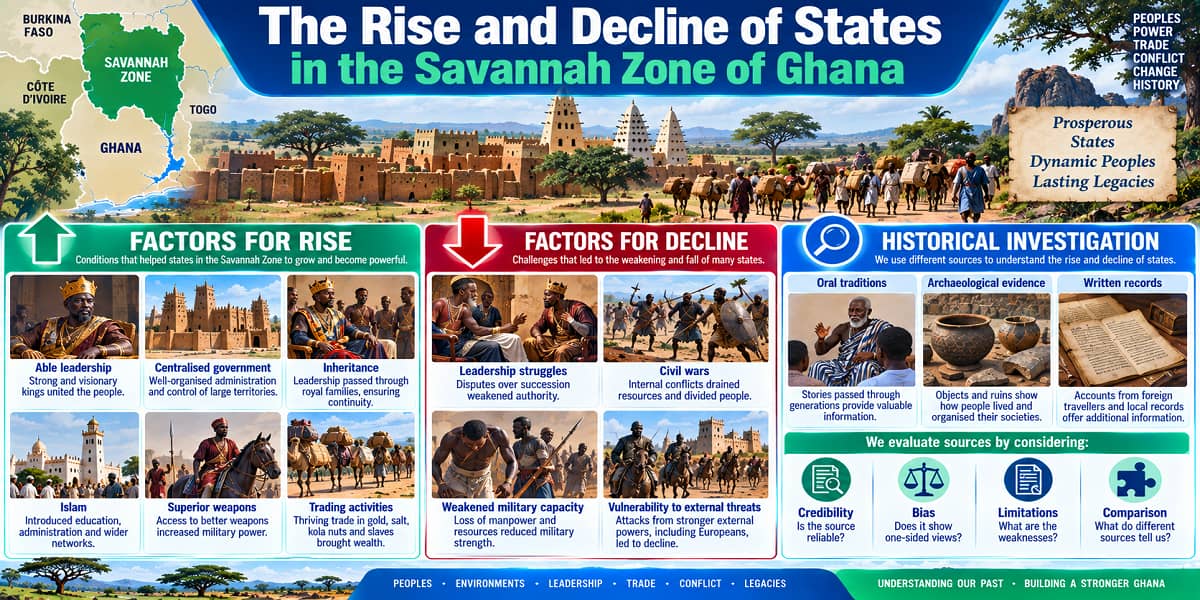
The Rise and Decline of States in the Savannah Zone of Ghana
Start with the Big Question
How does a society develop into a powerful state, and why might that state later weaken or change?
To answer this, we need to look at several connected factors. In the Savannah Zone of Ghana, the rise of states was associated with leadership, government, inheritance, Islam, weapons and trade. Understanding these factors requires more than memorising a list: we need to consider how they interacted and how their importance could differ from one state to another.
1. Factors Behind the Rise of States
| Factor | What it contributed to state development |
|---|---|
| Able leadership | Effective leaders could organise people and support the development and expansion of states. |
| Centralised government | A centralised system of government provided an organised political authority. |
| Inheritance system | The system of inheritance practised influenced political succession and continuity. |
| Introduction of Islam | Islam formed part of the religious and wider developments associated with Savannah states. |
| Superior weapons | Access to superior weapons could strengthen the military capacity of states. |
| Trading activities | Trade contributed to the economic development and power of states. |
Put the Factors Together
These factors did not necessarily operate independently. Leadership could support political organisation. Political organisation could help a state manage its resources and activities. Trade could contribute to economic strength, while military capability could support expansion.
The important historical question is therefore not simply “What were the factors?” but “How did the factors interact?”
2. Which Factor Was Most Important?
It is tempting to choose one factor immediately, but historical significance requires careful judgement. All six factors may have contributed, yet their importance could vary according to the circumstances of a particular state.
For example, a learner might argue that able leadership was highly significant because effective leaders could help organise government and direct the activities of a state. Another learner might argue that trade was more significant because economic activity could strengthen a state’s power.
A strong historical answer must do more than state an opinion. It should explain why the selected factor was important and compare it with other factors.
3. Why Do States Decline?
Understanding decline requires the same careful approach used to understand rise. States may face internal problems that weaken their political unity and military capacity.
One important case for investigation is the Mole-Dagbani kingdom. Internal conflicts could include leadership struggles and civil wars. Such conflicts could weaken the kingdom’s ability to defend itself and increase its vulnerability to external threats.
The relationship can be represented simply as:
Leadership struggles / civil wars → weakened political and military strength → greater vulnerability to external threats
4. Think About Rise and Decline Together
| Rise | Decline |
|---|---|
| Able leadership | Leadership struggles |
| Centralised government | Internal conflict can weaken political unity |
| Effective inheritance system | Conflict can disrupt political continuity |
| Introduction of Islam | Internal weaknesses can make a state vulnerable |
| Superior weapons | Weakened military capacity |
| Trading activities | External threats may become more difficult to resist |
The table is a way of organising historical thinking. It does not mean that every rise factor has one direct opposite responsible for decline. Rather, it helps us compare the conditions that can strengthen a state with internal weaknesses that can undermine it.
5. The Environment and State Formation
The Savannah Zone’s environment should also be considered when investigating state formation. Questions about resource availability, climate change, agriculture and food production can help us explore how environmental conditions influenced the development of complex societies.
Trade and settlement patterns also need to be considered because states developed within particular geographical and economic settings.
6. How Do We Know?
Historical explanations depend on evidence. Different kinds of sources can contribute to our understanding of the rise and decline of states in the Savannah Zone.
- Oral traditions preserve accounts and memories about the past.
- Archaeological evidence can provide material evidence of past societies.
- Written records provide another form of historical evidence.
Each source should be examined critically. Ask about its credibility, bias and limitations. A historian should not treat every account as equally reliable simply because it exists.
7. See History from Different Perspectives
People living within a state may not have experienced its rise in the same way. A ruler might emphasise leadership and political organisation. A warrior might attach greater importance to military strength and weapons. A trader might emphasise trade, while an ordinary person might focus on how political changes affected everyday life.
Considering these perspectives makes historical interpretation richer and helps us avoid a single, oversimplified explanation.
8. Learning Activity
Activity A: Identify
Name at least two factors responsible for the rise of states in the Savannah Zone.
Answer: Any two of able leadership, centralised government, inheritance system, introduction of Islam, superior weapons and trading activities.
Activity B: Explain
Explain how internal conflicts could contribute to the decline of a state.
Answer: Leadership struggles and civil wars could weaken political unity and military strength, making the state more vulnerable to external threats.
Activity C: Judge Significance
Which factor do you think was most significant in the rise of states in the Savannah Zone? Give a reason.
Model answer: Able leadership can be considered highly significant because effective leaders could organise people and contribute to the establishment of centralised government. However, other factors such as trade, weapons and Islam also contributed, so the judgement should recognise that state formation involved several connected factors.
Activity D: Compare
Draw a Venn diagram or chart comparing factors associated with the rise and decline of states in the Savannah Zone.
Model response: The rise side can include able leadership, centralised government, inheritance, Islam, superior weapons and trade. The decline side can include leadership struggles, civil wars, weakened military strength and vulnerability to external threats. The connecting section can show that political organisation and leadership affect both the strength and weakness of a state.
9. Extend Your Thinking
Imagine you are investigating the rise of a Savannah state. Begin with the question “What made this state powerful?” Then ask:
- Who provided leadership?
- How was government organised?
- How did inheritance affect succession?
- What role did Islam play?
- What military advantages existed?
- How did trading activities contribute?
- Which factor appears most significant?
- What evidence supports your judgement?
10. Final Synthesis
The rise of states in the Savannah Zone was associated with able leadership, centralised government, inheritance systems, Islam, superior weapons and trading activities. Their development should be understood as the result of interacting factors rather than a single cause.
Decline can likewise be connected to internal weaknesses. In the Mole-Dagbani case, leadership struggles and civil wars could weaken military capacity and increase vulnerability to external threats.
Remember: Good historical analysis identifies causes, connects them, evaluates their significance, considers different perspectives and examines the evidence behind historical claims.
Access NaCCA-aligned Support Packs
Download your structured NaCCA-aligned Teacher Support Pack and Student Learning Pack, designed for clarity, practicality, and reliable teaching and learning.