The Rise and Decline of States in the Savannah Zone of Ghana Explained for SHS 1 History (Sem. 1 – Week 8)
States do not emerge simply because people occupy a particular territory. Political authority develops through relationships among leadership, institutions, economic activity, belief systems, military capacity and the wider environment. The history of Ghana’s Savannah Zone offers an opportunity to examine these connections.
Six Forces Behind State Formation
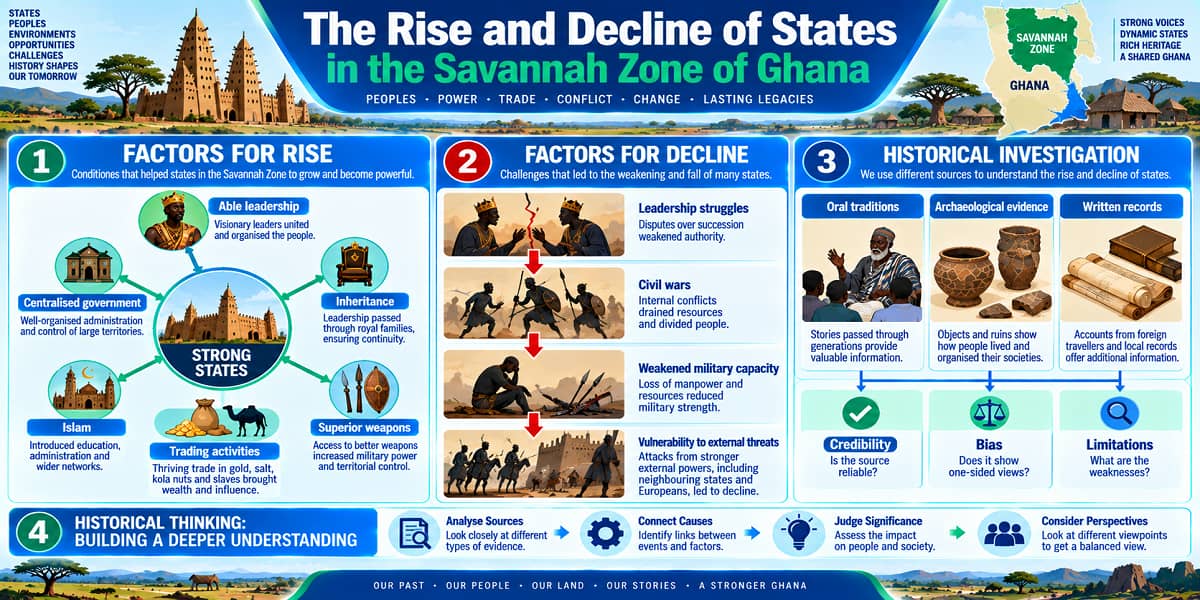
The material identifies six factors associated with the rise of states in the Savannah Zone: able leadership, centralised government, inheritance systems, the introduction of Islam, superior weapons and trading activities.
| Factor | Historical significance to investigate |
|---|---|
| Leadership | Consider how effective leaders could organise people and support political development. |
| Government | Consider how centralised authority could strengthen political organisation. |
| Inheritance | Consider how succession systems could influence continuity of political authority. |
| Islam | Consider its place within the development of Savannah states and their activities. |
| Weapons | Consider how superior weapons could strengthen military capacity. |
| Trade | Consider how trading activities could contribute to the development of state power. |
The significance of these factors lies partly in their interaction. A state with able leadership might develop stronger political organisation. Trade could support economic power, while military advantages could support expansion. The exact importance of each factor, however, depends on the historical circumstances being examined.
The Environment Behind the Politics
State formation also needs to be situated within its physical and economic setting. Questions about resource availability, climate change, agriculture and food production can help explain how larger and more complex societies developed.
Geography does not operate separately from human decisions. People use available resources, develop economic activities and organise political systems within particular environments.
Why States Decline
Understanding decline requires attention to internal as well as external pressures. The Mole-Dagbani kingdom provides an important case for investigating leadership struggles and civil wars.
Internal conflict can produce a chain of consequences:
Political struggle → weakened unity → weakened military capacity → increased vulnerability to external threats.
This illustrates an important historical principle: a state can possess considerable strength yet become vulnerable when internal divisions undermine its ability to act collectively.
History Is Not a Single Viewpoint
Imagine four people living in the same state: a ruler, a warrior, a trader and an ordinary member of the community. They might explain the state’s success differently.
| Perspective | Possible emphasis |
|---|---|
| Ruler | Leadership and political organisation |
| Warrior | Weapons and military strength |
| Trader | Trading activities and economic opportunity |
| Ordinary person | The effects of political and social changes on everyday life |
This does not mean that each person would necessarily hold exactly these views. Rather, it demonstrates why historians need to consider different perspectives when interpreting the past.
Evidence Matters
Historical investigations can draw upon oral traditions, archaeological evidence and written records. Each can contribute useful information, but each must be examined critically.
Three questions are especially important:
- Credibility: How trustworthy is the evidence for the claim being made?
- Bias: Could the perspective or context of the source influence what it says?
- Limitations: What does the evidence fail to tell us?
Source analysis therefore prevents historical explanation from becoming simple storytelling. It encourages learners to distinguish between an assertion and an argument supported by evidence.
Was Leadership the Most Important Factor?
There is room for historical judgement here. A learner might place able leadership at the top because leadership can influence political organisation and collective action. Another learner might place trade first because economic activity can contribute to state development.
Neither position becomes a strong historical argument merely by being stated. The stronger response explains the reasoning, compares the chosen factor with alternatives and uses relevant evidence.
From Rise to Decline
The same state can experience different conditions at different points in its history. Political organisation, economic activity and military strength can contribute to growth, while internal divisions can weaken those advantages.
This is why the rise and decline of states should be studied together. They are connected parts of a changing historical process rather than two completely separate stories.
A Historical Investigation Framework
When examining a Savannah state, a useful framework is:
Context → Factors → Interaction → Consequences → Evidence → Historical judgement
First establish the context. Then identify the relevant factors. Examine how they interacted, consider their consequences, test the explanation against evidence and finally make a reasoned judgement about significance.
Why This History Still Matters
Studying state formation offers a broader way to think about power and organisation. Political authority depends on people, institutions, resources and decisions. Leadership matters, but it operates within systems. Military strength matters, but internal conflict can undermine it. Trade creates opportunities, but economic activity exists within geographical and political conditions.
These relationships make the study of the Savannah Zone more than a list of historical factors. It becomes an investigation into how societies build power, maintain it and sometimes lose it.
Key Takeaway
The rise of states in Ghana’s Savannah Zone involved a combination of leadership, political organisation, inheritance, Islam, weapons and trade. Their decline must also be examined through internal conflicts and external pressures. By analysing evidence, comparing perspectives and evaluating significance, learners can move from simply remembering historical information to constructing stronger historical explanations.
Access NaCCA-aligned Support Packs
Download your structured NaCCA-aligned Teacher Support Pack and Student Learning Pack, designed for clarity, practicality, and reliable teaching and learning.