Family Structure, Kinship and Inheritance System, Naming Ceremonies and Puberty Rites in Pre-colonial Ghana
Think About What Makes a Community
Imagine a society in which family relationships are much wider than parents and children living in one household. Imagine, too, that a person’s name marks their entry into a community and that a later ceremony marks the movement from childhood into adulthood.
These ideas help us understand important parts of the socio-cultural life of pre-colonial Ghanaian societies. This lesson focuses on family and kinship, naming ceremonies and puberty rites.
1. Family Was at the Centre of Social Life
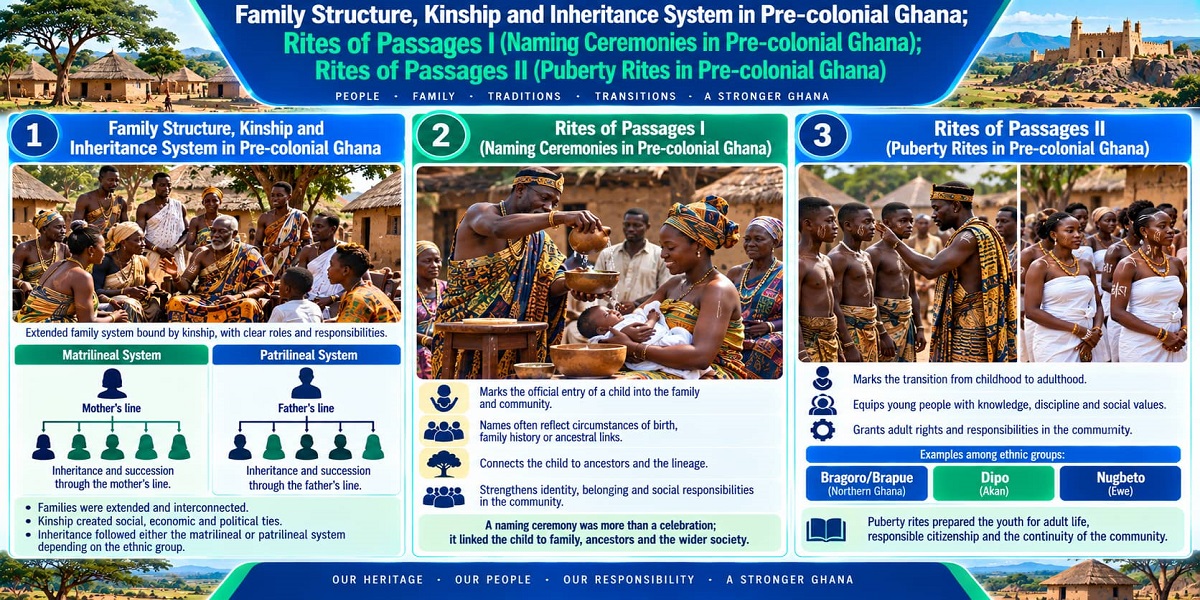
In pre-colonial Ghana, the family was considered the centre of social life. Family extended beyond conjugal members. A lineage or extended family was a much wider network of relationships in which members shared a common ancestor, either male or female.
The two major systems identified are matrilineal and patrilineal.
| System | Basis of Relationship | Groups Identified in the Lesson |
|---|---|---|
| Matrilineal | Family relationships are traced through the maternal relations. | Akan |
| Patrilineal | Family relationships are traced through the paternal relations. | Guan, Ewe, Ga-Adangbe, Mole-Dagbani and Gonja |
Family structures varied among different ethnic groups. This means that the organisation of family and inheritance cannot be understood as exactly the same throughout pre-colonial Ghana.
Matrilineal and Patrilineal: The Key Difference
In a matrilineal system, membership of the family lineage is associated with the mother’s side. In a patrilineal system, it is associated with the father’s side.
Understanding this distinction is important because kinship and inheritance are connected to the way a society defines family relationships.
2. Why Did Family Structure Matter?
Family was not simply a private arrangement. It had socio-cultural and spiritual significance. The wider lineage connected individuals to a common ancestor and to the community around them.
The historical study of family therefore requires attention to kinship, inheritance, cultural values, beliefs and communalism.
Historians can use sources such as proverbs, folktales and lineage histories to reconstruct aspects of family life. Because such evidence may be incomplete, it should be examined carefully and placed within its cultural context.
3. Naming: Welcoming a Child into the Community
A naming ceremony in pre-colonial Ghana was an important cultural tradition marking the birth and entry of a child into the community.
It celebrated new life while also connecting the child to ancestral roots and community identity.
Naming ceremonies varied among ethnic groups, including the Akan, Mole-Dagbani, Ewe, Ga-Adangbe, Guan and Gonja. Each group had its own customs and rituals.
What Can a Name Mean?
The lesson encourages us to investigate whether names had special meanings or reflected ideas about a child’s future. A name could therefore be studied as part of a person’s identity and as evidence of the values and beliefs of a community.
Historical investigation can ask:
- What type of name was given?
- What meaning did the name have?
- What role did family members play?
- Was there a special person who officiated?
- How did the ceremony reflect community values and beliefs?
- How did naming practices vary among ethnic groups?
4. Naming Ceremony as a Rite of Passage
A rite of passage marks an important transition in a person’s life. Naming ceremonies can be understood in relation to the transition into community membership, while puberty rites mark another major stage: the transition from childhood to adulthood.
This gives us a useful sequence:
Birth → Naming and entry into community → Childhood → Puberty rite → Adulthood
The exact customs and meanings could vary among different societies, so historical comparison is important.
5. Puberty Rites: Moving Towards Adulthood
Puberty rites were significant cultural practices marking the transition from childhood to adulthood.
They were performed to initiate young people into adult society and to bestow upon them the rights and responsibilities associated with adulthood.
| Ethnic Group | Name of Puberty Rite Identified |
|---|---|
| Akan | Bragoro or Brapue |
| Adangbe | Dipo |
| Ewe | Nugbeto |
What Was the Purpose?
The rites were connected with preparation for adult life. Historical investigation asks how they prepared young people for their future roles and what knowledge and skills were passed down.
The questions also require us to consider whether boys and girls experienced similar or separate ceremonies and how practices differed between ethnic groups.
6. From Ceremony to Identity
Family structures, naming ceremonies and puberty rites can all be connected to identity.
| Aspect | Connection to Identity |
|---|---|
| Family and kinship | Connected individuals to a lineage and common ancestor. |
| Naming ceremony | Marked a child’s entry into the community and connected the child to ancestral roots and community identity. |
| Puberty rites | Marked transition into adult society and the rights and responsibilities of adulthood. |
Seen together, these practices show how individuals were connected to families, communities and cultural traditions at different stages of life.
7. Historical Skills: How Can We Reconstruct the Past?
Source Analysis
Proverbs, folktales and lineage histories can help us investigate family structures. Oral histories can also help us understand naming and puberty practices.
Reconstruction
Historical evidence may be fragmented. Historians therefore piece together information from different sources to build a picture of past social structures.
Cultural Interpretation
A ritual should be understood within the values and beliefs of the society that practised it. Its meaning cannot automatically be assumed from a modern perspective.
Comparison
Comparing groups helps us identify similarities and differences without assuming that one cultural practice represents all pre-colonial Ghanaian societies.
Continuity and Change
Family structures and rites can be studied over time to consider how practices varied or evolved.
8. Check Your Understanding
Question 1
What is the main difference between a matrilineal and a patrilineal system?
Answer: A matrilineal system traces family relationships through the maternal relations, while a patrilineal system traces them through the paternal relations.
Question 2
Which group practised the matrilineal system according to the lesson?
Answer: The Akan.
Question 3
Name three groups identified as practising the patrilineal system.
Answer: Any three of the Guan, Ewe, Ga-Adangbe, Mole-Dagbani and Gonja.
Question 4
What did the naming ceremony signify?
Answer: It signified the birth and entry of a child into the community and connected the child to ancestral roots and community identity.
Question 5
What did puberty rites mark?
Answer: They marked the transition from childhood to adulthood and initiated young people into adult society with the rights and responsibilities associated with adulthood.
Question 6
Match each ethnic group with the puberty rite named in the lesson.
| Ethnic Group | Puberty Rite |
|---|---|
| Akan | Bragoro or Brapue |
| Adangbe | Dipo |
| Ewe | Nugbeto |
9. Apply the Ideas
Choose two ethnic groups and compare their kinship systems. Then explain one similarity and one difference.
Model answer: The Akan practised the matrilineal system, while the Guan, Ewe, Ga-Adangbe, Mole-Dagbani and Gonja practised the patrilineal system. A similarity is that both systems organised people through family and lineage relationships. The difference is the side of the family through which the relationship was traced.
Now consider this question: How can a naming ceremony shape identity?
Model answer: The naming ceremony marked a child’s entry into the community and connected the child to ancestral roots and community identity. Names and naming practices could therefore form part of how individuals understood their place within their families and communities.
10. Bring the Three Focal Areas Together
Family structure establishes relationships. Naming ceremonies connect a newborn to the community. Puberty rites mark a transition into adult society.
Family and kinship → Community membership → Adult identity and responsibility
These practices demonstrate how pre-colonial societies organised social relationships and marked important stages of life. At the same time, variation among ethnic groups reminds us that pre-colonial Ghana was culturally diverse.
Closing Reflection
As you study these practices, avoid asking only, “What happened?” Ask also, “What did the practice mean to the people who observed it?” That question helps turn cultural information into historical understanding.
Access NaCCA-aligned Support Packs
Download your structured NaCCA-aligned Teacher Support Pack and Student Learning Pack, designed for clarity, practicality, and reliable teaching and learning.