Family Structure, Kinship and Inheritance System, Naming Ceremonies and Puberty Rites in Pre-colonial Ghana Explained for SHS 1 History (Sem. 1 – Week 9)
How did people in pre-colonial Ghana understand belonging? The answer can be found partly in the organisation of family and kinship, and partly in the ceremonies that marked important stages of life.
Family relationships connected people to lineages. Naming ceremonies introduced newborns into their communities. Puberty rites marked the transition from childhood to adulthood. Together, these practices provide a window into the socio-cultural organisation of pre-colonial Ghanaian societies.
Family Was Larger Than the Household
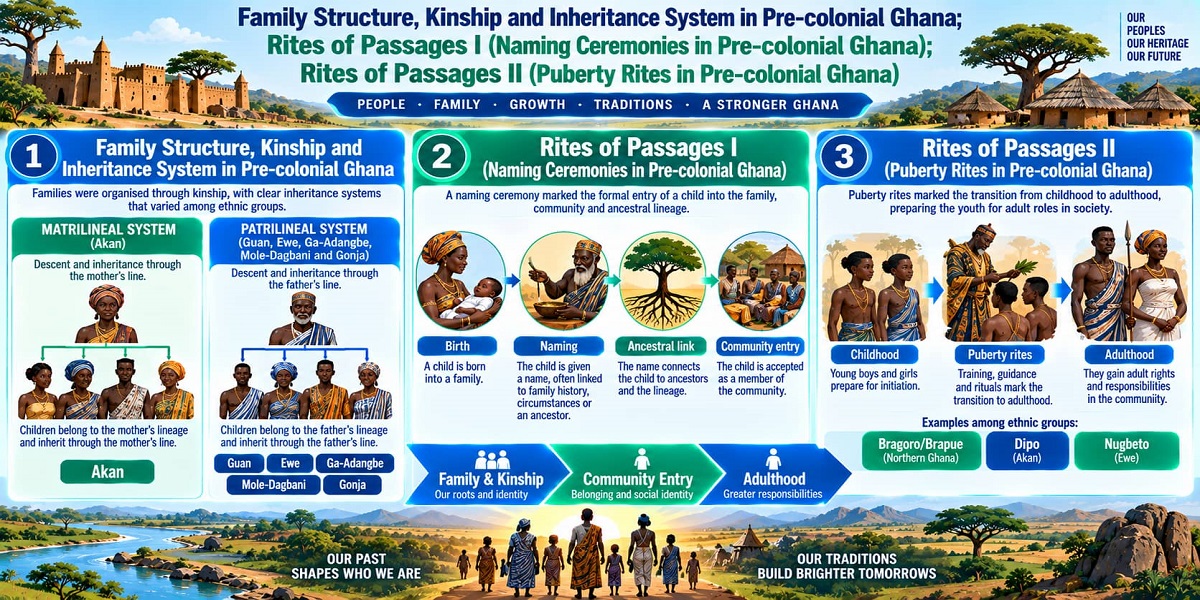
In pre-colonial Ghana, family was considered the centre of social life. The concept extended beyond conjugal members to include wider lineage relationships. Members of an extended family shared a common ancestor, either male or female.
This produced different systems of kinship and inheritance.
| System | Lineage Relationship | Groups Identified |
|---|---|---|
| Matrilineal | Maternal relations | Akan |
| Patrilineal | Paternal relations | Guan, Ewe, Ga-Adangbe, Mole-Dagbani and Gonja |
The distinction is straightforward, but its historical importance is much greater than the terminology suggests. Kinship helped organise relationships between people and connected individuals to a wider lineage.
Kinship as a Historical Window
Family systems can tell us about the values through which a society organised itself. The study of pre-colonial Ghanaian family structures therefore involves more than identifying whether a group was matrilineal or patrilineal.
Historians can examine proverbs, folktales and lineage histories as sources for reconstructing social structures. These sources need interpretation because historical evidence may be fragmented and shaped by cultural context.
The idea of communalism is particularly relevant to understanding the cultural values and beliefs surrounding family life.
A Child’s First Connection to Community
Birth was not simply a private family event. The naming ceremony signified the birth and entry of a child into the community.
It also connected the child to ancestral roots and community identity. Naming ceremonies differed among the Akan, Mole-Dagbani, Ewe, Ga-Adangbe, Guan and Gonja, with each group having its own customs and rituals.
This variation is historically important. It reminds us that there was no single cultural pattern shared identically by every pre-colonial Ghanaian society.
Names and Identity
A name can carry social meaning. The historical questions surrounding naming ceremonies ask whether names had special meanings or reflected ideas about the child’s future.
Studying names can therefore lead to broader questions about identity. What did a person’s name connect them to? What did the ceremony communicate about family and community? How did the practice vary between groups?
Day-born names are also identified as an area for investigation, allowing learners to examine how names functioned within particular cultural settings.
Another Major Transition: Puberty
If naming marked a child’s entry into the community, puberty rites marked another significant transition: the movement from childhood towards adulthood.
Puberty rites were performed to initiate young people into adult society and to bestow upon them the rights and responsibilities associated with adulthood.
| Community | Name of Puberty Rite |
|---|---|
| Akan | Bragoro or Brapue |
| Adangbe | Dipo |
| Ewe | Nugbeto |
The different names illustrate cultural variation, while the wider concept points to a shared social concern: preparing young people for adult society.
What Was Being Passed On?
The study of puberty rites asks what knowledge and skills were transmitted through these practices. It also asks how the rites prepared young people for future roles and whether boys and girls experienced similar or separate ceremonies.
These questions are important because rituals can carry meanings beyond the actions that are immediately visible. Their symbolic significance has to be interpreted within the society in which they were practised.
Three Stages of Belonging
Family structure, naming and puberty rites can be viewed as connected parts of social life:
| Stage | Social connection |
|---|---|
| Family and kinship | Connects an individual to a lineage and common ancestor. |
| Naming | Marks birth and entry into the community and connects the child to ancestral roots and community identity. |
| Puberty rites | Marks transition from childhood to adulthood and initiation into adult society. |
This sequence helps us see social organisation as something experienced across the life course rather than as a collection of unrelated customs.
How Historians Interpret Cultural Practices
Historical study requires more than description. A researcher must consider the evidence and the context in which the practice existed.
- Source analysis: Examine oral histories, proverbs, folktales and lineage histories carefully.
- Reconstruction: Combine fragments of evidence to build a picture of past social structures.
- Cultural interpretation: Understand practices according to the values and beliefs of the society in which they occurred.
- Comparison: Identify similarities and differences between ethnic groups.
- Continuity and change: Investigate how practices varied or evolved over time.
- Historical empathy: Consider the perspectives of children, young people, parents and elders who participated in these practices.
Why Variation Matters
Suppose two communities organise family relationships differently. That difference does not automatically mean that one system is more advanced than the other. It tells us that societies developed different ways of organising relationships and passing on identity.
The same principle applies to naming and puberty rites. Comparing cultural practices encourages us to understand difference within its historical context rather than judging it without investigation.
Past and Present
The study of these practices also invites questions about continuity and change. Family structures may differ across regions and may evolve over centuries. Naming and puberty rites can likewise be investigated for possible changes over time and for aspects that may still exist in modified forms.
The important historical task is to distinguish what the evidence shows from what we merely assume.
A Useful Historical Question
When studying any cultural practice, ask:
What did it do for the society?
For family and kinship, the answer begins with relationships and lineage. For naming, it begins with community membership and identity. For puberty rites, it begins with the transition to adulthood and the rights and responsibilities associated with adult society.
Key Takeaway
Socio-cultural organisation in pre-colonial Ghana was expressed through family structures, kinship systems and rites of passage. The Akan are identified with a matrilineal system, while the Guan, Ewe, Ga-Adangbe, Mole-Dagbani and Gonja are identified with patrilineal systems. Naming ceremonies marked birth and entry into community life, while puberty rites marked the transition from childhood to adulthood. Across all three areas, historical understanding depends on careful source analysis, cultural interpretation, comparison and attention to change over time.
Access NaCCA-aligned Support Packs
Download your structured NaCCA-aligned Teacher Support Pack and Student Learning Pack, designed for clarity, practicality, and reliable teaching and learning.