Referents for Angles Explained for SHS 1 Core Mathematics (Semester 2, Week 2)
Have you ever noticed the corner of a book, an open door or the hands of a clock? These everyday objects all show angles. Learning about angles helps you understand shapes, measure accurately and solve many geometry problems with confidence.
What You Will Learn
- What referents for angles are.
- How to recognise different types of angles.
- How angles are measured.
- How angles are used in everyday life.
Main Explanation
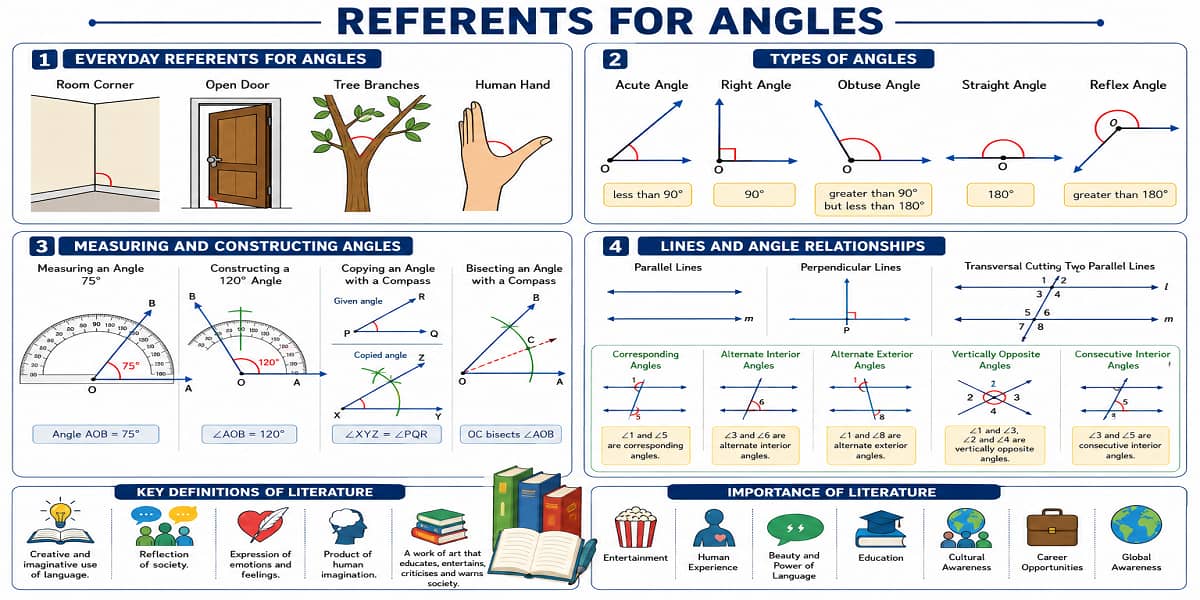
A referent for an angle is any familiar object that helps you recognise what an angle looks like. Instead of thinking about angles only as drawings in a mathematics book, you can see them in many objects around you every day.
For example, the corner of a classroom, an open door, tree branches, scissors and even the space between your fingers all form angles. Observing these objects helps you understand that angles are part of everyday life.
An angle is formed when two rays meet at a common point called the vertex. The amount of opening between the two rays determines the size of the angle. As the opening changes, the angle also changes.
The Main Types of Angles
Angles are classified according to their measurements. Knowing these classifications makes it easier to describe shapes and solve geometry problems.
- Acute Angle: Measures less than 90°.
- Right Angle: Measures exactly 90°.
- Obtuse Angle: Measures greater than 90° but less than 180°.
- Straight Angle: Measures exactly 180°.
- Reflex Angle: Measures greater than 180° but less than 360°.
Angles are measured in degrees (°) using a protractor. To measure an angle correctly, place the centre of the protractor on the vertex, align one arm of the angle with the zero line and read the value where the second arm crosses the scale.
Besides measuring angles, a protractor can also be used to construct angles of different sizes. A compass is another useful instrument because it allows you to copy an angle or divide an angle into two equal parts without measuring it.
Worked Examples
Example 1
Problem: One angle on a straight line measures 45°. Find the other angle.
- A straight angle measures 180°.
- Subtract the known angle from 180°.
- 180° − 45° = 135°.
Answer: The other angle is 135°.
Example 2
Problem: Two complementary angles add up to 90°. If one angle measures 35°, find the other angle.
- Complementary angles have a total of 90°.
- Subtract the known angle from 90°.
- 90° − 35° = 55°.
Answer: The other angle is 55°.
Why This Topic Matters
Angles play an important role in everyday life. Builders use angles to make sure walls and roofs are properly aligned. Carpenters use them to produce furniture with accurate corners. Engineers and architects depend on angles when designing roads, bridges and buildings. Understanding angles also prepares you for more advanced topics in geometry and mathematics.
Learning to measure, construct and identify angle relationships helps you solve problems more confidently and improves your observation of the world around you.
Quick Practice
- Identify five objects around you that form angles.
- Classify each of these angles as acute, right, obtuse, straight or reflex: 30°, 90°, 150°, 180° and 240°.
- Use a protractor to draw angles measuring 45°, 60° and 120°.
- If two supplementary angles are formed and one angle measures 68°, calculate the other angle.
- Explain the difference between measuring an angle and constructing an angle.
Summary
Angles are found in many everyday objects and are an important part of geometry. By learning how to recognise different types of angles, measure them accurately, construct them using a protractor or compass, and understand simple angle relationships, you build a strong foundation for solving mathematical problems and applying geometry in real-life situations.
Access NaCCA-aligned Support Packs
Download your structured NaCCA-aligned Teacher Support Pack and Student Learning Pack, designed for clarity, practicality, and reliable teaching and learning.