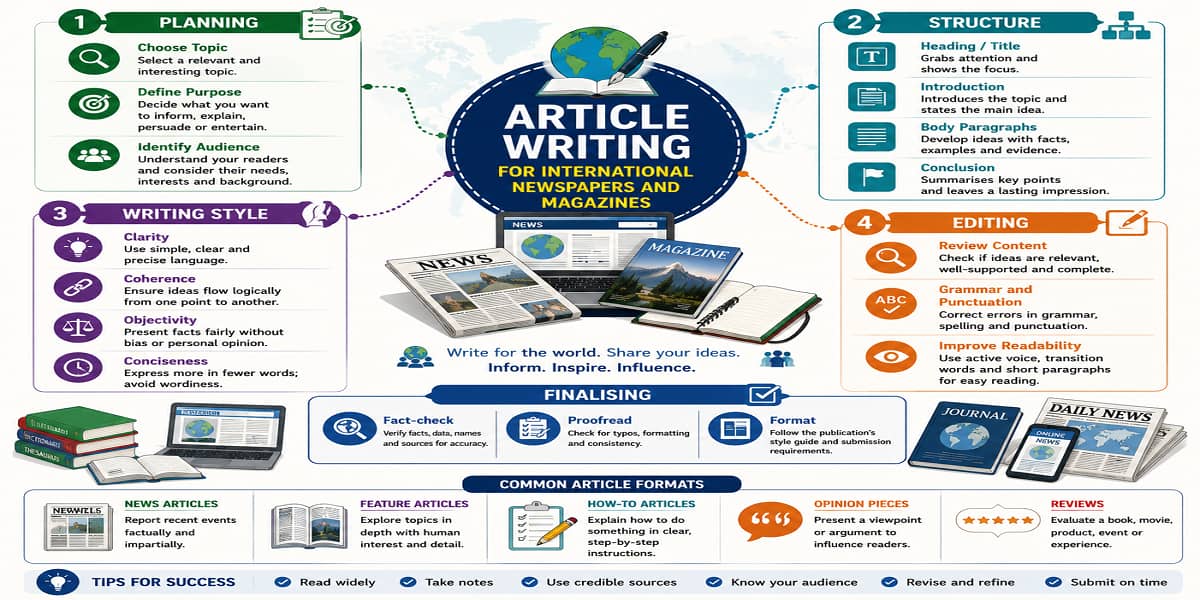
Article Writing for International Newspapers and Magazines Explained for SHS 2 English Language (Semester 2, Week 8)
Writing an article for an international newspaper or magazine requires more than good grammar. A writer must understand the audience, organise ideas logically, present accurate information and communicate clearly to readers from different parts of the world.
What You Will Learn
- The meaning and purpose of article writing.
- The different formats of articles.
- The characteristics of an effective article.
- The stages involved in planning, writing, editing and publishing an article.
- Strategies for improving article-writing skills.
Main Explanation
Article writing is the process of creating content for publication in newspapers, magazines, online blogs, journals and websites. Articles may be written to inform readers about an issue, persuade readers to accept a particular point of view or entertain readers through stories or anecdotes that often carry a serious underlying message.
Writing an effective article begins with careful research. A writer gathers reliable information, organises ideas logically and structures the content before writing. During the writing process, the article should be clear, concise and engaging. After completing the draft, the writer edits and proofreads the work for accuracy and quality while ensuring that the tone and style suit the intended audience and publication. :contentReference[oaicite:0]{index=0}
Articles are written in different formats depending on their purpose. These include news articles, feature articles, how-to articles, opinion pieces such as editorials and columns, and reviews of books, movies and products.
A well-written article has several important characteristics. It demonstrates objectivity unless it is intentionally opinion-based, uses clear and concise language, contains an engaging headline and introduction, presents information in a logical structure and maintains accurate grammar, spelling and punctuation throughout.
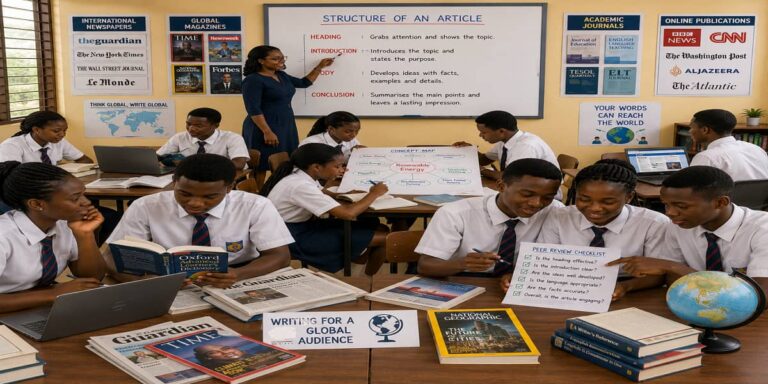
Before writing, learners should select a relevant topic, define the purpose of the article and identify the intended audience. During writing, they should create a catchy headline, write an engaging introduction, organise the body into paragraphs with supporting details and transitions, and conclude by restating the main idea, summarising the discussion and leaving a lasting impression.
After writing, learners should review the content for accuracy, relevance and consistency, check grammar and punctuation, improve readability by using headings and bullet points where appropriate, verify facts and sources, proofread carefully and format the article according to the required style.
To strengthen article-writing skills, learners should analyse well-written articles, participate in guided writing activities, exchange articles for peer review, attend writing workshops, conduct research, practise editing and revision, and publish their work through school magazines, blogs or online platforms where possible.
| Stage | Main Activities | Purpose |
|---|---|---|
| Planning | Choose a topic, define the purpose and identify the audience. | Prepare ideas before writing. |
| Writing | Create the headline, introduction, body and conclusion. | Present ideas logically and effectively. |
| Editing | Review content, grammar, punctuation and readability. | Improve quality and clarity. |
| Finalising | Fact-check, proofread and format the article. | Prepare the article for publication. |
| Part of an Article | Purpose |
|---|---|
| Heading/Title | Captures readers’ attention. |
| Introduction | Provides a hook, background information and the main idea. |
| Body Paragraphs | Develop ideas with supporting details and transitions. |
| Conclusion | Restates the main idea, summarises key points and leaves a lasting impression. |
Worked Examples
Example 1
Scenario: A learner is assigned to write an article for publication in an international magazine about environmental conservation.
Explanation: The learner researches the topic, identifies the purpose and audience, develops a catchy headline, writes an engaging introduction, organises supporting ideas into clear body paragraphs and concludes by summarising the discussion while leaving readers with a memorable final thought.
Example 2
Scenario: A learner completes an article and prepares it for publication.
Explanation: Before submission, the learner reviews the content for accuracy, corrects grammar and punctuation, improves readability, verifies facts, proofreads the final draft and formats the article according to the required publication guidelines.
Why This Topic Matters
Article writing equips learners with practical communication skills needed in journalism, education, professional writing and digital publishing. The ability to research accurately, organise ideas clearly and write for different audiences enables learners to communicate important issues effectively at local, national and international levels while developing critical thinking, creativity, collaboration and digital literacy.
Quick Practice
- State three purposes of article writing.
- Identify four characteristics of an effective article.
- Outline the main stages involved in writing an article.
- Write an article suitable for publication in your school magazine on naming ceremonies among people in your community.
- Write an article for a national newspaper on the causes and possible solutions to illegal mining (“galamsey”).
Summary
Effective article writing requires careful planning, research, logical organisation, clear writing and thorough editing. Understanding the audience, purpose, structure and style of an article enables learners to produce informative, persuasive and engaging articles suitable for publication in newspapers, magazines and other media. Mastering these skills prepares learners to communicate confidently with readers both locally and internationally.
Access NaCCA-aligned Support Packs
Download your structured NaCCA-aligned Teacher Support Pack and Student Learning Pack, designed for clarity, practicality, and reliable teaching and learning.