The Rewards of Factors of Production Explained for SHS 1 Economics (Sem. 1 – Week 9)
Production brings together land, human effort, capital and entrepreneurial ability. But why would people make these resources available for production?
One important answer is reward.
In Economics, a reward is something received in return for effort, achievement or as an incentive. The reward associated with each factor of production follows a clear pattern.
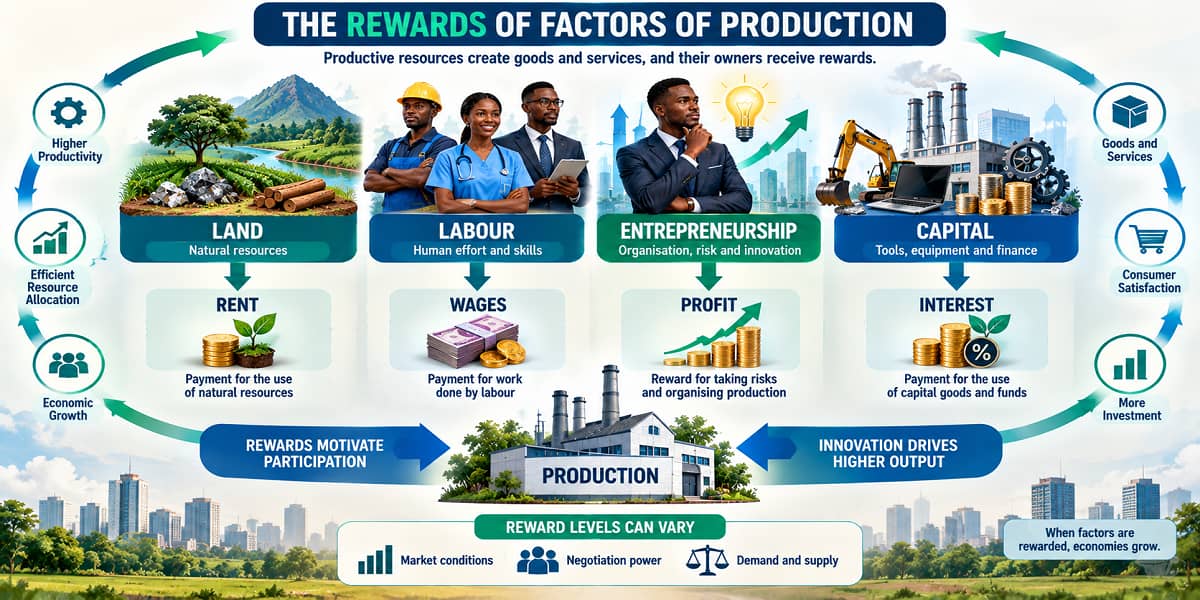
The Four Rewards
| Resource | Reward | What the Reward Represents |
|---|---|---|
| Land | Rent | Payment for the use of land. |
| Labour | Wages | Compensation for time, skills and effort. |
| Capital | Interest | Return to capital owners when money is lent or invested. |
| Entrepreneurship | Profit | Return for organising resources and taking risks. |
Rent: When Land Is Put to Use
Land is a natural factor of production. Its reward is rent.
A landowner can receive rent when individuals or businesses use the land for agricultural, commercial, industrial or residential purposes.
The central relationship is therefore:
Use of land → Rent to the landowner
Wages: The Return to Human Effort
Workers supply their time, skills and effort to production.
Their reward is wages.
This applies to the wide range of physical and intellectual contributions people make to the production of goods and services.
The relationship can be expressed simply:
Human effort and skills → Wages
Interest: The Return to Capital
Capital supports production through man-made resources and financial resources.
The reward associated with capital is interest.
Capital owners such as banks or investors can earn interest when they lend money or invest in businesses or projects.
Profit: The Entrepreneur’s Reward
Entrepreneurship has a distinctive role in production.
The entrepreneur organises and combines land, labour and capital, makes strategic decisions, takes risks and innovates.
The reward for this role is profit.
Profit is therefore connected to the entrepreneur’s willingness and ability to coordinate resources and undertake productive activity.
One Production Process, Four Returns
Imagine a productive activity involving all four factors.
The land is made available, workers contribute their effort, capital supports the activity and an entrepreneur coordinates the resources.
The resulting pattern is:
Why Rewards Matter to the Economy
Rewards do more than compensate resource owners. They can motivate individuals and businesses to participate in economic activities and make resources available for production.
They can also contribute to:
- efficient allocation of resources;
- creation of economic value;
- innovation;
- entrepreneurship;
- increased productivity; and
- economic growth.
Rewards and Resource Allocation
Consider an individual deciding whether to make a resource available for production.
The expected reward can influence that decision. In this sense, rewards form part of the mechanism through which resources are allocated within an economy.
However, rewards do not always remain at the same level.
Why Rewards Can Differ
The level of rewards may vary according to market conditions, negotiation power and other factors.
Therefore, two situations involving the same factor of production do not necessarily produce identical rewards.
Economic Systems Can Distribute Rewards Differently
The distribution of rewards can also depend on the economic system.
For example, in a system such as socialism, the distribution of rewards may be structured differently in pursuit of equity or other social objectives.
This reminds us that the existence of a reward and the way it is distributed are related but distinct questions.
A Useful Memory Tool
If you need to recall the four relationships quickly, use this sequence:
LAND → RENT
LABOUR → WAGES
CAPITAL → INTEREST
ENTREPRENEURSHIP → PROFIT
Once the factor is identified, ask: “What is its reward?”
Test Your Understanding
Which reward belongs to land?
Rent.
Which reward belongs to labour?
Wages.
Which reward belongs to capital?
Interest.
Which reward belongs to entrepreneurship?
Profit.
Why does an entrepreneur receive profit?
Because entrepreneurship involves organising resources, making strategic decisions, taking risks and successfully producing and selling goods or services.
Final Takeaway
The factors of production are connected to distinct economic rewards.
Rent rewards land, wages reward labour, interest rewards capital, and profit rewards entrepreneurship.
These returns can encourage participation in economic activity, efficient allocation of resources, innovation, increased productivity and economic growth. Their levels and distribution can vary with market conditions, negotiation power and the economic system.
The four relationships to remember are: Land–Rent, Labour–Wages, Capital–Interest and Entrepreneurship–Profit.
Access NaCCA-aligned Support Packs
Download your structured NaCCA-aligned Teacher Support Pack and Student Learning Pack, designed for clarity, practicality, and reliable teaching and learning.