Research and Presentation Explained for SHS 2 English Language (Semester 2, Week 9)
Research helps us discover new knowledge, solve problems and make informed decisions. Presenting research effectively allows us to communicate ideas, evidence and findings clearly to different audiences.
What You Will Learn
- The meaning and purpose of research.
- The major types of research.
- The stages involved in the research process.
- The ethical principles that guide research.
- The key elements of an effective presentation.
Main Explanation
Research is a systematic process of inquiry that seeks to discover new knowledge, validate existing theories or solve specific problems. It is an important activity in science, technology, the humanities and the social sciences because it expands knowledge and supports informed decision-making. Research involves a careful and detailed study of a particular problem, issue or phenomenon using scientific methods.
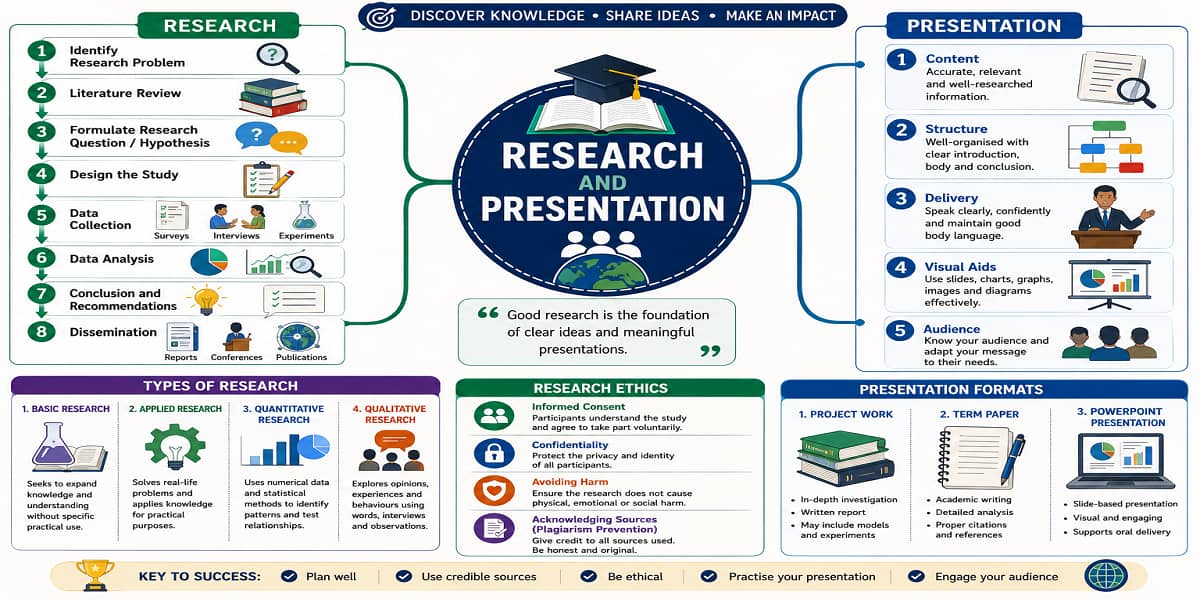
The main goals of research are to explore new ideas, understand complex issues, provide evidence-based conclusions and contribute to knowledge in a particular field. Depending on its purpose, research may be classified into four main types. Basic research focuses on increasing knowledge without immediate practical applications, while applied research seeks practical solutions to specific problems. Quantitative research involves collecting and analysing numerical data through methods such as surveys and experiments, whereas qualitative research uses interviews and observations to understand experiences, concepts and social phenomena.
A successful research project follows a systematic process. It begins by identifying a research problem that requires investigation. The researcher then conducts a literature review to examine existing knowledge and identify gaps. A clear research question or hypothesis is formulated before designing the study by selecting suitable data collection methods, sampling procedures and analysis techniques. Data are collected through surveys, experiments, interviews or observations and analysed using statistical or thematic methods. Finally, conclusions and recommendations are drawn, and the findings are shared through reports, publications or presentations.
Ethics play an important role in every research project. Researchers should obtain informed consent from participants, protect confidentiality, avoid causing physical, psychological or emotional harm and acknowledge all sources properly to prevent plagiarism. Following these ethical principles ensures the integrity of the research and protects everyone involved in the study.
Research contributes to society by advancing knowledge, informing policy and practice and promoting critical thinking and problem-solving skills. Learners are encouraged to develop curiosity, evaluate information critically, use credible print and digital sources, collaborate with others and apply research to real-life situations.
Presenting research findings is just as important as conducting the research itself. A presentation is a structured delivery of information, ideas or arguments to an audience using spoken words, visual aids and sometimes multimedia. An effective presentation contains well-organised content, a clear structure consisting of an introduction, body and conclusion, confident delivery, appropriate visual aids and careful consideration of the audience. Common presentation formats include project work, term papers and PowerPoint presentations.
| Stage of Research | Purpose | Outcome |
|---|---|---|
| Identify Research Problem | Select the issue to investigate. | Research focus established. |
| Literature Review | Study existing information. | Knowledge gaps identified. |
| Research Question or Hypothesis | Guide the investigation. | Clear research direction. |
| Study Design | Plan methods, sampling and analysis. | Research methodology prepared. |
| Data Collection | Gather evidence. | Research data obtained. |
| Data Analysis | Interpret findings. | Evidence-based conclusions. |
| Conclusion and Recommendations | Summarise findings and implications. | Recommendations produced. |
| Dissemination | Communicate findings. | Reports, publications or presentations. |
| Presentation Element | Purpose |
|---|---|
| Content | Communicates facts, evidence and ideas. |
| Structure | Organises information into introduction, body and conclusion. |
| Delivery | Uses voice, body language, eye contact and gestures effectively. |
| Visual Aids | Support understanding using slides, charts, graphs, images and videos. |
| Audience | Determines the most appropriate style and level of presentation. |
Worked Examples
Example 1
Scenario: A learner investigates the effects of plastic waste in the school community.
Explanation: The learner identifies the problem, reviews relevant information, develops research questions, collects data through observations and surveys, analyses the findings, writes conclusions and recommendations, and presents the results in a journal presentation.
Example 2
Scenario: A group of learners prepares a presentation on environmental degradation.
Explanation: The learners organise the presentation into an introduction, body and conclusion, use slides and charts to illustrate key findings, deliver the presentation confidently with appropriate body language and respond to questions from the audience.
Why This Topic Matters
Research and presentation skills are valuable in education, business and many professional careers. They enable learners to investigate problems, evaluate information from credible sources, organise ideas logically and communicate findings effectively. These skills also promote critical thinking, collaboration, creativity and informed decision-making in real-life situations.
Quick Practice
- State the four main types of research.
- Arrange the stages of the research process in the correct order.
- Explain four ethical principles that guide research.
- Identify the five key elements of an effective presentation.
- Investigate a community issue and prepare a journal presentation of your findings.
Summary
Research is a systematic process used to generate knowledge and solve problems through careful investigation. Conducting quality research requires following organised stages, applying ethical principles and communicating findings effectively. By combining sound research practices with clear presentations, learners develop the ability to communicate complex ideas confidently, make evidence-based decisions and contribute meaningfully to academic and professional work.
Access NaCCA-aligned Support Packs
Download your structured NaCCA-aligned Teacher Support Pack and Student Learning Pack, designed for clarity, practicality, and reliable teaching and learning.