Relationship Between Plot, Subplots and Conflict
A good prose story is not simply a collection of events. The writer arranges events into a plot, develops struggles through conflict, and may introduce subplots that add further dimensions to the main story.
Understanding how these three elements work together helps you appreciate how a story develops and how different events contribute to its overall meaning.
1. What Is Plot?
Plot is a literary element that provides the structure of a story. It is the arrangement of events and actions that gives the narrative its shape and movement.
When you read a story, you can ask:
- How does the story begin?
- What happens to the main character?
- Where does the main character encounter conflict?
- How does the action build?
- What is the turning point?
- What happens after the turning point?
- How is the story resolved?
These questions help you trace the development of the plot.
2. The Plot Structure
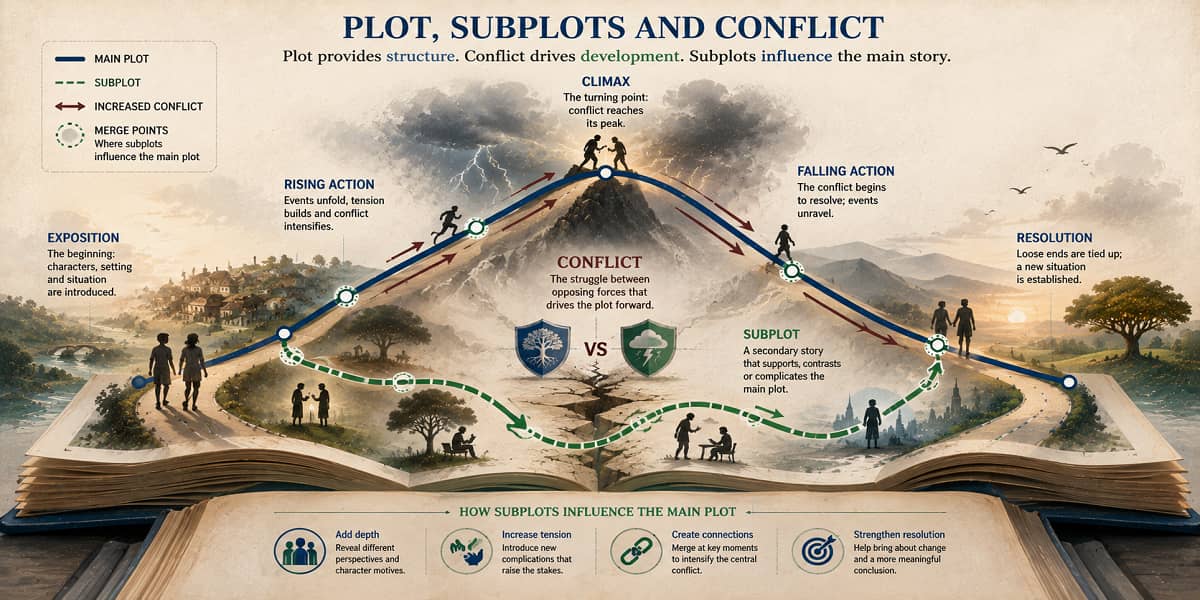
The plot diagram in the weekly material presents the movement of a story through exposition, rising action, climax, falling action and resolution. The diagram also shows the introduction of characters and setting at the exposition and the main character facing conflicts during the rising action. :contentReference[oaicite:0]{index=0}
| Plot Stage | What Happens |
|---|---|
| Exposition | The beginning of the story where the characters and setting are introduced. |
| Rising Action | The action develops as the main character faces conflicts. |
| Climax | The most exciting part of the story, where the outcome becomes clear. |
| Falling Action | Events leading towards the end of the story. |
| Resolution | The end of the story. |
3. What Is Conflict?
Conflict is the dramatic struggle between two forces that helps the development of the plot.
The relationship between conflict and plot is especially important because, without conflict, there is generally no plot. Conflict creates the struggle that gives characters something to face and gives events a reason to develop.
Think of the relationship this way:
Conflict → develops action → moves the plot forward.
4. Conflict and the Development of Plot
Imagine a story in which nothing challenges the main character. There would be little reason for events to change or develop.
Once a dramatic struggle appears, however, the story can move forward. The character must respond to the situation, and those responses create further events.
Therefore, when analysing a plot, look carefully for the conflicts that cause the action to develop.
Think About It
If a main character faces a serious struggle that forces the character to make decisions and take action, what element is helping to develop the plot?
Answer: Conflict.
5. What Is a Subplot?
A subplot is a minor story or digression within a main story or main plot.
A subplot may involve the main characters or other characters whose narrative interaction influences the development of the main plot.
A subplot can also reflect what is happening in the main plot in a comic or tragic way.
6. Main Plot and Subplot
The main plot is the central story. A subplot is a secondary narrative that exists within or alongside the main story.
| Main Plot | Subplot |
|---|---|
| The central story. | A minor story or digression within the main story. |
| Usually revolves around the protagonist and his or her conflict. | May involve the main characters or other characters. |
| Provides the principal narrative movement. | Can influence the development of the main plot. |
| Provides the central line of action. | Can reflect the main plot in a comic or tragic way. |
7. An Example: Romeo and Juliet
The weekly material uses Romeo and Juliet as an example.
The main plot follows the love story between the two main characters. Alongside this is the subplot involving the two families, the Montagues and the Capulets.
The family conflict increases the difficulty surrounding the young lovers’ forbidden romance. The subplot therefore does not merely sit beside the main story. It contributes to the conflict and influences the development of the main plot.
This example demonstrates an important principle:
A subplot can help intensify the conflict of the main plot.
8. The Relationship Among Plot, Subplot and Conflict
These three elements can be understood as a connected system.
Plot provides the structure of the story.
Conflict provides dramatic struggle and helps the plot develop.
Subplots provide additional stories or digressions that can influence the main plot and its conflicts.
A useful representation is:
MAIN PLOT → develops through conflict
SUBPLOT → adds another narrative line → can influence the main plot and conflict
This means that a subplot may strengthen, complicate or reflect the central action.
9. Follow the Protagonist
When you begin analysing a selected prose text, first identify the protagonist and the conflict surrounding that character.
Ask:
- Who is the protagonist?
- What is the protagonist trying to achieve or overcome?
- What conflict stands in the way?
- Which events develop from this conflict?
- Where does the main plot build towards its climax?
This gives you a starting point for identifying the main plot.
10. Look Beyond the Main Story
After identifying the main plot, look for other narrative strands.
Ask:
- Are there other characters whose stories develop alongside the main story?
- Do their experiences influence the main plot?
- Does another story reflect what is happening in the main plot?
- Does a secondary story create additional conflict?
- Does it have a comic or tragic relationship with the main action?
If the answer is yes, you may have identified a subplot.
11. Plot Build-Up
To understand the build-up of a plot, trace the events from the exposition through the rising action towards the climax, then follow the falling action to the resolution.
Do not simply list events. Look for connections between them.
Ask:
- What information is introduced at the beginning?
- What conflict develops?
- What events make the conflict more significant?
- How do the characters respond?
- How does the action rise towards the climax?
- What happens after the climax?
- How is the story brought to an end?
12. Activity: Trace the Main Plot
Choose a selected prose text and identify the main plot that revolves around the protagonist and his or her conflict.
| Stage | Evidence from the Text |
|---|---|
| Exposition | What characters and setting are introduced? |
| Rising Action | What conflicts and developing events involve the protagonist? |
| Climax | What is the major turning point? |
| Falling Action | What events lead towards the end? |
| Resolution | How does the story end? |
13. Activity: Identify the Subplots
Now return to the same prose text and look for secondary narrative lines.
For each possible subplot, record:
- the characters involved;
- the events that make up the secondary story;
- its relationship to the main plot; and
- its influence on the conflict.
A useful analytical pattern is:
Subplot → Characters → Events → Relationship to Main Plot → Effect on Conflict
14. How a Subplot Can Strengthen the Main Plot
A subplot may introduce additional events that make the central conflict more complicated.
It can also provide information about characters, create another source of struggle or reflect the main action in a comic or tragic way.
In Romeo and Juliet, for example, the subplot concerning the Montagues and Capulets increases the conflict surrounding the young lovers’ forbidden romance.
15. How Conflict Connects the Stories
A subplot becomes particularly important when its events influence the main conflict.
Imagine a main story involving a character who is facing a major struggle. A secondary character then experiences an event that changes the circumstances surrounding the main character. The secondary story has now become relevant to the main plot.
When analysing a text, therefore, do not ask only, “What is the subplot?” Ask also, “What does this subplot do to the main plot?”
16. Visualising the Relationship
A visual representation can make the relationship easier to understand.
MAIN PLOT
↓
Protagonist + Central Conflict
↓
Rising Action → Climax → Falling Action → Resolution
At different points:
SUBPLOT → Secondary Characters/Events → Influences Main Plot → Affects Conflict
This shows that a subplot does not necessarily form a completely separate story. It can feed into the central narrative.
17. A Closer Look at Conflict
Because conflict helps develop plot, it should be tracked throughout a story.
Ask:
- When does the conflict first appear?
- How does it grow?
- Which characters are involved?
- Which events make it more intense?
- How does the conflict contribute to the rising action?
- What happens at the climax?
- How is the conflict connected to the resolution?
These questions help you see conflict as a force that drives narrative development.
18. A Short Analytical Example
Consider a fictional story in which a young character wants to pursue a relationship but faces opposition from two groups around them.
The love story can form the main plot if it is the central narrative involving the protagonist and the principal conflict.
The story of the two opposing groups can operate as a subplot if it is a secondary narrative that increases the conflict surrounding the central relationship.
The relationship can therefore be represented as:
Main plot: central relationship
Subplot: conflict between the groups
Effect: the subplot increases the central conflict and influences the development of the main plot.
This follows the relationship demonstrated in the weekly example of Romeo and Juliet.
19. Storytelling Through Freytag’s Pyramid
The plot diagram presented in the weekly material follows the familiar rising-and-falling shape of a plot pyramid. :contentReference[oaicite:1]{index=1}
You can use this structure to create your own short story.
- Exposition: Introduce the characters and setting.
- Rising Action: Introduce and develop the central conflict.
- Climax: Bring the story to its most exciting point, where the outcome becomes clear.
- Falling Action: Present events leading towards the end.
- Resolution: End the story.
As you write, consider whether a subplot can be introduced without distracting from the main plot.
20. Creative Writing Challenge
Create a short story based on the plot structure above.
Your story should include:
- a clear protagonist;
- a central conflict;
- an identifiable main plot;
- at least one subplot;
- a climax;
- falling action; and
- a resolution.
After writing, identify the exact point at which your subplot influences the main plot.
21. Role-Play the Story
Choose a prose text with clear plot, subplot and conflict elements. Work with classmates to act out important scenes.
During the performance, pay attention to:
- which scenes belong to the main plot;
- which scenes belong to a subplot;
- where the central conflict becomes stronger; and
- how the subplot influences the main action.
Role-playing can make the relationship among the three elements easier to see because the different narrative strands become visible through action.
22. Draw the Story
Create a visual representation of a prose text showing:
- the main plot;
- the main conflict;
- the subplot or subplots;
- the characters involved; and
- the points where the subplot or subplots connect with the main plot.
You can use arrows to show influence.
Subplot → increases/changes → Conflict → develops → Main Plot
23. Present Your Interpretation
After analysing the text, present the relationship among plot, subplots and conflict orally.
Use precise literary language. Instead of saying only, “The subplot is important,” explain how it is important.
A strong statement could follow this structure:
“The subplot involving ______ influences the main plot by ______, which increases/develops the conflict between ______ and ______.”
Complete the statement with evidence from the selected text.
24. Check Your Understanding
Recall
1. What is plot?
Answer: Plot is a literary element that provides the structure of the story.
2. What is conflict?
Answer: Conflict is the dramatic struggle between two forces which helps the development of the plot.
3. What is a subplot?
Answer: A subplot is a minor story or digression within a main story or main plot.
4. Name the five stages shown in the plot diagram.
Answer: Exposition, rising action, climax, falling action and resolution.
Conceptual Understanding
Question: Why is conflict important to plot?
Answer: Conflict provides dramatic struggle and helps the development of the plot. Without conflict, there is generally no plot.
Question: How can a subplot influence the main plot?
Answer: A subplot can involve characters or events whose interactions influence the development of the main plot. It can increase conflict or reflect what is occurring in the main plot in a comic or tragic way.
Strategic Reasoning
Question: How would you identify the main plot in a selected prose text?
Answer: Identify the protagonist, identify the protagonist’s main conflict, trace the events that develop from that conflict and follow those events through the plot structure towards the resolution.
Extended Critical Thinking
Question: How can you show the relationship among plot, subplot and conflict in a prose text?
Answer: Identify the central plot and the protagonist’s conflict, locate the subplot or subplots and identify the characters and events involved, then explain how those secondary narratives influence, intensify or reflect the main conflict and thereby contribute to the development of the main plot.
25. Final Synthesis
Plot, subplot and conflict are closely connected.
Plot provides the structure of the story.
Conflict creates dramatic struggle and helps move the plot forward.
Subplot introduces a secondary story or digression that can influence the main plot, involve other characters or reflect the main action in a comic or tragic way.
The most important reading skill is to examine their relationship rather than studying each element in isolation.
When you encounter a prose text, ask:
- What is the main story?
- Who is the protagonist?
- What is the central conflict?
- How does the conflict develop the plot?
- Are there subplots?
- Who is involved in the subplots?
- How do the subplots affect the main plot?
- How do all these elements lead towards the climax and resolution?
Once you can answer these questions with evidence from the text, you are not merely retelling a story. You are analysing how its narrative structure works.
Access NaCCA-aligned Support Packs
Download your structured NaCCA-aligned Teacher Support Pack and Student Learning Pack, designed for clarity, practicality, and reliable teaching and learning.