Accounts of the Origin of the Guan and Ethnic Groups in the Savannah Zone of Ghana
How can we know where a people came from when different communities tell different stories about their origins?
This question is central to the study of migration history. The origins of ethnic groups may be explained through oral traditions, historical narratives, linguistic evidence and archaeological evidence. These accounts may agree in some respects and differ in others.
In this lesson, we examine accounts of the origin and migration of the Guan, the early peoples of the Savannah Zone, the Mole-Dagbani and the Gonja. We will also learn how historians compare different accounts rather than simply accepting one story without examination.
1. The Guan: Who Are They?
The Guan people are believed to be among the earliest inhabitants of present-day Ghana because many ethnic groups claim that they met Guan communities when they arrived.
According to Guan oral tradition, the Guans had established small independent states in Ghana before the arrival of other ethnic groups.
Another account states that the Guans migrated from the north, somewhere around the Mossi region of present-day Burkina Faso. According to this account, incessant wars with the Mande contributed to their movement southwards towards the area of modern Gonjaland in northern Ghana.
The traditions further state that the Guans entered modern Ghana in three groups.
The Three Groups
| Group | Settlement according to the account |
|---|---|
| First group | Remained in Gonjaland. |
| Second group | Settled in the Afram Plains. |
| Third group | Moved southwards towards the Lower Volta and settled at present-day Larteh, Adukrom, Santrokofi, Akpafu, Effutu and Awutu. |
2. Why Are There Different Guan Accounts?
There are different variations of accounts concerning the migration of the Guan. This does not automatically mean that one account is completely useless and another completely correct.
Historical accounts can differ because they come from different perspectives and types of evidence. Oral traditions may preserve community memories and values, while historical records and archaeological evidence may provide different forms of information.
The historian’s task is therefore to compare, analyse and evaluate the accounts.
3. How to Evaluate an Origin Account
When two accounts appear different, ask the following questions:
- What is the source?
- What does the account claim?
- What evidence supports it?
- What are the strengths of the source?
- What are its limitations?
- Could the account contain bias?
- Does another source confirm or challenge it?
- How might the account reflect the identity or values of the people who preserve it?
This process is called source analysis.
4. The Savannah Zone of Ghana
The Savannah Zone has been home to several ethnic groups with different migration traditions, languages, cultural practices and histories.
According to oral history, some of the early settlers or indigenous inhabitants of the Savannah Zone were the Vagala, Sisala, Tampulensi and Guan, who lived along the White Volta.
Other groups, including the Konkomba, Koma and Chamba, lived east of the White Volta.
Features of the Early Settlers
The early settlers were associated with several characteristics:
- apart from the Guans, the groups spoke related languages;
- their communities were acephalous in nature;
- they had social units or family systems;
- the Tindana was present; and
- they practised polytheism as a religious system.
Acephalous here refers to communities without a centralised political authority headed by a single ruler.
5. The Mole-Dagbani Migration
Another important migration account concerns the Mole-Dagbani.
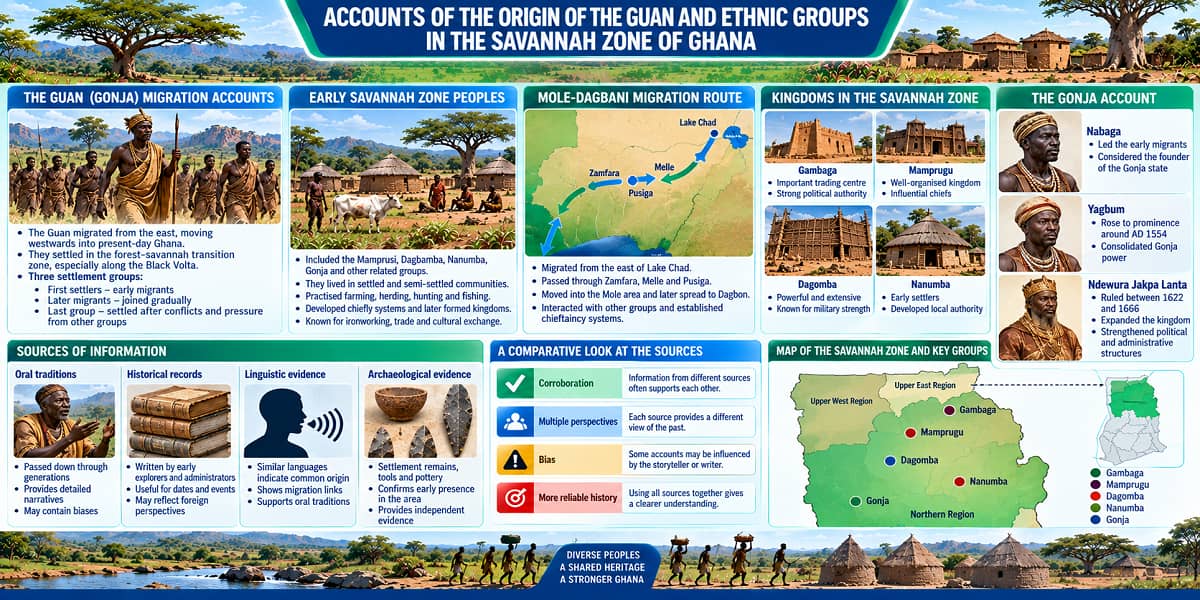
According to the account presented here, the Mole-Dagbani migrated from east of Lake Chad. Their movement took them to Zamfara in northern Nigeria, then to Melle in Mali, and eventually to Pusiga.
From Pusiga, they founded kingdoms including:
- Gambaga
- Mamprugu
- Dagomba
- Nanumba
6. The Origin of the Gonja
The history of the Gonja provides another example of how migration accounts connect movement, military activity and state formation.
The Gonja Kingdom was founded by Wadh Naba, or Nabaga. According to the account, Nabaga was sent by his overlord, King Mande Kaba of the Mande Kingdom, on a punitive expedition against the gold-producing town of Begho.
When Nabaga reached the Northern Zone, he refused to return to his king. Instead, he established a military base at Yagbum around AD 1554.
From this base, Nabaga conquered a number of states, including Guan communities, and imposed Mande or Gonja authority over them.
Ndewura Jakpa Lanta
Between 1622 and 1666, the Gonja, led by their new king Ndewura Jakpa Lanta, invaded Dagomba.
Ndewura Jakpa Lanta was a descendant of Nabaga and became the fifth Gonja king. He expanded the kingdom considerably.
| Person/Event | Significance in the account |
|---|---|
| Nabaga | Founded the Gonja Kingdom after establishing a military base at Yagbum around AD 1554. |
| Yagbum | Military base established by Nabaga after he refused to return to Mande. |
| Ndewura Jakpa Lanta | Fifth Gonja king, descendant of Nabaga; led the Gonja invasion of Dagomba between 1622 and 1666 and expanded the kingdom. |
7. Why Multiple Perspectives Matter
There may be different variations of the migration accounts of both the Mole-Dagbani and the Gonja.
A historian should therefore avoid treating one account as automatically complete. Instead, different accounts should be compared with other evidence.
Useful questions include:
- Who produced or preserved the account?
- When was it recorded or transmitted?
- What purpose might it have served?
- What information does it provide?
- What information might it leave out?
- Does another source support or challenge it?
8. Historical Sources and Their Strengths
| Source | Possible value | What must be considered |
|---|---|---|
| Oral traditions | Preserve community memories, traditions, identities and perspectives. | Transmission over time may produce variations; perspectives and purposes should be examined. |
| Historical records | Can provide written accounts of people and events. | The author’s perspective, purpose and possible bias should be considered. |
| Linguistic evidence | Can contribute to understanding relationships among groups. | It should be considered alongside other evidence. |
| Archaeological evidence | Provides physical evidence of past human activities and settlement. | Material remains require careful interpretation and contextualisation. |
| Drum music | Can preserve historical traditions and narratives. | Its interpretation and relationship to other evidence require careful evaluation. |
9. Corroboration: Putting Evidence Together
Corroboration means comparing information from different sources to develop a more comprehensive understanding.
For example, if an oral tradition describes a migration route, a historian can compare that account with other historical narratives, linguistic evidence and archaeological findings.
The purpose is not necessarily to force every source to tell exactly the same story. Instead, differences and agreements can themselves become evidence for historical interpretation.
10. Bias and Perspective
Historical narratives can reflect the perspectives and values of the people who create or preserve them.
A migration story may help a community explain its identity, relationship with other groups or connection to a particular territory. This does not automatically make the story false. It means that the historian should understand the context and purpose of the narrative.
Good historical analysis therefore combines respect for different perspectives with careful evaluation of evidence.
11. The 5Ws and 1H Approach
A useful way to investigate an origin account is to ask:
- Who? Who migrated or settled?
- What? What happened?
- When? When did the movement or event occur?
- Where? Where did people come from and where did they settle?
- Why? Why did the movement occur?
- How? How did the migration and settlement take place?
These questions help turn a migration story into a structured historical investigation.
12. Let’s Work Through an Example
Claim: The Guans entered Ghana in three groups.
Step 1 — Identify the claim: The account describes three movements and different settlement areas.
Step 2 — Identify the evidence: The account comes from Guan migration traditions.
Step 3 — Compare: Other accounts should be examined to determine whether they support, modify or challenge this interpretation.
Step 4 — Consider perspective: Ask how the account contributes to Guan identity and how it relates to the histories of neighbouring groups.
Step 5 — Reach a careful conclusion: The account is useful evidence, but a comprehensive understanding requires comparison with other available sources.
13. Learner Practice
Activity 1: Migration Map
Sketch a map of Ghana and mark the major places associated with the Guan settlement traditions: Gonjaland, Afram Plains, Larteh, Adukrom, Santrokofi, Akpafu, Effutu and Awutu.
Answer guide: Your map should show the three broad directions of Guan settlement described in the account, with Gonjaland represented in the north, the Afram Plains in the central area, and the listed Lower Volta settlements towards the south.
Activity 2: Mole-Dagbani Route
Arrange these places in the correct sequence:
Pusiga — Melle — east of Lake Chad — Zamfara
Answer: East of Lake Chad → Zamfara → Melle → Pusiga.
Activity 3: Source Evaluation
Question: Why should an oral tradition about migration be compared with other evidence?
Answer: Comparison helps identify agreements, contradictions, strengths, limitations and possible biases, leading to a more comprehensive understanding of the past.
Activity 4: Gonja Chronology
Question: What happened around AD 1554?
Answer: Nabaga established a military base at Yagbum after refusing to return to his Mande king.
Question: What happened between 1622 and 1666?
Answer: The Gonja, led by Ndewura Jakpa Lanta, invaded Dagomba, and he expanded the kingdom far and wide.
14. Key Ideas to Remember
- The Guan are presented as among the earliest inhabitants of present-day Ghana.
- Guan traditions describe three groups moving to Gonjaland, the Afram Plains and settlements towards the Lower Volta.
- The Savannah Zone was home to several early groups, including the Vagala, Sisala, Tampulensi and Guan, as well as Konkomba, Koma and Chamba.
- The Mole-Dagbani account traces movement from east of Lake Chad through Zamfara and Melle to Pusiga.
- The Mole-Dagbani established kingdoms including Gambaga, Mamprugu, Dagomba and Nanumba.
- Nabaga established a military base at Yagbum around AD 1554 and founded the Gonja Kingdom according to the account.
- Ndewura Jakpa Lanta later expanded the Gonja Kingdom.
- Different migration accounts should be compared rather than accepted uncritically.
- Source analysis, corroboration, identifying bias, evaluating evidence and considering multiple perspectives are essential historical skills.
15. Final Synthesis
The history of migration is rarely a single, simple story. Different communities may preserve different explanations of where they came from and how they reached their present locations.
The Guan traditions describe three groups and several settlement areas. Accounts of the Savannah Zone identify early settlers and describe later movements associated with the Mole-Dagbani and Gonja.
The most important historical skill is not simply memorising these accounts. It is learning to question, compare, corroborate and interpret them.
When historians bring different perspectives and forms of evidence together, they can construct a more informed understanding of migration, settlement and the development of ethnic identities in Ghana.
Access NaCCA-aligned Support Packs
Download your structured NaCCA-aligned Teacher Support Pack and Student Learning Pack, designed for clarity, practicality, and reliable teaching and learning.