
The Importance of Agriculture to the Ghanaian Economy Explained for SHS 1 Economics (Semester 2, Week 10)
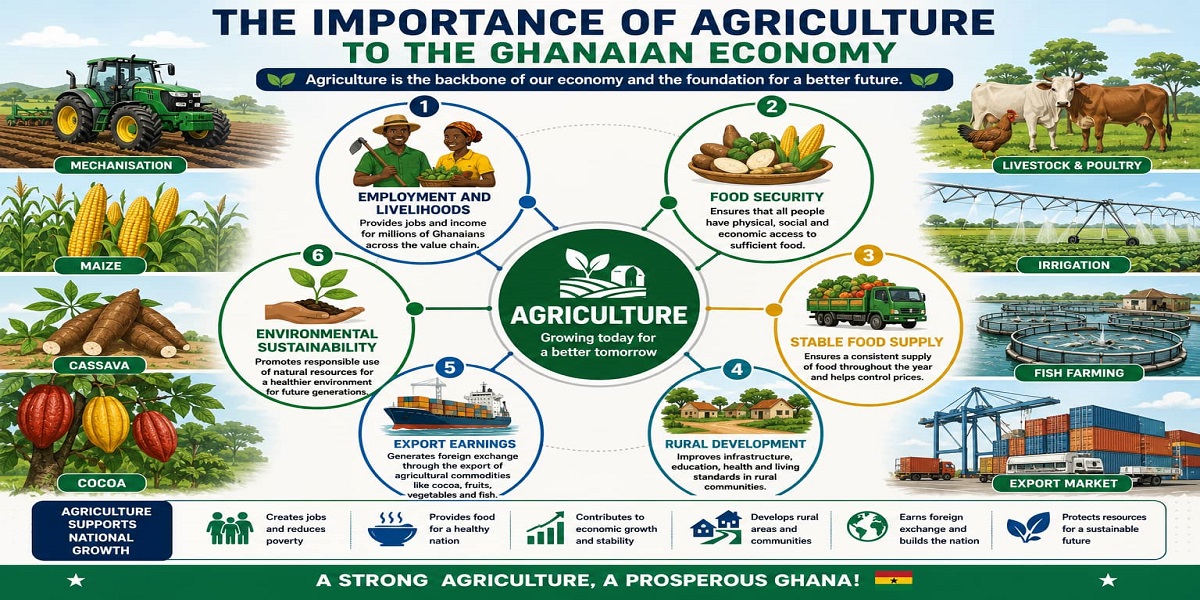
Agriculture remains one of the most important sectors of Ghana’s economy because it provides food, creates employment and supports national development.
What You Will Learn
- The meaning of agriculture.
- The meaning of environmental sustainability.
- The importance of agriculture to the Ghanaian economy.
- Examples of agricultural practices in Ghana.
- How agriculture contributes to economic development.
Main Explanation
Agriculture is the practice of cultivating plants, raising animals and carrying out related activities for the production of food, fibre and other goods needed for human consumption and use. It is one of the oldest economic activities and remains a major contributor to Ghana’s economy. Besides supplying food and raw materials, agriculture supports employment, generates export earnings and promotes rural development. In 2022, agriculture contributed 19.57% to Ghana’s Gross Domestic Product (GDP).
One of the major contributions of agriculture is the creation of employment and livelihoods. A significant proportion of Ghana’s population, particularly in rural areas, depends on agriculture for employment. People engage in farming activities either as small-scale subsistence farmers or as workers in larger agricultural enterprises. This provides income for households and contributes to reducing poverty and unemployment.
Agriculture also promotes food security by producing the food required to feed the country’s population. The production of staple crops such as maize, rice, yam and cassava helps ensure a stable supply of food while reducing dependence on imported food products.
The sector contributes to rural development by creating economic opportunities, improving infrastructure and supporting the growth of agribusinesses and related industries. Increased agricultural production also improves rural incomes and helps reduce rural-urban migration.
Agriculture is an important source of export earnings. Ghana exports agricultural products such as cocoa, cashew nuts, shea butter, fruits and vegetables to international markets. These exports earn foreign exchange, support imports and contribute to national economic growth.
Another important contribution is environmental sustainability. Sustainable agricultural practices such as conservation agriculture, organic farming and agroforestry encourage responsible management of land and natural resources. These practices help conserve water resources, maintain soil fertility, preserve biodiversity and reduce the effects of climate change.
| Importance of Agriculture | Contribution | Benefit |
|---|---|---|
| Employment and Livelihoods | Provides jobs and income | Reduces poverty and unemployment |
| Food Security | Produces food for the population | Ensures food availability |
| Stable Food Supply | Produces staple crops | Maintains stable food prices |
| Rural Development | Supports rural economic activities | Improves livelihoods and infrastructure |
| Export Earnings | Exports agricultural products | Generates foreign exchange |
| Environmental Sustainability | Promotes sustainable farming practices | Protects natural resources |
Worked Examples
Example 1
Scenario: A farming community produces maize, cassava and yam throughout the year to supply nearby towns.
Explanation: The agricultural activities provide food for the population, improve food security, generate employment and create income for farming households while supporting local economic development.
Example 2
Scenario: Ghana exports cocoa, cashew nuts and fruits to international markets.
Explanation: These agricultural exports generate foreign exchange earnings, strengthen the country’s balance of trade and contribute to economic growth by providing revenue for national development.
Why This Topic Matters
Understanding the importance of agriculture helps learners appreciate its contribution to employment, food production, export earnings, rural development and environmental sustainability. It also encourages learners to recognise agriculture as an important sector that supports national economic growth and improved living standards.
Quick Practice
- Define agriculture and environmental sustainability.
- State six ways agriculture contributes to the Ghanaian economy.
- List six examples of agricultural practices in Ghana.
- Explain how agriculture supports food security.
- Describe the importance of agriculture to your community.
Summary
Agriculture is one of the pillars of Ghana’s economy. It provides employment, ensures food security, supports rural development, earns foreign exchange through exports and promotes environmental sustainability. Through improved agricultural practices and responsible management of natural resources, agriculture continues to contribute significantly to Ghana’s economic and social development.
Access NaCCA-aligned Support Packs
Download your structured NaCCA-aligned Teacher Support Pack and Student Learning Pack, designed for clarity, practicality, and reliable teaching and learning.