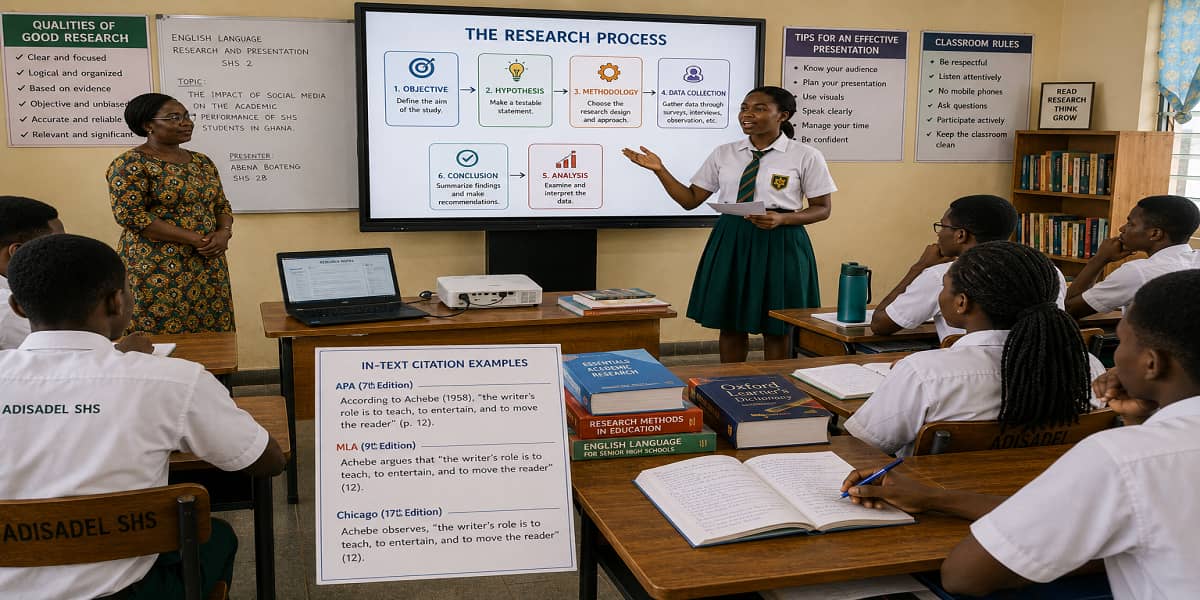
Research And Presentation Explained for SHS 2 English Language (Semester 2, Week 12)
Good presentations begin with good information. When you know how to research a topic, organise your findings and communicate them clearly, you can turn information into a message that others can understand and use.
What You Will Learn
- What research means and why it is important.
- The difference between basic research and applied research.
- The main components of research.
- What a presentation is and what makes one effective.
- How research supports clear and credible presentations.
- How in-text citation gives credit to sources.
Main Explanation
Research is a systematic process of investigating, studying and exploring information. It can be used to establish facts, answer questions, solve problems or develop new theories. Research is therefore more than simply collecting information. It involves working with information in an organised way so that useful conclusions can be reached.
Research is important in many areas of life. It helps people increase knowledge, solve practical problems, make decisions based on evidence, develop new products and methods, and improve education through new findings and insights.
Types Of Research
| Type | Purpose |
|---|---|
| Basic Research | Expands knowledge and seeks to understand fundamental principles and theories without a specific practical application in mind. |
| Applied Research | Addresses specific practical problems by applying existing knowledge to develop new products, processes or technologies. |
The main difference is the focus of the research. Basic research seeks to expand knowledge, while applied research uses knowledge to address specific practical problems.
Key Components Of Research
Objective
The objective states clearly what the research aims to achieve or understand. A clear objective gives direction to the research.
Hypothesis
A hypothesis is a proposed explanation or prediction that can be tested through the research.
Methodology
Methodology is the systematic plan used to carry out the research. It includes the methods used to collect and analyse data.
Data Collection
Data collection involves gathering information. The information may come from primary sources such as experiments, surveys and observations, or from secondary sources such as books, articles and databases.
Analysis
Analysis involves examining and interpreting the collected data to identify patterns, relationships or trends.
Conclusion
The conclusion summarises the findings and determines whether the hypothesis was supported or refuted.
Publication
Publication involves sharing the research results with a wider community through reports, articles, presentations or other forms of communication.
Why Research Matters
Research helps us move from assumptions to evidence. It can increase knowledge, provide solutions to practical problems and support decisions by policymakers, businesses and individuals. It can also promote innovation by contributing to new products, technologies and methods.
In education, research provides new findings and insights that can support both teaching and learning. This makes research an important skill for students who need to investigate questions, understand information and communicate what they have discovered.
Presentation: Turning Research Into A Clear Message
A presentation is a structured form of communication in which an individual or group shares information, ideas or arguments with an audience. Presentations are used in education, business and conferences to inform, persuade or entertain.
A strong presentation does not depend only on having information. The information must be organised clearly and delivered in a way that suits the audience.
Key Elements Of A Presentation
| Element | What It Means |
|---|---|
| Purpose | The main objective of the presentation, such as informing, persuading or entertaining. |
| Audience | The people receiving the presentation. Their background, needs and expectations should be considered. |
| Content | The information or message being communicated. It should be organised logically and coherently. |
| Structure | The arrangement of the presentation, usually consisting of an introduction, body and conclusion. |
| Delivery | The way the message is communicated, including tone, body language, eye contact and pacing. |
Types Of Presentations
- Informative Presentation: Provides information, explains concepts or teaches the audience about a topic.
- Persuasive Presentation: Seeks to convince the audience to accept a viewpoint, take an action or change a behaviour.
- Demonstrative Presentation: Shows the audience how to do something through a step-by-step process.
- Inspirational Presentation: Aims to motivate and inspire the audience.
- Business Presentation: Covers matters such as project updates, financial reports, strategic plans and pitches in a business setting.
- Technical Presentation: Communicates technical information, including complex data, methodologies or scientific findings.
- Team Presentation: Is delivered by a group in which each member contributes part of the overall message. Coordination and collaboration are important.
Tips For Effective Presentations
- Know Your Audience: Consider the audience’s interests, level of knowledge and expectations when preparing the content and planning the delivery.
- Practise: Rehearse the presentation several times to become familiar with the content and improve your delivery.
Research And Presentation Work Together
Research and presentation are closely connected. Research provides the essential groundwork for creating a well-informed, credible and engaging presentation.
The depth and quality of the research can directly influence the effectiveness and impact of the presentation. When information has been properly researched, it gives the presenter a stronger basis for communicating ideas to the audience.
In-Text Citation
When you use information, ideas or data from another source in academic writing, you need to give credit to the original source. In-text citation is one way of doing this. The format used depends on the citation style.
APA Style
The APA 7th edition format uses the author’s last name and year of publication.
Format: (Author’s Last Name, Year of Publication)
Example: (Smith, 2020)
For a direct quotation, the page number is also included.
Example: (Smith, 2020, p. 23)
- Two authors: (Smith & Jones, 2020)
- Three or more authors: (Smith et al., 2020)
MLA Style
The MLA 8th edition format uses the author’s last name and page number.
Format: (Author’s Last Name Page Number)
Example: (Smith 23)
- Two authors: (Smith and Jones 23)
- Three or more authors: (Smith et al. 23)
Chicago Style
The Chicago 17th edition author-date style uses the author’s last name, year of publication and, where applicable, the page number.
Format: (Author’s Last Name Year of Publication, Page Number)
Example: (Smith 2020, 23)
- Two authors: (Smith and Jones 2020, 23)
- Three or more authors: (Smith, Jones, and Brown 2020, 23)
Worked Examples
Example 1
Scenario: A group of learners is asked to research the effects of examination malpractice and present its findings to the class.
Explanation: The group first needs to gather relevant information from appropriate local or internet sources. The information can then be examined and organised into a clear presentation. The presentation should have a purpose, suitable content and a clear structure, while the delivery should consider the audience.
Example 2
Scenario: A learner uses an idea from a source published by Smith in 2020 and wants to acknowledge the source using APA style.
Explanation: The learner can use the in-text citation (Smith, 2020). If the learner directly quotes from page 23, the citation becomes (Smith, 2020, p. 23).
Why This Topic Matters
Research and presentation skills are useful beyond the classroom. They help learners investigate issues, evaluate information, solve problems and communicate findings to others. These skills can also support communication, critical thinking, creativity and reasoning in real-life situations.
Learning how to cite sources is equally important because it shows where information, ideas and data have come from. This helps learners organise academic work responsibly while building confidence in research and presentation.
Quick Practice
- State two types of research and explain the difference between them.
- List five key components of research.
- State five key elements of a presentation.
- Identify the type of presentation that shows an audience how to perform a task step by step.
- Write the APA in-text citation for a work by Smith published in 2020.
- Using APA style, write the citation for a direct quotation from page 23 of Smith’s 2020 work.
Summary
Research is a systematic process of investigating information to establish facts, answer questions, solve problems or develop new theories. Basic research expands knowledge, while applied research focuses on specific practical problems. Research involves components such as an objective, hypothesis, methodology, data collection, analysis, conclusion and publication.
A presentation provides a structured way to communicate research findings, ideas or arguments to an audience. Its effectiveness depends on a clear purpose, suitable content, logical structure, knowledge of the audience and effective delivery. Research provides the foundation for a credible presentation, while in-text citation helps give credit to the sources used in academic writing.
Access NaCCA-aligned Support Packs
Download your structured NaCCA-aligned Teacher Support Pack and Student Learning Pack, designed for clarity, practicality, and reliable teaching and learning.
Similar Posts
Market Equilibrium And Determination Of Equilibrium Price And Quantity – SHS 2 Economics (S2 W3)
Market Equilibrium And Determination Of Equilibrium Price And Quantity Explained for SHS 2 Economics (Semester 2, Week 3) Every market seeks a balance between what consumers want to buy and what producers want to sell. This balance is known as market equilibrium. What You Will Learn The meaning of market equilibrium The concepts of equilibrium…
Regional Materials And Privileged Materials – SHS 2 Art & Design Foundation (S2 W1)
Regional Materials And Privileged Materials Explained for SHS 2 Art & Design Foundation (Semester 2, Week 1) Artists use both valuable privileged materials and locally available regional materials to create meaningful and expressive artworks. What You Will Learn The meaning of privileged materials The meaning of regional materials Examples of privileged materials in art How…
Market And Its Types – SHS 1 Economics (S2 W3)
Market And Its Types Explained for SHS 1 Economics (Semester 2, Week 3) Every day, people buy and sell goods and services through different forms of markets. Understanding how markets operate helps explain how economies function. What You Will Learn The meaning of a market The importance of markets in the economy The forms of…
Introduction To National Income And Calculation Using The Product Approach – SHS 2 Economics (S2 W5)
Introduction To National Income And Calculation Using The Product Approach Explained for SHS 2 Economics (Semester 2, Week 5) How do economists determine the total value of goods and services produced in a country? One important method is the product approach to calculating national income. What You Will Learn The meaning of national income The…
The Rise and Decline of States in the Savannah Zone of Ghana – SHS 1 History (S1 W8)
The Rise and Decline of States in the Savannah Zone of Ghana Explained for SHS 1 History (Sem. 1 – Week 8) States do not emerge simply because people occupy a particular territory. Political authority develops through relationships among leadership, institutions, economic activity, belief systems, military capacity and the wider environment. The history of Ghana’s…
Price In The Economy – SHS 1 Economics (S2 W4)
Price In The Economy Explained for SHS 1 Economics (Semester 2, Week 4) Every purchase we make involves a price. Whether buying food, clothing, transportation, or electronic devices, price influences our decisions and plays a vital role in the economy. What You Will Learn The meaning of price How prices are determined The relationship between…