
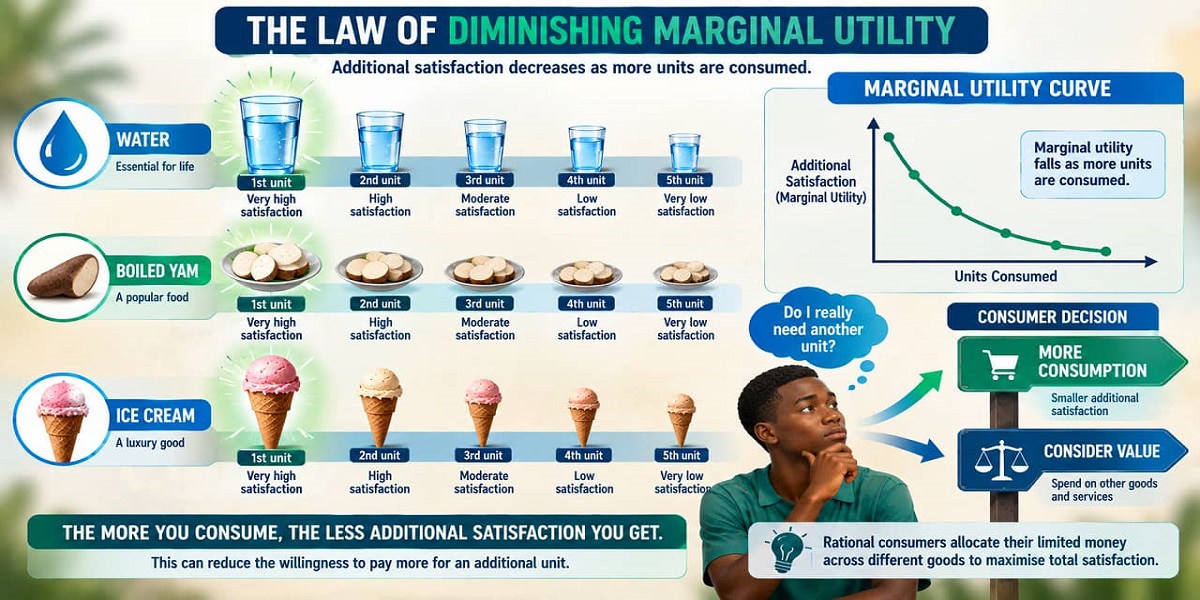
The Law of Diminishing Marginal Utility in Everyday Life Explained for SHS 1 Economics (Sem. 1 – Week 7)
The first glass of water you drink when extremely thirsty can feel remarkably satisfying. The second may still be welcome. After several glasses, however, another glass may not seem nearly as valuable.
This simple experience captures a powerful economic idea: the law of diminishing marginal utility.
Start With the “Next Unit”
To understand the idea, focus on the word marginal.
Marginal utility is the additional satisfaction gained from consuming one more unit of a good or service.
It is therefore not asking, “How much satisfaction have I received altogether?” It asks:
“What extra satisfaction will the next unit give me?”
Why Does the Next Unit Usually Matter Less?
When a particular need or want is being satisfied, the urgency of that need can decline.
A thirsty person has a strong reason to drink water. The first glass directly addresses that thirst. Once some thirst has been satisfied, another glass may still help, but its additional contribution can be smaller.
With continued consumption, the additional satisfaction tends to diminish.
Water: The Clearest Everyday Example
Imagine three stages:
| Stage | Experience | Marginal Utility |
|---|---|---|
| Very thirsty | First glass addresses a strong need. | High |
| Partly satisfied | Second glass still provides satisfaction. | Lower |
| Further consumption | The additional benefit continues to diminish. | Lower still |
The important point is not that water suddenly becomes useless. Rather, the additional satisfaction from another unit becomes smaller.
Boiled Yam Shows the Same Pattern
Think about eating slices of boiled yam.
If you are hungry, the first slice may provide considerable satisfaction. A second slice can still be enjoyable, but its additional satisfaction may be lower. As you continue eating, the extra satisfaction from each additional slice can diminish.
Eventually, you may feel full. Further consumption may then provide little enjoyment or even reduce enjoyment.
Ice Cream Offers Another Illustration
The same principle applies to successive cones of ice cream.
The first cone may provide a high level of satisfaction. The second and third can still be enjoyable, but the additional satisfaction may decrease with each successive cone.
The examples differ, but the economic principle remains the same.
From Satisfaction to Consumer Decisions
Diminishing marginal utility has an important implication for consumers.
When an additional unit provides less satisfaction, a consumer may attach less value to that additional unit. This can make the consumer less willing to pay more for it.
In this way, the concept connects personal satisfaction with consumer decision-making and value for money.
Imagine a Consumer at a Choice Point
You have already consumed several units of a good. Another unit is available.
Your decision can be framed around three questions:
- How much additional satisfaction will I receive?
- Do I still need or want another unit?
- Is the additional satisfaction enough to justify the choice?
As the additional satisfaction declines, the attractiveness of further consumption can also decline.
Why the Concept Matters
The law of diminishing marginal utility helps explain a familiar feature of consumer behaviour: people do not necessarily value every additional unit of a good equally.
The value of an additional unit can depend on how much has already been consumed and how much of the original need or want has been satisfied.
This provides an important link between consumption, satisfaction and choice.
Try It Yourself
Think about drinking a cup of water.
Ask:
- How do you feel before drinking it?
- How satisfied are you after the first cup?
- Would another cup provide exactly the same additional satisfaction?
- Why might your answer change after several cups?
Model explanation: The first cup may provide high additional satisfaction, especially when the person is thirsty. As more water is consumed and thirst is progressively satisfied, the additional satisfaction from another cup tends to diminish.
A Broader Lesson About Choice
Consumer decisions involve limited resources and competing uses. When the additional satisfaction from another unit falls, consumers may reconsider whether further consumption is worthwhile.
This is why the concept of marginal utility is useful beyond a single glass of water. It helps us think about the value consumers attach to successive units and how that value can influence their choices.
Key Terms
| Term | Meaning |
|---|---|
| Diminishing | Becoming less or reducing in size, intensity, importance or effectiveness over time. |
| Marginal | The additional change or effect from a small increase or decrease. |
| Marginal utility | The additional satisfaction gained from consuming one more unit. |
| Diminishing marginal utility | The tendency for additional satisfaction to decrease as more units are consumed. |
Final Takeaway
The law of diminishing marginal utility is easiest to understand through experience.
The first glass of water when very thirsty can provide substantial satisfaction. A second may provide less additional satisfaction, and further glasses may provide still less.
The same reasoning can be applied to boiled yam and ice cream.
Marginal utility focuses on the additional satisfaction from the next unit. As consumption continues, that additional satisfaction tends to diminish.
This helps explain why consumers may place less value on additional units and why diminishing marginal utility can influence consumer decision-making and value for money.
Access NaCCA-aligned Support Packs
Download your structured NaCCA-aligned Teacher Support Pack and Student Learning Pack, designed for clarity, practicality, and reliable teaching and learning.