
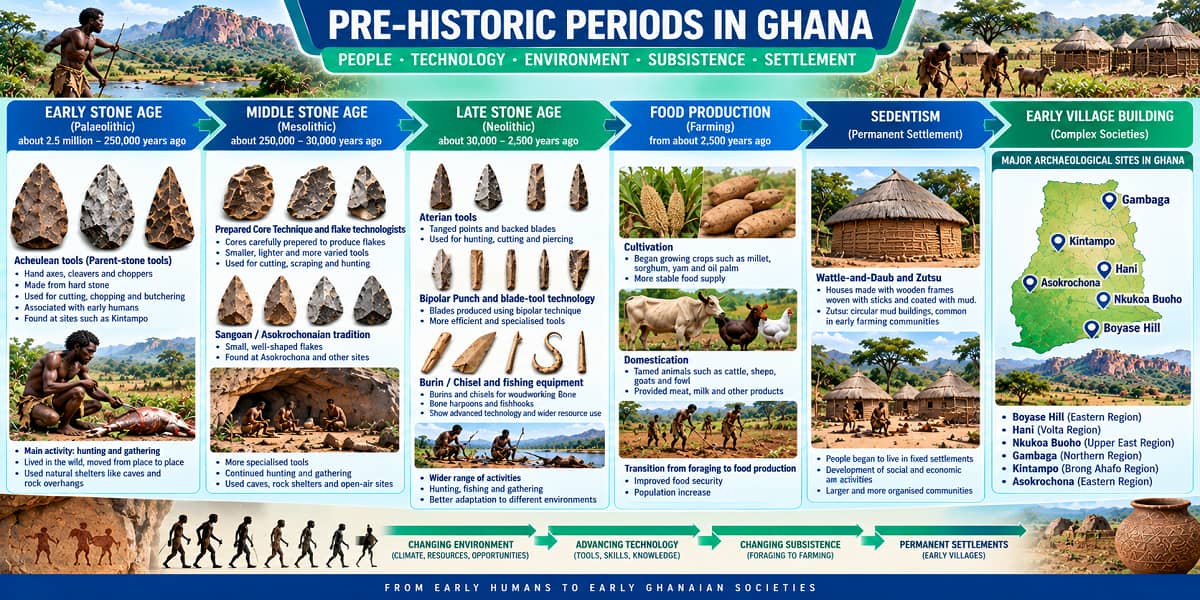
Pre-Historic Periods in Ghana
Imagine trying to understand the lives of people who lived in Ghana thousands of years ago, before written records were introduced. What evidence would help us reconstruct their lives?
Archaeological evidence such as stone tools, bones, pottery and settlement remains provides important clues. By examining these clues and arranging developments in sequence, we can understand the major stages of Ghana’s pre-history and the changes in human technology, subsistence and settlement.
1. What Is Pre-History?
Pre-history refers to the period before writing was introduced into a particular society. In Ghana, the pre-historic period presented in this lesson extends from 50,000 BCE to 700 CE.
The major phases identified are:
- Early Stone Age
- Middle Stone Age
- Late Stone Age
2. The Early Stone Age in Ghana
The Early Stone Age was characterised by the use of parent stones rather than flakes in the manufacture of tools.
The earliest tools discovered in Ghana were found in the fossil gravel of the Volta, Oti and Birim Rivers. Other tools were found at a fossil marine beach at Asokrochona near Tema.
These early tools were called Acheulean tools. They were used for activities including:
- hunting;
- food gathering; and
- meat preparation.
The tools therefore provide evidence not only of technological ability but also of the activities undertaken by early people.
Reading an Early Stone Age Tool
When studying an archaeological tool, we can ask:
- What material was used to make it?
- How was it manufactured?
- What was it probably used for?
- What does its design reveal about the skills of its maker?
- What can its archaeological context tell us?
This is source analysis: using physical evidence to develop reasonable interpretations about the past.
3. The Middle Stone Age in Ghana
The Middle Stone Age brought improvements in toolmaking technology. A major development was the Prepared Core Technique, which tended to use flakes more than cores.
The people who manufactured these tools were therefore described as Flake Technologists.
In some parts of Ghana, people combined the older core-tool technique with the newer flake-tool technique. The choice of technique was influenced largely by the environmental conditions in which people lived.
The Sangoan Tradition
In the grassland and forest regions of middle and southern Ghana, the tool tradition was similar to the Sangoan Tradition, named after Sango Bay in Uganda.
Cultural materials associated with this tradition were excavated at Asokrochona near Tema Beach. Some archaeologists in Ghana refer to the materials found there as the Asokrochonaian Tradition.
The Aterian Industry
In northern Ghana, Middle Stone Age people used the Prepared Core Technique to produce flake tools widely distributed in the confluence region of the Black and White Volta Rivers.
A stone industry known as Aterian was associated with this technique. Its tools included flaked knives and arrowheads with thick bases fixed in wooden shafts.
4. The Late Stone Age in Ghana
The Late Stone Age is also described as the Era of Blade-Tool Technologists. People of this period developed technology in response to growing economic demands.
A new technique known as the Bipolar Punch was adopted. A tool called a burin or chisel helped in producing fishing equipment such as:
- bone harpoons;
- bone fishhooks; and
- stone arrowheads.
Evidence from rock shelters at Kintampo in the Bono East Region and shelters along the Kwahu escarpment provides information about this period.
Late Stone Age people hunted animals using methods such as poisoned stone arrowheads and traps. They also gathered shellfish and giant snails for food.
Organic remains found in rock shelters and caves also include Celtis integrifolia (Nettle Tree), Canarium schweinfurthii (Incense Tree) and Elaeis guineensis (Oil Palm Tree).
| Period | Main technological feature | Examples of activities/evidence |
|---|---|---|
| Early Stone Age | Parent stones used instead of flakes; Acheulean tools. | Hunting, food gathering and meat preparation. |
| Middle Stone Age | Prepared Core Technique; increased use of flakes. | Flake knives and arrowheads; Aterian industry; environmental adaptation. |
| Late Stone Age | Bipolar Punch; blade-tool technology; burin or chisel. | Bone harpoons, fishhooks, stone arrowheads, hunting, trapping and gathering. |
5. What Changed Across the Stone Ages?
The progression from the Early Stone Age through the Middle and Late Stone Ages demonstrates continuity and change.
The use of stone remained important, but toolmaking techniques became more varied. The use of flakes became more important in the Middle Stone Age, while Late Stone Age technology included blade tools and equipment associated with fishing.
These developments demonstrate human ingenuity and resourcefulness. People adapted technologies to their needs and, according to the lesson, to environmental conditions.
6. From Foraging to Food Production
Foraging involved obtaining plant and animal resources through hunting and gathering according to their availability within a particular environment.
From about 10,000 BCE, changes made it difficult for this system alone to provide a sustainable food supply. Two important developments were identified:
- climatic changes reduced rainfall, causing some rivers and lakes to dry up and some animals and plants to disappear;
- population growth increased the need to produce more food.
Between 10,000 and 2,000 BCE, people adopted a new economic order called food production.
Two stages characterised this development:
- Cultivation
- Domestication
This change represents an important shift from reliance on foraging towards more organised food production.
7. The First Village Builders
The development of food production was accompanied by human sedentism. People abandoned long-term nomadic practices and increasingly settled in permanent houses.
Archaeological excavations in Ghana have revealed remains of fossil mud, laterite blocks and stone blocks used in the construction of the prehistoric Wattle-and-Daub style of building.
This building technology is still used in Ghana and is known among the Dangme as Zutsu.
Evidence of Early Settlements
Prehistoric settlement remains associated with this building style have been discovered at:
- Boyase Hill near Kumasi Airport;
- Hani in the Bono Region;
- Nkukoa Buoho near Kumasi; and
- Gambaga in north-eastern Ghana.
Inhabitants of these settlements were involved in activities including the production of stone beads, stone arrowheads, clay pots and milling stones.
8. From Stone Tools to Settled Communities
Look at the overall pattern:
Stone-tool development → changing subsistence strategies → food production → sedentism → permanent settlements.
This sequence does not mean that every development happened in exactly the same way everywhere. It helps us recognise a broad pattern of technological and economic change described in Ghana’s pre-history.
| Development | Key feature |
|---|---|
| Early Stone Age | Acheulean tools made using parent stones; hunting, gathering and meat preparation. |
| Middle Stone Age | Prepared Core Technique and increased use of flakes. |
| Late Stone Age | Blade-tool technology, Bipolar Punch and specialised fishing equipment. |
| Food production | Cultivation and domestication between 10,000 and 2,000 BCE. |
| Village building | Sedentary communities and permanent houses using materials including mud, laterite and stone. |
9. Think Like a Historian
Suppose you discover a stone tool at an archaeological site. It is tempting to immediately decide what it was used for. Historical thinking requires more care.
You should examine its material, shape, manufacturing technique, archaeological context and similarities to other known tools. You can then develop an interpretation of its possible function and significance.
This approach combines source analysis, chronological reasoning, cause and consequence, and continuity and change.
10. Check Your Understanding
Question 1
What is pre-history?
Answer: Pre-history refers to the period before writing was introduced into a particular society.
Question 2
What are the three major phases of Ghana’s pre-history identified in this lesson?
Answer: Early Stone Age, Middle Stone Age and Late Stone Age.
Question 3
What were Acheulean tools used for?
Answer: They were used for hunting, food gathering and meat preparation.
Question 4
What was the Prepared Core Technique?
Answer: It was a Middle Stone Age toolmaking technique that tended to use flakes more than cores.
Question 5
What technique was adopted during the Late Stone Age?
Answer: The Bipolar Punch technique was adopted.
Question 6
Why did food production become necessary from about 10,000 BCE?
Answer: Climatic changes reduced rainfall and caused some water bodies, plants and animals to disappear, while population growth increased the need to produce more food.
Question 7
What two stages characterised food production?
Answer: Cultivation and domestication.
Question 8
What evidence demonstrates the development of permanent settlements?
Answer: Archaeological remains of fossil mud, laterite blocks and stone blocks used in Wattle-and-Daub buildings, together with remains of activities such as stone-bead, arrowhead, clay-pot and milling-stone production.
11. Final Synthesis
Ghana’s pre-historic period, as presented in this lesson, extends from 50,000 BCE to 700 CE and includes the Early, Middle and Late Stone Ages.
The Early Stone Age was associated with Acheulean tools made from parent stones and used for hunting, food gathering and meat preparation. The Middle Stone Age introduced greater use of flakes through the Prepared Core Technique, while the Late Stone Age developed blade-tool technology and the Bipolar Punch technique, including equipment for fishing.
Later developments in food production involved cultivation and domestication. Changes in climate and population growth contributed to the shift from foraging towards food production. The development of sedentism then contributed to the emergence of permanent settlements and Wattle-and-Daub building.
The major historical idea is change through adaptation: technological developments, changing subsistence strategies and settlement patterns provide evidence of how early communities in Ghana responded to their circumstances over time.
Access NaCCA-aligned Support Packs
Download your structured NaCCA-aligned Teacher Support Pack and Student Learning Pack, designed for clarity, practicality, and reliable teaching and learning.