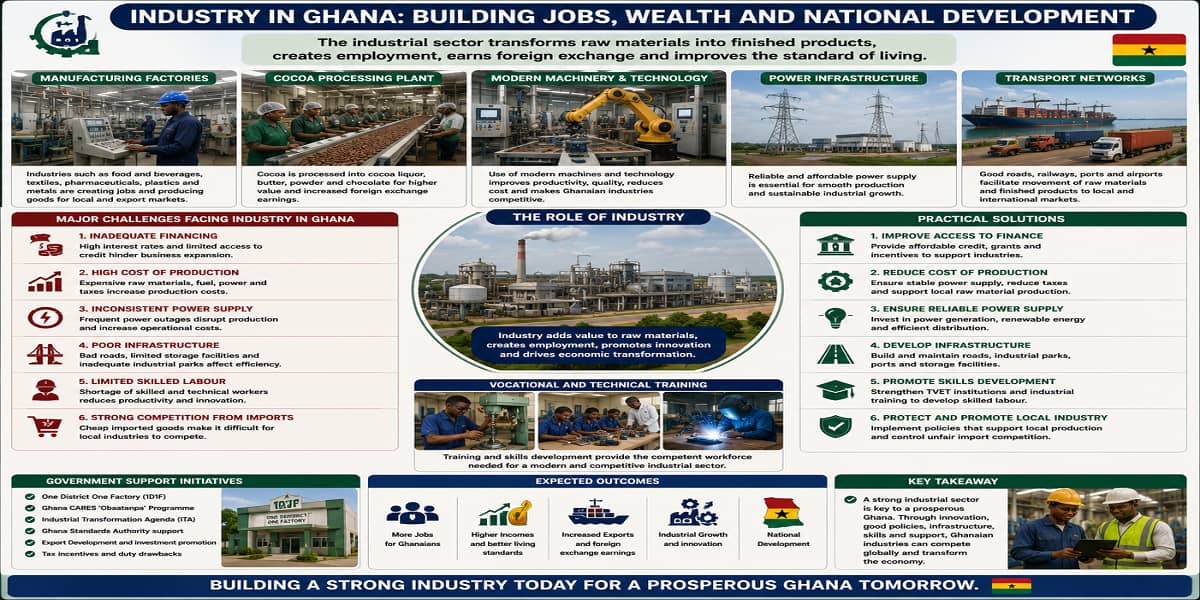
Challenges And Solutions To The Secondary Industrial Sector In Ghana
Introduction
The secondary industrial sector involves processing, manufacturing, and construction activities that transform raw materials into finished goods. It is one of the three major sectors of the economy and contributes significantly to Ghana’s economic development through industrial production, employment creation, and value addition. Despite its importance, the sector faces several challenges that affect productivity, competitiveness, and industrial growth.
Key Concepts
- Secondary Industrial Sector: The sector of the economy involved in processing, manufacturing, and construction.
- Manufacturing: The transformation of raw materials into finished goods.
- Infrastructure: Basic facilities such as electricity, roads, railways, ports, and water supply that support industrial activities.
- Technological Adoption: The use of modern technologies and innovations to improve production.
- Vocational Training: Practical education that equips individuals with industry-related skills.
- Industrial Development Fund: Financial support established to promote industrial investment and expansion.
Explanation
The secondary industrial sector transforms raw materials into finished products through manufacturing, construction, and energy production. It adds value to raw materials and contributes to employment, industrialisation, and economic growth. However, several obstacles limit the sector’s ability to realise its full potential in Ghana.
One major challenge is inadequate infrastructure. Frequent power outages, unreliable electricity supply, poor road networks, inadequate railway systems, congested ports, and inconsistent water supply increase production costs and disrupt manufacturing activities. Industries that rely heavily on water and electricity are particularly affected.
Limited access to affordable finance prevents industries from investing in modern equipment and expanding production. A shortage of skilled labour also exists because the skills possessed by many workers do not always match industry requirements. High production costs resulting from expensive raw materials, energy, and transportation reduce the competitiveness of locally manufactured products. Regulatory and bureaucratic procedures may discourage investment, while limited technological adoption reduces productivity and efficiency.
Challenges Facing The Secondary Industrial Sector
| Challenge | Description | Effect |
|---|---|---|
| Infrastructure Deficits | Unreliable electricity, roads, railways, ports, and water supply | Higher production costs and disruptions |
| Access To Finance | Limited affordable funding | Restricted industrial expansion |
| Skilled Labour Shortage | Mismatch between workforce skills and industry needs | Reduced productivity |
| High Production Costs | Expensive raw materials, energy, and logistics | Reduced competitiveness |
| Regulatory And Bureaucratic Hurdles | Complex administrative procedures | Slower investment and business growth |
| Technological Gaps | Limited use of modern technology | Lower efficiency and innovation |
Several solutions can improve the performance of the industrial sector. Investment in reliable electricity, transport infrastructure, and water systems enhances industrial operations. Improving access to finance through affordable loans and industrial development funds encourages business expansion. Vocational education and apprenticeship programmes help develop skilled labour. Production costs can be reduced by promoting local raw materials and energy-efficient technologies. Regulatory reforms simplify business procedures, while research, innovation, and tax incentives encourage technological advancement.
Solutions To Industrial Challenges
| Solution | Description | Expected Outcome |
|---|---|---|
| Infrastructure Development | Improve electricity, transport, and water systems | Efficient industrial operations |
| Improving Access To Finance | Affordable loans and industrial development funds | Business expansion |
| Skill Development Programmes | Vocational training and apprenticeships | Skilled workforce |
| Reducing Production Costs | Use local raw materials and energy-efficient technologies | Greater competitiveness |
| Streamlining Regulatory Processes | Simplify business registration and licensing | Increased investment |
| Encouraging Technological Adoption | Research support and technology incentives | Higher productivity and innovation |
The cocoa processing industry illustrates how these solutions can be applied. Government tax incentives, investments in energy and transport infrastructure, access to affordable finance, technology transfer partnerships, and workforce training have been introduced to increase value addition and improve Ghana’s competitiveness in processed cocoa products.
Examples
Example 1
Problem: Explain one effect of unreliable electricity supply on industries.
- Identify the infrastructure problem.
- Determine its effect on production.
- State the economic consequence.
Final Answer: Unreliable electricity increases operational costs and disrupts production activities in industries.
Example 2
Problem: State one measure that can improve industrial productivity.
- Identify a challenge.
- Match it with an appropriate solution.
- Explain the expected result.
Final Answer: Providing vocational training programmes equips workers with industry-relevant skills and improves productivity.
Application and Activities
- Identify industries operating within your community.
- Discuss the effects of unreliable infrastructure on manufacturing businesses.
- Suggest measures that can improve industrial development in Ghana.
- Examine how technology can increase industrial productivity.
Practice Questions
- State four challenges facing Ghana’s secondary industrial sector.
- Explain four solutions to the challenges facing the industrial sector.
- Discuss the importance of infrastructure in industrial development.
Summary
The secondary industrial sector plays a significant role in Ghana’s economy through manufacturing and value addition. However, infrastructure deficits, limited finance, shortages of skilled labour, high production costs, regulatory challenges, and technological gaps affect its growth. Solutions such as infrastructure development, improved financing, vocational training, regulatory reforms, and technological innovation can strengthen industrial productivity and promote sustainable economic development.
Access NaCCA-aligned Support Packs
Download your structured NaCCA-aligned Teacher Support Pack and Student Learning Pack, designed for clarity, practicality, and reliable teaching and learning.