Economics Starts from the Home and the Economist
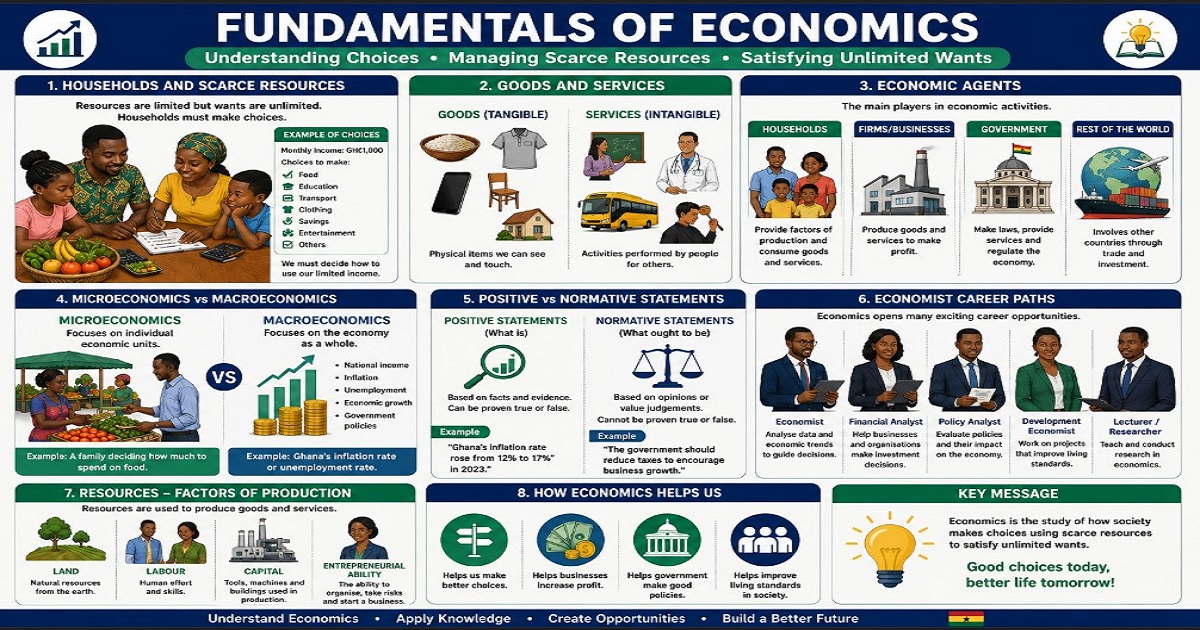
Economics begins with everyday life. At home, in school and in the wider community, people have many wants and needs, but the resources available to satisfy them are limited. This situation makes choice and careful allocation of resources necessary.
Economics helps us understand how individuals, businesses and governments make these choices.
1. Economics in Everyday Life
Think about a household with limited food but several people who need to eat. Everyone may want enough food, but the available quantity may not be enough to satisfy everyone fully. A decision has to be made about how the available food will be used.
Similarly, when resources available at school are not enough to satisfy every need, choices have to be made about their use.
These everyday situations introduce the central economic problem: human wants are unlimited, but resources are limited.
2. What Is Economics?
Economics is a social science that studies how individuals, businesses and governments allocate their limited resources to satisfy their unlimited wants and needs.
Economics is therefore concerned with choice. Since resources are scarce in relation to people’s wants and needs, individuals and organisations must decide how best to allocate what they have.
3. The Basic Economic Problem
Human beings have numerous wants and needs. However, the resources available to satisfy those wants and needs are limited.
This creates a situation in which people cannot have everything they want. They must therefore make choices.
The basic relationship can be expressed as:
Unlimited Wants + Limited Resources → Choice → Allocation of Resources
This relationship is at the heart of Economics.
4. Goods
Goods are tangible items.
Examples include:
- cars;
- houses;
- food; and
- clothing.
The important feature of a good is that it is tangible, meaning that it has a physical form.
5. Services
Services are intangible items or activities.
Examples include:
- cleaning;
- teaching;
- health care services; and
- transport services.
| Goods | Services |
|---|---|
| Tangible | Intangible |
| Cars, houses, food, clothing | Cleaning, teaching, health care, transport |
6. Resources
Resources are the various factors or inputs used in the production of goods and services to satisfy human wants and needs.
Resources are also called factors of production.
The main resources are:
- Land
- Labour
- Capital
- Entrepreneurial ability
Because these resources are limited, they have to be carefully allocated among competing uses.
7. Economic Agents
Economic agents are individuals, groups or entities that make decisions about the allocation of scarce resources in order to achieve their objectives.
Economic agents include:
- households;
- firms;
- governments; and
- other organisations involved in economic activities.
These economic agents interact in the process of producing, distributing and consuming goods and services.
8. Economics Starts from the Home
The home is a useful place to begin studying Economics because the economic problem can easily be observed there.
A household has limited resources but may have many competing wants and needs. Household members must therefore make decisions about how the available resources should be used.
The same principle applies to firms and governments. They also have objectives to achieve but must make decisions within the limits of available resources.
9. Two Broad Branches of Economics
Economics can be studied from two broad perspectives: microeconomics and macroeconomics.
Microeconomics
Microeconomics examines the behaviour of individual households, firms and industries. It considers the allocation of resources, market interactions and individual decision-making.
Macroeconomics
Macroeconomics focuses on the economy as a whole. It analyses aggregate variables such as GDP, inflation and unemployment, as well as fiscal and monetary policies.
10. Microeconomics and Macroeconomics Compared
| Microeconomics | Macroeconomics |
|---|---|
| Studies individual households, firms and industries. | Studies the economy as a whole. |
| Examines resource allocation, market interactions and individual decision-making. | Examines aggregate economic variables. |
| Focuses on individual economic units. | Includes GDP, inflation, unemployment, fiscal policy and monetary policy. |
11. Positive Economics
Positive Economics deals with objective statements based on facts and data analysis.
It describes and explains economic phenomena as they are without expressing opinions or value judgements.
For example:
“Ghana’s government introduced a program to provide free primary education, leading to increased enrollment and access to education.”
This is positive because it describes an economic situation and its reported effect rather than stating what ought to happen.
12. Normative Economics
Normative Economics involves subjective value judgements and concerns what ought to be.
For example:
“The government should provide subsidies for small farmers to promote agricultural productivity and food security.”
This is normative because it expresses a judgement about what the government should do.
13. Positive and Normative Statements
| Positive | Normative |
|---|---|
| Based on objective statements, facts and data. | Involves subjective value judgements. |
| Describes or explains what is. | Concerns what ought to be. |
| Does not express a value judgement. | Expresses a judgement or recommendation. |
14. How to Identify the Difference
When you read an economic statement, ask one simple question:
Is the statement describing what is happening, or is it saying what ought to happen?
If it describes or explains an economic phenomenon as it is, it is positive.
If it expresses a judgement about what ought to happen, it is normative.
15. An Economist
An economist is a professional who studies and analyses the production, distribution and consumption of goods and services within an economy.
Economists use economic theories, models and empirical research to understand how economies function, identify trends and predict future developments.
16. The Private Sector
The private sector refers to the part of the economy that is owned, controlled and operated by private individuals or entities rather than by the government.
Economists working in the private sector can contribute to business and financial decision-making through economic analysis.
17. The Public Sector
The public sector refers to the part of an economy that is owned, controlled and operated by the government or its agencies at national, regional or local levels.
Economists in the public sector can contribute to policy-making and economic development.
18. Career Opportunities in Economics
Studying Economics can open career opportunities in both the private and public sectors.
These opportunities include:
- data analysis and research;
- entrepreneurship and innovation;
- economic development;
- environmental economics;
- social policy analysis;
- government economic roles;
- central banking;
- international organisations;
- investment banking;
- financial analysis;
- market research; and
- consulting.
19. Data Analysis and Research
Economists can work as data analysts and research associates.
Their work can involve analysing large datasets, conducting empirical studies and producing economic forecasts. These skills are relevant in academia, think tanks and research organisations.
20. Entrepreneurship and Innovation
Economics can also prepare learners for entrepreneurial ventures and innovative roles.
Economic knowledge can help in identifying market opportunities, understanding consumer behaviour and making informed business decisions.
21. Policy and Social Impact
Economics can lead to roles connected with policy and social issues.
Examples include:
- economic development specialist;
- environmental economist; and
- social policy analyst.
These roles apply economic thinking to questions involving development, the environment and social policy.
22. Business and Finance
Economists can work in business and finance in areas such as:
- investment banking;
- financial analysis;
- market research; and
- consulting.
Economic analysis contributes to decision-making in these fields.
23. Career Opportunities at a Glance
| Career Area | Possible Tasks |
|---|---|
| Data analysis and research | Analyse datasets, conduct empirical studies and produce economic forecasts. |
| Entrepreneurship and innovation | Identify market opportunities, understand consumer behaviour and support business decisions. |
| Policy and social impact | Work in economic development, environmental economics and social policy analysis. |
| Government and public institutions | Contribute to policy-making and economic development. |
| Business and finance | Apply economic analysis in investment banking, financial analysis, market research and consulting. |
24. Activity: Find Economics Around You
Think about a situation at home, school or in your community where available resources are limited.
Answer these questions:
- What resources are limited?
- What wants or needs are competing for those resources?
- What choice has to be made?
- How are the available resources allocated?
Answer guide: A complete response should identify the limited resources, the competing wants or needs and the decision about how the resources should be allocated.
25. Activity: Positive or Normative?
Classify each statement.
A. “The government introduced a programme that increased access to education.”
Answer: Positive, because it describes an economic situation.
B. “The government should increase support for small farmers.”
Answer: Normative, because it expresses what the government ought to do.
26. Activity: Micro or Macro?
A. The behaviour and decision-making of an individual household are being examined.
Answer: Microeconomics.
B. GDP, inflation and unemployment in the economy are being examined.
Answer: Macroeconomics.
27. Activity: Think About Economics as a Career
Identify two possible Economics career paths, one in the private sector and one in the public sector.
For each one, explain at least one task an economist may perform.
Answer guide: A suitable private-sector example could be financial analysis, market research, investment banking or consulting. A suitable public-sector example could involve government economic work, policy-making or economic development.
28. Group Discussion
Work with classmates to identify Economics-related career opportunities.
Discuss both private- and public-sector opportunities. Listen respectfully to different views and allow every group member an opportunity to contribute.
29. Critical Thinking
Question: A learner says, “Economics is simply the study of money.” Do you agree?
Answer: No. Economics studies how individuals, businesses and governments allocate scarce resources to satisfy unlimited wants and needs. Money may be involved in economic activity, but the central concern is choice and the allocation of limited resources.
30. Review Questions
1. Define Economics.
Answer: Economics is the social science that studies how individuals, businesses and governments allocate limited resources to satisfy unlimited wants and needs.
2. What are goods?
Answer: Goods are tangible items such as cars, houses, food and clothing.
3. What are services?
Answer: Services are intangible items such as cleaning, teaching, health care and transport services.
4. Mention the four main resources or factors of production.
Answer: Land, labour, capital and entrepreneurial ability.
5. Who are economic agents?
Answer: They are individuals, groups or entities that make decisions about allocating scarce resources to achieve their objectives.
6. Name two broad branches of Economics.
Answer: Microeconomics and macroeconomics.
7. Differentiate between positive and normative Economics.
Answer: Positive Economics describes and explains economic phenomena as they are using objective statements, facts and data. Normative Economics involves subjective value judgements about what ought to be.
8. What is an economist?
Answer: An economist is a professional who studies and analyses the production, distribution and consumption of goods and services within an economy.
9. Mention two career paths available to Economics students.
Answer: Examples include data analysis, research, entrepreneurship, economic development, environmental economics, social policy analysis, government economic work, investment banking, financial analysis, market research and consulting.
10. Explain two tasks performed by economists.
Answer: Economists may analyse large datasets and conduct empirical studies in research roles. In business and finance, they may apply economic analysis to financial analysis, market research, investment banking or consulting.
31. Final Synthesis
Economics begins with an everyday reality: human wants and needs are unlimited, but resources are limited.
Because resources are scarce, individuals, businesses and governments must make choices about how to allocate them.
Goods are tangible, while services are intangible. Resources are the inputs used to produce goods and services, and economic agents make decisions about scarce resources.
Microeconomics examines individual households, firms and industries, while macroeconomics focuses on the economy as a whole.
Positive Economics deals with objective descriptions and explanations of economic phenomena, while normative Economics involves value judgements about what ought to happen.
An economist applies economic theories, models and empirical research to understand economic activity, identify trends and predict future developments. Economics can lead to careers across research, data analysis, entrepreneurship, policy, social impact, government, business and finance.
Economics starts with choice, and choice begins with scarcity.
Access NaCCA-aligned Support Packs
Download your structured NaCCA-aligned Teacher Support Pack and Student Learning Pack, designed for clarity, practicality, and reliable teaching and learning.