The Economic System
Introduction
An economic system is the way a society organizes the ownership and control of resources and answers the fundamental economic questions of what to produce, how to produce, and for whom to produce. Different societies solve economic problems differently, and these differences give rise to various economic systems. The ownership and control of scarce resources determine how economic decisions are made within a country.
Key Concepts
- Economic System: A set of organizational and institutional arrangements established to answer basic economic questions and determine how scarce resources are owned and controlled.
- Scarce Resources: Resources that are limited in supply relative to human wants.
- Market Economy: An economic system in which private individuals and businesses make most economic decisions.
- Capitalism: Another name for a market economy characterized by private ownership and limited government intervention.
- Planned Economy: An economic system in which government controls production, distribution, and resource allocation.
- Socialism: An economic system emphasizing government ownership and control of major resources and industries.
- Mixed Economy: An economic system combining elements of both market and planned economies.
- Resource Allocation: The process of distributing resources among different uses in an economy.
- Private Property Rights: The right of individuals and businesses to own and control property.
Explanation
An economic system refers to the method a society uses to answer the fundamental economic questions and manage scarce resources. It determines who owns resources, who controls them, and who makes decisions regarding production and distribution. Some resources may be collectively owned by government, while others may be privately owned by individuals and businesses.
Economic systems arise because societies must find ways to address scarcity and allocate limited resources effectively. Based on ownership and control of resources, three main economic systems can be identified: market economy (capitalism), planned economy (socialism or communism), and mixed economy.
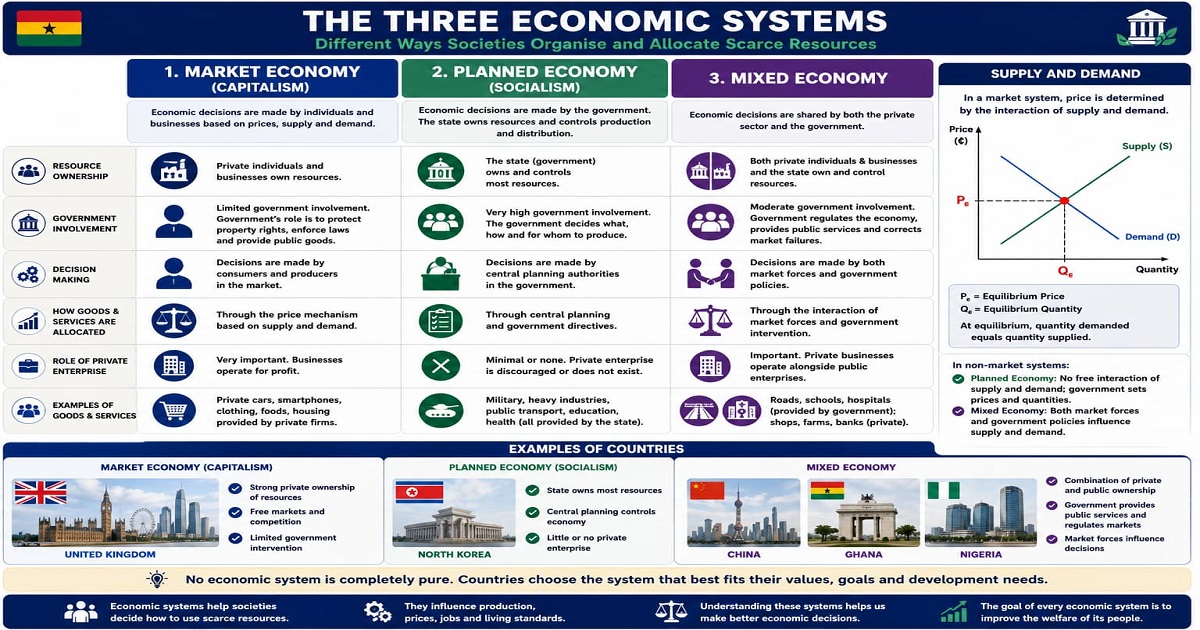
Market Economy (Capitalism) is an economic system in which most economic decisions are made by private individuals and businesses. Prices, production, and resource allocation are determined by the forces of supply and demand. Private property rights and individual self-interest are important features of this system. Government intervention is limited, and markets generally operate freely. The United Kingdom is an example of a country practising a market economy.
Planned Economy (Socialism or Communism) is an economic system in which government or a central authority controls production, distribution, and resource allocation. The main objective is to promote economic equality and social welfare. Major industries and resources are often owned and managed by the state. There is less emphasis on private ownership and profit motives. North Korea and China are examples of countries that practise socialist economic systems.
Mixed Economy combines features of both market and planned economic systems. In this system, both private businesses and government participate in resource allocation and economic decision-making. Governments provide public services and regulate certain sectors, while private businesses operate in various industries. Ghana, Nigeria, and many African countries practise mixed economic systems.
The diagram on page 1 illustrates the three major economic systems branching from the broader concept of an economic system: Capitalist Economy, Socialist Economy, and Mixed Economy.
Types Of Economic Systems
| Economic System | Ownership Of Resources | Decision Makers |
|---|---|---|
| Market Economy (Capitalism) | Private individuals and businesses | Consumers and producers through market forces |
| Planned Economy (Socialism) | Government or state ownership | Government or central authority |
| Mixed Economy | Both private and public ownership | Government and private sector |
Features Of Economic Systems
| System | Main Features | Example Countries |
|---|---|---|
| Market Economy | Private ownership, supply and demand determine prices, limited government intervention | United Kingdom |
| Planned Economy | Government ownership, central planning, emphasis on social welfare | North Korea, China |
| Mixed Economy | Combination of private and government participation | Ghana, Nigeria |
Comparison Of Economic Systems
| Aspect | Market Economy | Planned Economy | Mixed Economy |
|---|---|---|---|
| Resource Ownership | Mainly private | Mainly government | Both private and public |
| Price Determination | Supply and demand | Government decisions | Market forces and government influence |
| Government Role | Limited | Extensive | Moderate |
| Profit Motive | Strong | Less emphasis | Present but regulated |
Examples
Example 1
Problem: Identify the economic system practised in the United Kingdom.
- Examine who owns resources.
- Determine who makes economic decisions.
- Identify the role of supply and demand.
Final Answer: The United Kingdom practises a market economy where private individuals and businesses make most economic decisions.
Example 2
Problem: Explain why Ghana is classified as a mixed economy.
- Identify the role of private businesses.
- Identify the role of government.
- Determine how resources are allocated.
Final Answer: Ghana is a mixed economy because both private businesses and government participate in economic activities and resource allocation.
Application and Activities
- Discuss the different economic systems practised around the world.
- Identify countries that practise market, planned, and mixed economies.
- Debate which type of ownership and control of resources is more effective.
- Examine how economic systems influence the economic performance of countries.
Practice Questions
- Define an economic system.
- Outline the three main types of economic systems.
- Compare the features of market, planned, and mixed economies.
Summary
An economic system is the method by which a society organizes the ownership and control of scarce resources and answers fundamental economic questions. The three major economic systems are market economy (capitalism), planned economy (socialism), and mixed economy. These systems differ in resource ownership, decision-making processes, and the role of government. Understanding economic systems helps explain how different countries manage resources and address economic challenges.
Access NaCCA-aligned Support Packs
Download your structured NaCCA-aligned Teacher Support Pack and Student Learning Pack, designed for clarity, practicality, and reliable teaching and learning.