The Economic System Explained for SHS 1 Economics (Semester 2, Week 6)
Every society faces the challenge of deciding how to use limited resources to satisfy unlimited human wants. The way these decisions are made forms the basis of an economic system.
What You Will Learn
- The meaning of an economic system
- Why economic systems exist
- The three major types of economic systems
- The characteristics of market, planned, and mixed economies
- Examples of countries that practise each system
Main Explanation
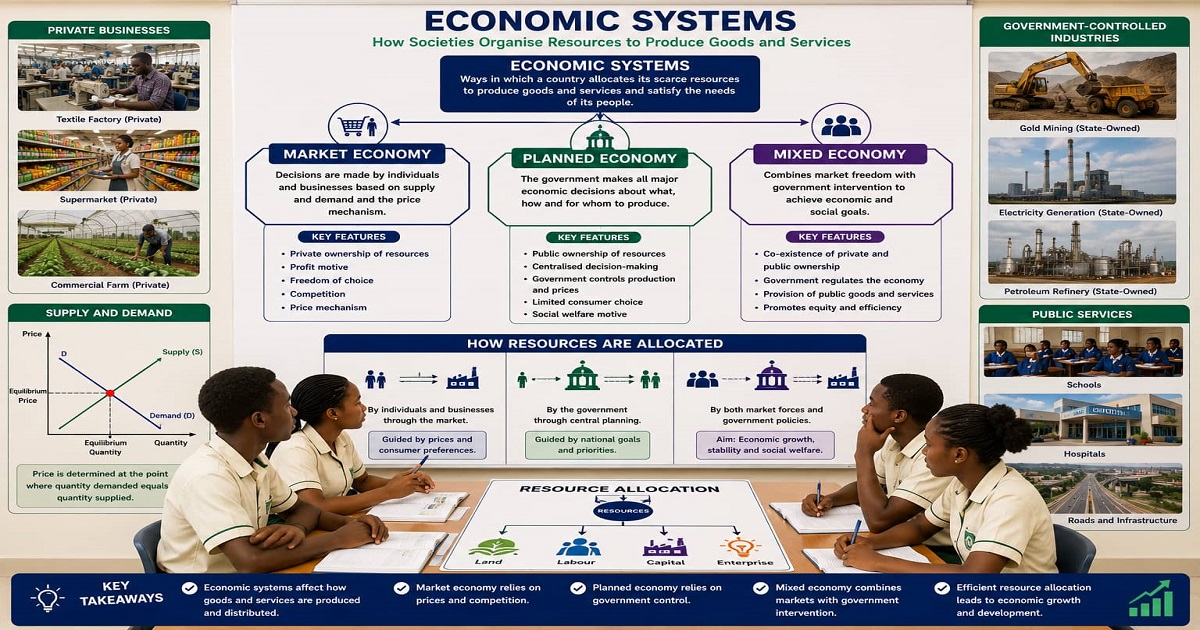
An economic system is a set of organizational and institutional arrangements established to answer basic economic questions and determine how scarce resources are owned and controlled within an economy. Economic systems arise because societies must decide what to produce, how to produce, and for whom to produce.
Different societies solve economic problems in different ways. Some allow individuals and businesses to make most economic decisions, while others place these decisions under government control. Based on ownership and control of resources, economists identify three major economic systems: market economy, planned economy, and mixed economy.
Market Economy (Capitalism) is characterized by private ownership of resources and limited government intervention. Prices, production, and resource allocation are determined by supply and demand. Businesses compete to provide goods and services, while consumers make choices based on their preferences and purchasing power. The United Kingdom is an example of a country practising this system.
Planned Economy (Socialism or Communism) places the responsibility for production and resource allocation in the hands of government or a central authority. The state often owns major industries and determines what goods and services should be produced. The objective is to promote economic equality and social welfare. North Korea and China are examples identified in the source material.
Mixed Economy combines features of both market and planned economies. Private businesses operate in many sectors, while government provides public services and regulates important areas of the economy. Ghana, Nigeria, and many African countries operate mixed economic systems.
The diagram in the source material presents economic systems as three interconnected categories: Capitalist Economy, Socialist Economy, and Mixed Economy, showing the main classifications of resource ownership and control.
Types Of Economic Systems
| Type | Who Owns Resources? | Who Makes Decisions? |
|---|---|---|
| Market Economy | Private individuals and firms | Consumers and producers |
| Planned Economy | Government | Central authority |
| Mixed Economy | Both government and private sector | Government and market participants |
Comparison Of Economic Systems
| Feature | Market Economy | Planned Economy | Mixed Economy |
|---|---|---|---|
| Ownership | Private | State | Public and private |
| Price Determination | Supply and demand | Government planning | Both market and government influence |
| Government Role | Limited | Extensive | Moderate |
Worked Examples
Example 1
Scenario: A country allows businesses to determine production levels and prices through competition and market forces.
Explanation: This describes a market economy because private businesses make most economic decisions and prices are determined by supply and demand.
Example 2
Scenario: Government owns major industries and decides what goods should be produced and distributed.
Explanation: This describes a planned economy because production and resource allocation are controlled by government authorities.
Why This Topic Matters
Economic systems influence employment, production, income distribution, investment, and economic growth. Understanding economic systems helps learners appreciate why countries make different economic decisions and how ownership and control of resources affect national development.
Quick Practice
- Define an economic system.
- State the three main economic systems.
- Explain one characteristic of a mixed economy.
Summary
An economic system determines how scarce resources are owned, controlled, and allocated within a society. The three major economic systems are market economy, planned economy, and mixed economy. These systems differ in ownership structures, decision-making processes, and the degree of government involvement in economic activities. Understanding them provides insight into how different countries organize and manage their economies.
Access NaCCA-aligned Support Packs
Download your structured NaCCA-aligned Teacher Support Pack and Student Learning Pack, designed for clarity, practicality, and reliable teaching and learning.