The Importance of Agriculture to the Ghanaian Economy
Introduction
Agriculture is one of the oldest and most fundamental human activities. It involves cultivating plants, raising animals and carrying out related activities for the production of food, fibre and other goods needed for human consumption and use. Agriculture is a primary industry that provides food and raw materials to economies and plays an important role in Ghana’s economic development through employment, food security and export earnings. In 2022, agriculture contributed 19.57% to Ghana’s Gross Domestic Product (GDP).
Key Concepts
- Agriculture: The practice of cultivating plants, raising animals and undertaking related activities for the production of food, fibre and other goods needed for human consumption and use.
- Environmental Sustainability: Creating and maintaining conditions under which humans and nature can exist in productive harmony while meeting present and future social, economic and environmental needs.
Explanation
Agriculture is a major contributor to Ghana’s economy because it supports livelihoods, provides food and supplies raw materials for industries. It also contributes to national income and promotes sustainable use of natural resources.
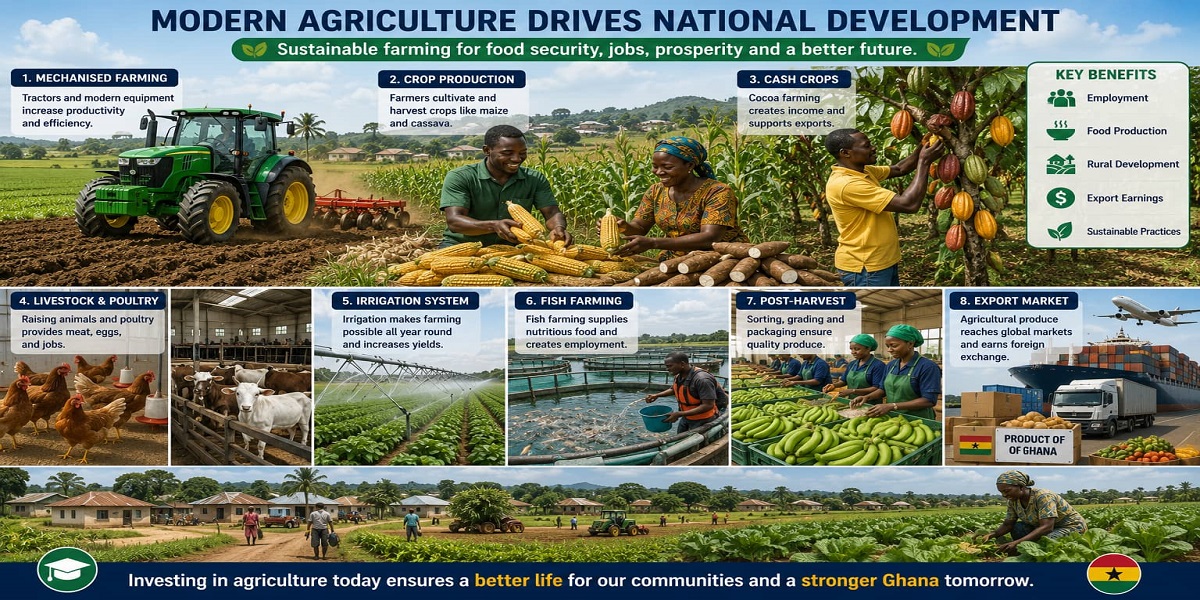
Employment and Livelihoods: Agriculture provides employment for a significant portion of Ghana’s population, particularly in rural communities. Many people work as small-scale subsistence farmers or as employees in larger agricultural enterprises. Agriculture serves as a source of income and helps reduce poverty and unemployment.
Food Security: Agriculture is the primary source of food production in Ghana. It ensures the availability of staple crops and other food items needed for domestic consumption.
Stable Food Supply: Agriculture contributes to the production of staple crops such as maize, rice, yam, cassava and other food items. A strong agricultural sector helps maintain stable food prices and reduces dependence on imported food.
Rural Development: Agricultural activities generate economic opportunities, improve infrastructure and promote social well-being in rural communities. Agriculture stimulates local markets, supports agribusinesses and ancillary industries, enhances rural incomes and helps reduce rural-urban migration.
Export Earnings: Ghana earns foreign exchange from exporting agricultural products such as cocoa, cashew nuts, shea butter, fruits and vegetables. Export earnings support imports, promote economic growth and diversify the country’s export base.
Environmental Sustainability: Sustainable agricultural practices such as conservation agriculture, organic farming and agroforestry promote responsible land and natural resource management. These practices help protect soil fertility, conserve water resources, preserve biodiversity and reduce the effects of climate change.
| Importance of Agriculture | Description | Contribution to Ghana |
|---|---|---|
| Employment and Livelihoods | Provides jobs and income | Reduces poverty and unemployment |
| Food Security | Produces food for the population | Ensures food availability |
| Stable Food Supply | Produces staple crops | Maintains stable prices and reduces imports |
| Rural Development | Promotes economic activities in rural areas | Improves infrastructure and livelihoods |
| Export Earnings | Exports agricultural products | Generates foreign exchange |
| Environmental Sustainability | Encourages sustainable farming practices | Protects natural resources |
| Agricultural Practice | Description |
|---|---|
| Agricultural Mechanisation | Use of agricultural technologies to improve production |
| Improved Crop Varieties | Production of crops such as maize, okro and cassava |
| Irrigation Systems | Supplying water to crops for cultivation |
| Fishing and Aquaculture | Production of fish through fishing and fish farming |
| Animal Husbandry | Raising livestock for economic purposes |
| Poultry Farming | Rearing birds for food and income |
Examples
Example 1
Problem: Explain how agriculture contributes to employment in Ghana.
- Identify agricultural activities that employ people.
- Explain how these activities generate income.
Final Answer: Agriculture provides employment and livelihoods for many people, especially in rural communities, thereby reducing poverty and unemployment.
Example 2
Problem: State how agriculture promotes food security.
- Identify staple crops produced in Ghana.
- Explain how their production benefits the country.
Final Answer: Agriculture ensures the availability of staple foods, supports stable food prices and reduces dependence on imported food.
Application and Activities
- Discuss observations made from a school farm or agricultural video.
- Explain how backyard farming can be started at home.
- Discuss why agriculture is important to learners.
- Explain how agriculture contributes to Ghana’s economic development.
- Identify agricultural practices carried out within the local community.
Practice
- Describe three agricultural practices in Ghana.
- Explain the importance of agriculture to a senior high school learner.
- Discuss how agriculture contributes to the Ghanaian economy.
Summary
Agriculture is an essential sector of Ghana’s economy. It provides employment, ensures food security, supports rural development, earns foreign exchange and promotes environmental sustainability. Through modern agricultural practices and sustainable resource management, agriculture continues to play a significant role in national economic development.
Access NaCCA-aligned Support Packs
Download your structured NaCCA-aligned Teacher Support Pack and Student Learning Pack, designed for clarity, practicality, and reliable teaching and learning.