Cost: Concepts, Calculations and Cost Curves Explained for SHS 2 Economics (Sem. 1 – Week 8)
Every producer has to answer a simple but important question: how much does it cost to produce a given quantity of output? Economics answers this question by separating costs into different categories and then examining how those costs behave as production changes.
Starting with the Cost of Production
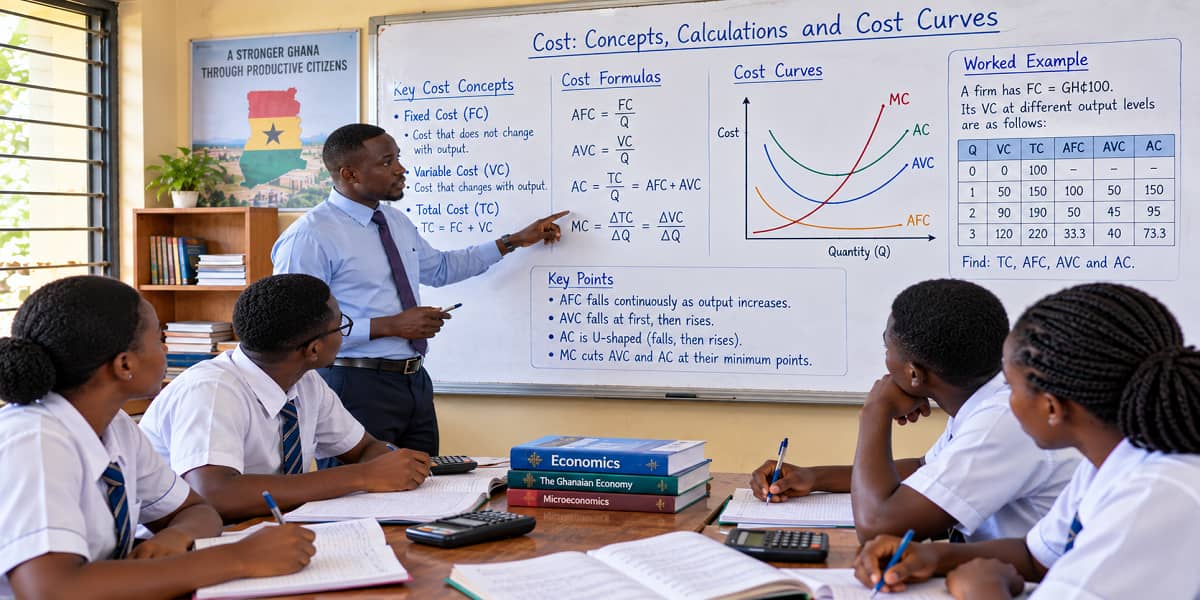
Cost is the monetary value spent in producing goods or services. But not every cost behaves in the same way.
Fixed cost remains unchanged as output changes. Rent, insurance and depreciation are examples. Variable cost changes with output and can include raw materials, direct labour and production-related utilities.
When these two are combined, we obtain total cost:
TC = TFC + TVC
Not All Costs Are Cash Payments
Cost analysis also distinguishes between explicit and implicit costs. Explicit costs are direct cash payments, such as wages and rent. Implicit costs are non-cash opportunity costs associated with resources owned by the firm, such as the owner’s time or use of an owned building.
Economic cost = Explicit cost + Implicit cost.
There are also opportunity costs, which represent the next best alternative given up, and sunk costs, which have already been incurred and cannot be recovered.
Why the Time Horizon Matters
Cost behaviour is also linked to the time horizon. In the short run, at least one factor is fixed. In the long run, all factors are variable and the firm can adjust its production capacity.
| Short Run | Long Run |
|---|---|
| At least one factor is fixed. | All factors are variable. |
| Production capacity is constrained. | Production capacity can be adjusted. |
| Fixed costs exist. | There are no fixed costs. |
From Total Cost to Cost per Unit
Total cost alone does not tell us the cost of producing each individual unit. For that, economists use average costs.
| Measure | What it tells us | Formula |
|---|---|---|
| AFC | Fixed cost per unit | TFC ÷ Q |
| AVC | Variable cost per unit | TVC ÷ Q |
| AC | Total cost per unit | TC ÷ Q |
| MC | Additional cost of producing another unit | ΔTC ÷ ΔQ |
Average cost can also be understood as:
AC = AFC + AVC
A Practical Cost Calculation
Consider the bakery case. Its monthly fixed costs are GH₵1,000 rent, GH₵4,000 employee salaries, GH₵500 insurance, GH₵300 equipment lease and GH₵200 fixed utilities.
Therefore:
TFC = GH₵6,000
The variable cost per unit is:
GH₵1.00 + GH₵0.20 + GH₵0.05 + GH₵0.50 = GH₵1.75
At 1,000 units:
TVC = GH₵1.75 × 1,000 = GH₵1,750
TC = GH₵6,000 + GH₵1,750 = GH₵7,750
Average cost is therefore:
AC = GH₵7,750 ÷ 1,000 = GH₵7.75 per unit.
Reading the Cost Curves
The shapes of cost curves communicate important information. The AFC curve declines as output increases. AVC and AC are typically U-shaped. MC represents the additional cost associated with an increase in output and, in the standard relationship presented in this topic, intersects AVC and AC at their lowest points.
What the Numbers Reveal
The cost table in this week’s work shows fixed cost remaining at GH₵1,000 as output changes. Variable cost rises from zero as production begins. Consequently, total cost also rises.
For example, when output increases from 3 to 4:
MC = (TC4 − TC3) ÷ (4 − 3)
= (GH₵1,680 − GH₵1,540) ÷ 1
= GH₵140
This illustrates the central idea behind marginal cost: it focuses on the additional cost associated with an additional unit of output.
The Big Picture
Cost analysis connects several ideas. Fixed and variable costs explain the components of total cost. Average costs show the cost per unit, while marginal cost focuses on the additional cost of expanding output. The resulting curves help us visualise how these measures behave as production changes.
Quick Review
- FC: does not change with output.
- VC: changes with output.
- TC: TFC + TVC.
- AFC: TFC ÷ Q.
- AVC: TVC ÷ Q.
- AC: TC ÷ Q or AFC + AVC.
- MC: ΔTC ÷ ΔQ.
Access NaCCA-aligned Support Packs
Download your structured NaCCA-aligned Teacher Support Pack and Student Learning Pack, designed for clarity, practicality, and reliable teaching and learning.