Identifying and Distinguishing Between the Different Forms of Drama
Introduction: Understanding Drama and Its Different Forms
Have you ever watched a stage performance in which the audience laughed throughout the story? Have you also encountered a play in which the main character experienced serious difficulties and eventually suffered a tragic ending? These different experiences demonstrate that dramatic works can communicate different emotions, situations and messages.
Drama is an important form of literature because it presents human experiences through performance. It allows audiences to observe characters, follow their actions, listen to their conversations and understand the situations they encounter.
However, not every dramatic work follows the same pattern. Some plays are designed primarily to entertain through humour, while others explore serious situations and unfortunate outcomes. Some combine humour with serious subject matter, whereas others present exaggerated characters and dramatic situations.
These differences give rise to four important forms of drama: comedy, tragedy, tragicomedy and melodrama. Understanding their characteristics helps readers identify them in dramatic texts and distinguish one form from another.
PART ONE: UNDERSTANDING THE MEANING AND FORMS OF DRAMA
1. What Is Drama?
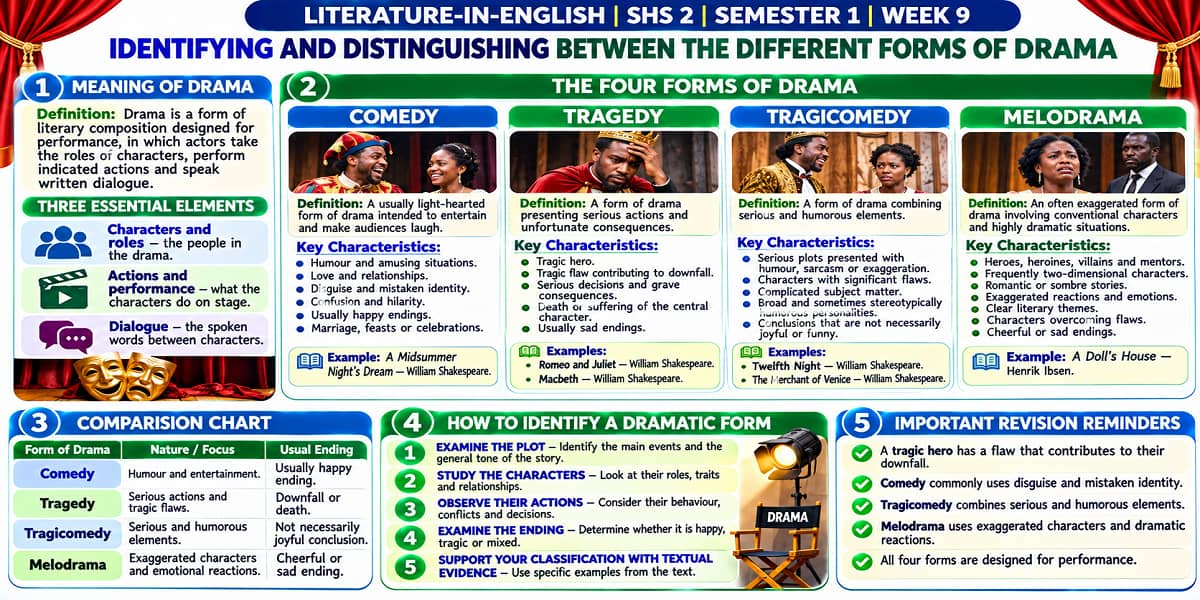
Drama is a form of literary composition designed for performance, in which actors take the roles of characters, perform indicated actions and speak written dialogue.
This definition highlights three important features of drama.
Characters and Roles
Drama involves characters represented by actors. Each actor takes a particular role and helps communicate the story through performance.
Actions and Performance
Unlike a narrative that is communicated entirely through written narration, drama is designed to be performed. Characters carry out actions that contribute to the development of the story.
Dialogue
Dialogue refers to the spoken words exchanged between characters. Through dialogue, audiences learn about characters, their relationships, their problems and the situations surrounding them.
These elements work together to bring a dramatic composition to life. The written dialogue provides what characters say, while their actions and performances communicate what happens throughout the play.
2. The Four Major Forms of Drama
Drama can be classified into different forms according to the nature of its story, the experiences of its characters, the emotions it creates and the way events develop.
1. Comedy
Comedy consists of light-hearted plays that are generally intended to entertain audiences and make them laugh. Such plays usually have happy endings.
They may involve amusing situations, misunderstandings, love, disguises and mistaken identities. Confusion arising from the decisions or behaviour of characters often produces humour and entertainment.
At the conclusion, the main characters usually get married or participate in a feast or celebration.
An example is A Midsummer Night’s Dream by William Shakespeare.
2. Tragedy
Tragedy is a form of drama that represents serious actions and usually ends sadly. It often presents the downfall or death of the central character or characters.
A tragic play may feature a tragic hero, who possesses important heroic qualities but also has a tragic flaw. This flaw is a weakness in the character that contributes to their downfall.
The decisions made by characters may lead to death and other grave consequences. By the end of the play, the main character dies or suffers a serious downfall.
Examples include Romeo and Juliet and Macbeth by William Shakespeare.
3. Tragicomedy
Tragicomedy is a form of drama that combines elements of tragedy and comedy. Its general description involves a mixture of sad and happy moments.
It may present a serious plot through funny, sarcastic or exaggerated situations. Characters may have significant flaws, but their actions do not necessarily result in death.
Other features include complicated subject matter and characters with broad personalities who sometimes behave in stereotypically humorous ways. Its conclusion is not necessarily joyful or funny.
Examples identified include Twelfth Night and The Merchant of Venice by William Shakespeare.
4. Melodrama
Melodrama is often an exaggerated form of drama involving conventional characters such as heroes, heroines, villains and mentors.
These characters are frequently presented as one-dimensional, meaning their personalities are developed around relatively simple and recognisable characteristics.
Melodramatic stories may be romantic or sombre and often involve grand narratives or highly dramatic situations. Characters react in exaggerated ways, and the story may have either a cheerful or sad ending.
Characters may also need to overcome personal flaws before reaching a resolution. An example identified is A Doll’s House by Henrik Ibsen.
3. Understanding the Four Forms at a Glance
Although these forms share the basic elements of drama, they differ in their dominant characteristics and the experiences they create for audiences.
| Form | Main characteristic | Typical outcome |
|---|---|---|
| Comedy | Humour, love, disguise and mistaken identity. | Happy ending, marriage or celebration. |
| Tragedy | Serious actions, tragic flaws and grave consequences. | Sad ending, downfall or death. |
| Tragicomedy | Combination of serious and humorous elements. | May contain complicated or non-joyful conclusions. |
| Melodrama | Exaggerated characters, emotions and dramatic situations. | Cheerful or sad ending. |
PART TWO: DISTINGUISHING BETWEEN THE FORMS OF DRAMA
4. Recognising Tragedy
Tragedy is distinguished by the seriousness of its actions and the unfortunate consequences experienced by its central characters.
The Tragic Hero
A tragic hero possesses significant heroic qualities but also has a flaw that contributes to their downfall. The character’s weakness influences decisions and actions that eventually lead to serious consequences.
Grave Consequences
Decisions made within a tragedy may result in death or other serious outcomes. These consequences contribute to the development of the central conflict.
Sad Ending
The main character dies or suffers a serious downfall by the end of the play. This outcome is one of the strongest features used to recognise tragedy.
When identifying tragedy, pay attention to the seriousness of the plot, the weaknesses of the central character and the consequences of the character’s decisions.
5. Recognising Comedy
Comedy is mainly associated with entertainment, humour and situations that make audiences laugh.
Love
Love is an important element that may influence relationships and the development of events in a comedy.
Disguise and Mistaken Identity
Characters may disguise themselves or mistake one person for another. These situations create confusion and humorous developments.
Confusion and Hilarity
The decisions and actions of characters often produce misunderstandings and amusing situations. These developments contribute to the entertaining nature of the play.
Happy Ending
The main characters usually get married or participate in a feast or celebration at the end. This positive conclusion helps distinguish comedy from tragedy.
When identifying comedy, look for humorous situations, mistaken identities, love-related developments and a generally happy conclusion.
6. Recognising Tragicomedy
Tragicomedy combines serious and humorous elements, making it different from drama that follows only a consistently comic or tragic direction.
Serious Plot with Humorous Presentation
A tragicomedy may communicate serious subject matter through funny, sarcastic or exaggerated situations. This creates a combination of contrasting experiences.
Characters with Significant Flaws
Characters may possess weaknesses that influence their actions. However, these actions do not necessarily result in death.
Complicating Subject Matter
The subject matter may involve complicated situations that make the story more difficult to interpret through a purely humorous or tragic perspective.
Humorous Character Behaviour
Characters may have broad personalities and behave in stereotypically humorous ways, even when the overall plot deals with serious matters.
Conclusion
A tragicomedy does not necessarily end with a joyful or funny conclusion. Its combination of serious and humorous elements makes it distinct from ordinary comedy.
7. Recognising Melodrama
Melodrama is distinguished by exaggerated characters, strong emotional reactions and highly dramatic situations.
Conventional Character Types
Heroes, heroines, villains and mentors are common character types. They are frequently two-dimensional, meaning their personalities are presented through relatively simple and recognisable traits.
Romantic or Sombre Stories
Melodramas may explore romantic or sombre subject matter and often involve grand narratives.
Dramatic Plots
The plot may be epic in scope or highly focused on particular dramatic events. Either way, the presentation emphasises strong dramatic developments.
Exaggerated Reactions
Characters often respond to situations in exaggerated ways. Their reactions help create the intense emotional atmosphere associated with melodrama.
Clear Literary Themes
Melodramas often communicate clearly defined themes through the actions and experiences of their characters.
Overcoming Character Flaws
Characters may need to overcome their weaknesses before reaching a resolution.
Different Endings
Unlike tragedy and comedy, melodrama may conclude either cheerfully or sadly.
8. Comparing Similarities and Differences
All four forms belong to drama. They involve characters, actions and dialogue, and are designed for performance. However, their differences become clearer when their plots, characters and outcomes are examined.
| Comparison | Comedy | Tragedy |
|---|---|---|
| Main emphasis | Humour and entertainment. | Serious actions and consequences. |
| Typical character development | Love, disguise and mistaken identity. | Tragic flaws and downfall. |
| Typical ending | Marriage or celebration. | Sadness, death or downfall. |
| Comparison | Tragicomedy | Melodrama |
|---|---|---|
| Main emphasis | Combination of serious and humorous elements. | Exaggerated characters and dramatic situations. |
| Character features | Flawed characters with sometimes humorous behaviour. | Conventional heroes, heroines, villains and mentors. |
| Typical ending | Not necessarily joyful. | Cheerful or sad. |
One important distinction is that tragicomedy combines contrasting elements within its plot, whereas melodrama is identified particularly by its exaggerated characters, emotions and dramatic presentation.
9. Using Evidence to Identify a Form of Drama
Identifying a dramatic form requires more than guessing from the title of a play. Readers should examine the actual events, character behaviour and conclusion of the dramatic text.
Examine the Plot
Consider whether the events are mainly humorous, serious, mixed or highly dramatic.
Examine the Characters
Identify whether the central characters display tragic flaws, conventional character traits, humorous behaviour or exaggerated reactions.
Examine the Ending
Determine whether the play concludes with a celebration, a downfall, a mixture of contrasting outcomes or a cheerful or sad resolution.
Support Your Classification
Identify specific details from the text that justify your decision. A good classification should be supported by evidence rather than the reader’s personal preference.
PART THREE: PRACTICAL APPLICATION AND ASSESSMENT
10. Identifying Drama Forms Through Examples
Consider four descriptions of dramatic situations.
Situation A
A play presents amusing misunderstandings involving characters who fall in love. Disguises and mistaken identities create confusion, but the main characters eventually celebrate their happiness.
This is comedy because humour, mistaken identity and a happy ending are its dominant features.
Situation B
A central character possesses admirable qualities but has a weakness that influences important decisions. These decisions lead to serious consequences and an unfortunate ending.
This is tragedy because a tragic flaw contributes to the downfall of the central character.
Situation C
A play explores serious subject matter but presents some situations through sarcasm, exaggerated behaviour and humour. The conclusion is not necessarily joyful.
This is tragicomedy because serious and humorous elements occur together.
Situation D
A dramatic work features heroes, villains and highly emotional reactions. Characters respond dramatically to difficult situations, and the story concludes either happily or sadly.
This is melodrama because of its conventional character types and exaggerated emotional presentation.
11. Practice Questions and Model Answers
Attempt each question before examining the model answer.
Question 1: What is drama?
Model Answer: Drama is a form of literary composition designed for performance, in which actors take the roles of characters, perform indicated actions and speak written dialogue.
Question 2: List the four forms of drama discussed in this lesson.
Model Answer:
- Comedy.
- Tragedy.
- Tragicomedy.
- Melodrama.
Question 3: State four characteristics of comedy.
Model Answer:
- It is usually light-hearted.
- It is intended to entertain and make audiences laugh.
- It may involve love, disguise and mistaken identity.
- It usually ends with marriage or a celebration.
Question 4: Explain the meaning of a tragic hero.
Model Answer: A tragic hero is a central character who possesses significant heroic qualities but also has a tragic flaw or weakness that contributes to their downfall.
Question 5: What makes tragicomedy different from ordinary comedy?
Model Answer: Tragicomedy combines serious and humorous elements. Its plot may deal with complicated or serious subject matter while presenting some situations through humour, sarcasm or exaggeration. Its conclusion is not necessarily joyful.
Question 6: Mention four characteristics of melodrama.
Model Answer:
- It features conventional characters such as heroes, heroines and villains.
- Characters react in exaggerated ways.
- It often presents romantic or sombre stories.
- Its endings may be cheerful or sad.
Question 7: Match the following descriptions with the correct forms of drama.
A. A story with a happy ending.
B. A story with a sad ending.
C. A story that combines humour and serious themes.
D. A story featuring exaggerated emotions and actions.
Model Answer: A – Comedy; B – Tragedy; C – Tragicomedy; D – Melodrama.
Question 8: Compare tragedy and comedy.
Model Answer: Both are forms of drama designed for performance and involve characters, actions and dialogue. However, tragedy presents serious actions and often ends with the downfall or death of the central character, whereas comedy uses humour, amusing situations and usually ends happily through marriage or celebration.
12. Extended Application Activities
Activity 1: Classifying Drama Descriptions
Study descriptions of different plays and classify each under comedy, tragedy, tragicomedy or melodrama. Support every classification with evidence from the description.
Activity 2: Drama Form Guessing Game
Work in groups. One learner selects a card containing the name of a drama form and describes its characteristics without mentioning its name. Other group members must identify the form within thirty seconds.
Activity 3: Comparing Dramatic Scenes
Select scenes from different dramatic texts. Compare their characters, actions, emotions and endings. Explain how these features help distinguish the forms represented.
Activity 4: Creating a Short Cartoon Story
Create a short cartoon story depicting one of the four forms of drama. Make the selected form recognisable through the characters, events, emotions and conclusion.
Activity 5: Preparing a Dramatic Performance
Work in groups to select and act out scenes representing different forms of drama. Choose characters you are comfortable performing and use appropriate gestures, expressions and dialogue.
Activity 6: Writing a Comparative Explanation
Write a three-paragraph explanation of why you would choose to perform a comedy, tragedy, tragicomedy or melodrama. Explain how your choice might make your audience feel and support your decision with relevant examples.
Conclusion: Recognising the Different Forms of Drama
Drama is a literary composition designed for performance through characters, actions and spoken dialogue. Its different forms provide different ways of presenting human experiences and creating emotional responses among audiences.
Comedy focuses on humour and entertainment, usually ending happily. Tragedy presents serious actions and the downfall or suffering of central characters. Tragicomedy combines serious and humorous elements, while melodrama emphasises exaggerated characters, emotions and dramatic situations.
Recognising these differences requires careful attention to the plot, characters, actions and endings of dramatic texts. Classification should always be supported by evidence from the work being examined.
Understanding the four forms makes it easier to analyse dramatic compositions, participate in performances and appreciate the different ways playwrights communicate ideas through drama.
Final Self-Check
Confirm that you can:
- Define drama and explain its main elements.
- Identify comedy, tragedy, tragicomedy and melodrama.
- Describe the main characteristics of each form.
- Explain what makes a tragic hero different.
- Distinguish between serious and humorous dramatic situations.
- Identify conventional and exaggerated characters in melodrama.
- Classify dramatic descriptions using supporting evidence.
- Compare and contrast different forms of drama.
Final Application: Select one of the four forms of drama and create a short cartoon story or dramatic scene that demonstrates its defining characteristics. Explain why your work belongs to that particular form.
Access NaCCA-aligned Support Packs
Download your structured NaCCA-aligned Teacher Support Pack and Student Learning Pack, designed for clarity, practicality, and reliable teaching and learning.