Types Of Profits In Each Market Structure Explained for SHS 2 Economics (Semester 2, Week 2)
Why do some firms make extraordinary profits while others struggle to survive? The answer often depends on the market structure in which they operate.
What You Will Learn
- The meaning of normal, super-normal, and sub-normal profits
- How profits differ across market structures
- The profit outcomes of perfect competition
- The profit outcomes of monopoly
- The profit outcomes of monopolistic competition
Main Explanation
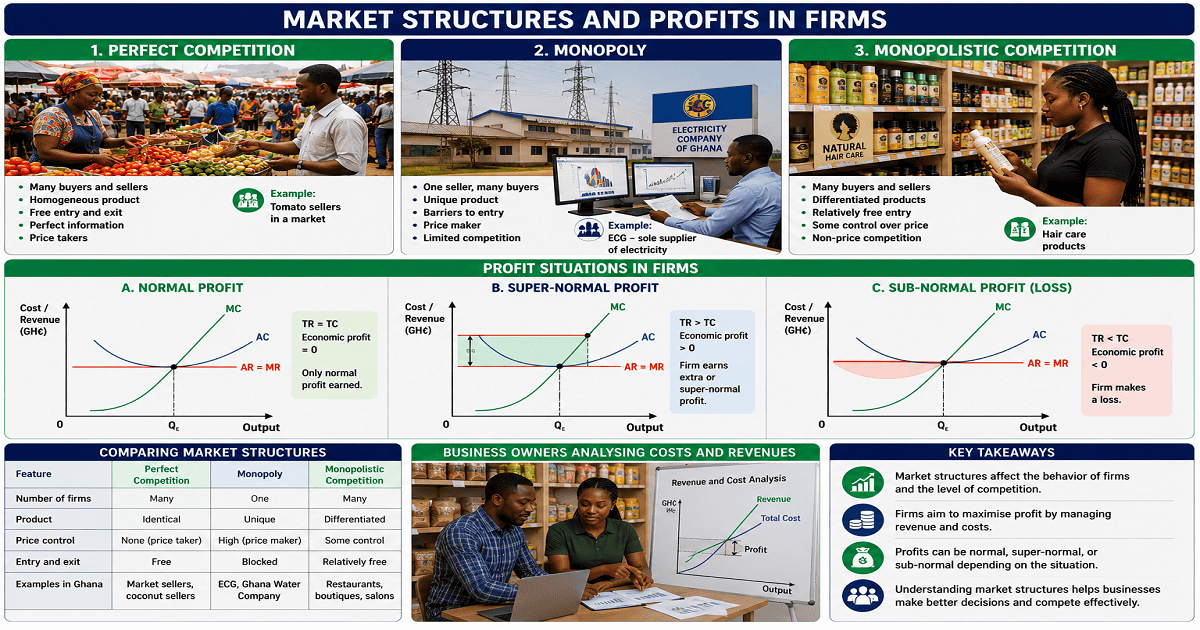
Firms operate to earn profits, but the level of profit achieved depends on market conditions and competition. Economists classify profits into three main categories: normal profit, super-normal profit, and sub-normal profit.
Normal profit is the minimum profit needed to keep a firm operating in the market. It covers all opportunity costs and gives the entrepreneur no incentive to leave or change business activities.
Super-normal profit is profit earned above the normal level. It represents excess earnings and often attracts new firms into the market where entry is possible.
Sub-normal profit, also called an economic loss, occurs when total revenue is less than total costs, including both explicit and implicit costs.
In a perfectly competitive market, firms may earn super-normal profits in the short run. However, because entry into the market is free, new firms are attracted by these profits. Increased competition eventually reduces profits until only normal profit remains.
Firms may also suffer sub-normal profits in the short run if demand falls or costs increase. If losses continue, firms leave the market, reducing supply and helping restore normal profits.
Monopolies operate differently. Since there is only one dominant seller and barriers prevent competitors from entering, monopolists can earn super-normal profits in both the short run and long run.
Monopolistic competition combines elements of competition and market power. Firms sell differentiated products and may earn super-normal profits in the short run. However, new entrants attracted by these profits increase competition, causing long-run profits to fall to normal levels.
Firms in monopolistic competition may also experience sub-normal profits if competition intensifies or consumer preferences change.
Profit Types Across Market Structures
| Market Structure | Short-Run Profit | Long-Run Profit |
|---|---|---|
| Perfect Competition | Normal, super-normal, or sub-normal | Normal only |
| Monopoly | Normal or super-normal | Normal or super-normal |
| Monopolistic Competition | Normal, super-normal, or sub-normal | Normal only |
Understanding Profit Outcomes
| Profit Type | Meaning | Market Effect |
|---|---|---|
| Normal Profit | Covers opportunity costs | Firms remain in business |
| Super-Normal Profit | Excess profit above normal level | Attracts new firms where possible |
| Sub-Normal Profit | Economic loss | May force firms to leave the market |
Worked Examples
Example 1
Scenario: A firm in a perfectly competitive market earns unusually high profits this year.
Explanation: The super-normal profit will attract new firms into the market. Increased competition will reduce profits until only normal profit remains in the long run.
Example 2
Scenario: A monopolist continues earning high profits year after year.
Explanation: High barriers to entry prevent competitors from entering the market, allowing the monopolist to sustain super-normal profits over time.
Why This Topic Matters
Understanding profit types helps learners analyse business decisions, market competition, and firm behaviour. It also explains why some businesses expand rapidly, while others leave the market due to persistent losses.
Quick Practice
- Define sub-normal profit.
- State one reason monopolists can sustain super-normal profits.
- Explain why firms in monopolistic competition earn normal profit in the long run.
Summary
Normal profit is the minimum profit required to keep a firm operating, super-normal profit is profit above the normal level, and sub-normal profit represents an economic loss. Perfect competition and monopolistic competition tend toward normal profits in the long run because of free entry and exit, while monopolies can sustain super-normal profits because barriers to entry limit competition.
Access NaCCA-aligned Support Packs
Download your structured NaCCA-aligned Teacher Support Pack and Student Learning Pack, designed for clarity, practicality, and reliable teaching and learning.