Market And Its Types Explained for SHS 1 Economics (Semester 2, Week 3)
Every day, people buy and sell goods and services through different forms of markets. Understanding how markets operate helps explain how economies function.
What You Will Learn
- The meaning of a market
- The importance of markets in the economy
- The forms of markets
- The different types of markets
- Examples of markets in Ghana
Main Explanation
A market is a system or environment where buyers and sellers interact to exchange goods, services, or resources. Markets facilitate voluntary exchange and allow consumers and producers to agree on prices and quantities. The interaction between demand and supply helps determine the equilibrium price in the market.
Markets are important because they help allocate resources efficiently, encourage competition, support economic growth, and provide information about prices and consumer preferences.
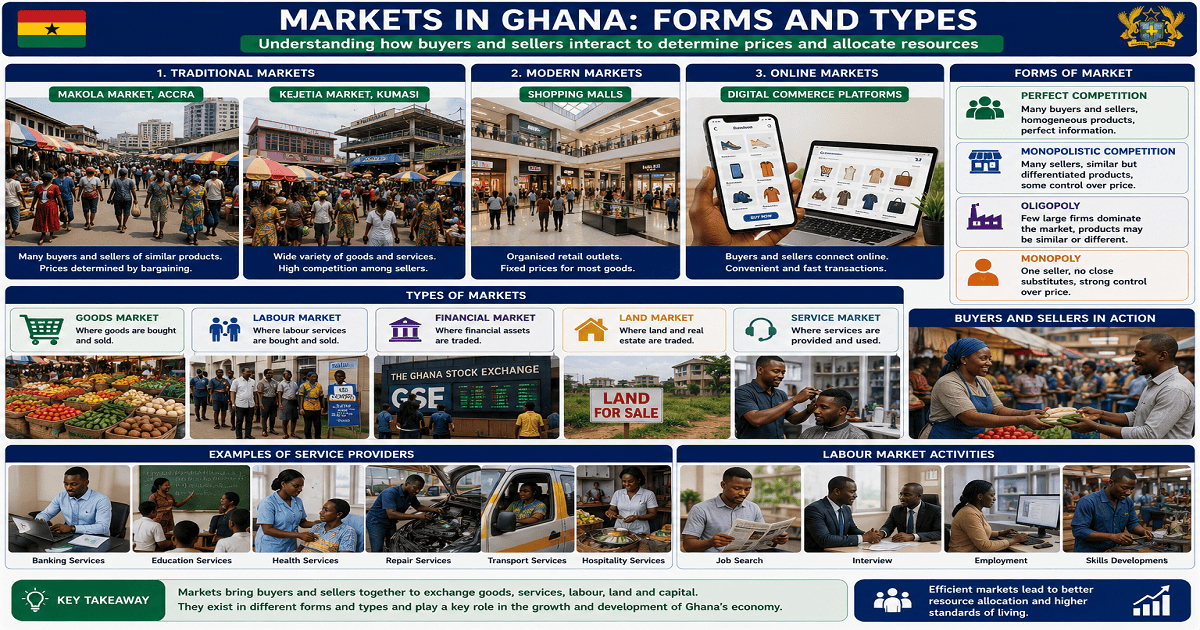
Markets can exist in different forms. A physical market involves direct face-to-face interaction between buyers and sellers. Examples include Makola Market, Kejetia Market, farmers’ markets, retail stores, and shopping malls.
An online market operates through internet platforms. Buyers and sellers complete transactions electronically without being physically present in the same place. Examples include Jumia Ghana, Zoobashop, and Melcom Online.
Economists also classify markets according to the goods and services exchanged.
Product markets involve the buying and selling of tangible goods such as food, clothing, electronics, machinery, and raw materials.
Service markets facilitate the exchange of services such as healthcare, education, housing, financial services, and professional services.
Labour markets connect employers and workers through job fairs, recruitment agencies, and online employment platforms.
Virtual markets are digital marketplaces where virtual products and digital assets are exchanged.
Black markets involve illegal transactions that take place outside government regulations and official market systems.
Ghana has many important markets that support trade and economic development. These include Makola Market in Accra, Kejetia Market in Kumasi, Techiman Market, Tamale Central Market, Takoradi Market Circle, and online platforms such as Jumia Market.
Forms Of Markets
| Form | Description | Examples |
|---|---|---|
| Physical Market | Face-to-face exchange | Makola Market, Kejetia Market |
| Online Market | Internet-based transactions | Jumia Ghana, Melcom Online |
Types Of Markets
| Type | What Is Exchanged | Examples |
|---|---|---|
| Product Market | Tangible goods | Food, electronics, clothing |
| Service Market | Services | Education, healthcare |
| Labour Market | Labour services | Job fairs and recruitment agencies |
| Virtual Market | Digital goods | Gaming economies |
| Black Market | Illegal trade | Unauthorized transactions |
Worked Examples
Example 1
Scenario: A student purchases a textbook from an online shopping platform.
Explanation: This transaction occurs in an online market because the exchange takes place through an internet-based platform rather than a physical location.
Example 2
Scenario: A job seeker attends a recruitment fair to find employment opportunities.
Explanation: This is an example of a labour market because labour services are being exchanged between job seekers and employers.
Why This Topic Matters
Understanding markets helps learners appreciate how goods and services move from producers to consumers. Markets influence prices, employment, production decisions, and economic development. Knowledge of market types also helps individuals participate effectively in economic activities.
Quick Practice
- Define a market.
- State two examples of physical markets in Ghana.
- Explain one difference between a product market and a service market.
Summary
Markets are systems that facilitate the exchange of goods, services, and resources between buyers and sellers. Markets may be physical or online and can be classified into product markets, service markets, labour markets, virtual markets, and black markets. These markets play a central role in resource allocation, price determination, competition, and economic growth.
Access NaCCA-aligned Support Packs
Download your structured NaCCA-aligned Teacher Support Pack and Student Learning Pack, designed for clarity, practicality, and reliable teaching and learning.