Report Writing Structure And Format Explained for SHS 2 English Language (Semester 2, Week 5)
Reports are used in schools, businesses, and organisations to communicate information in a systematic and professional manner. Learning how to write reports helps learners present ideas clearly and accurately.
What You Will Learn
- The meaning of report writing
- The different types of reports
- The structure and format of reports
- The importance of report writing
- The features of effective reports
Main Explanation
Report writing is the process of organising information and presenting findings, analyses, and recommendations in a structured form. Reports help people communicate information and support decision-making.
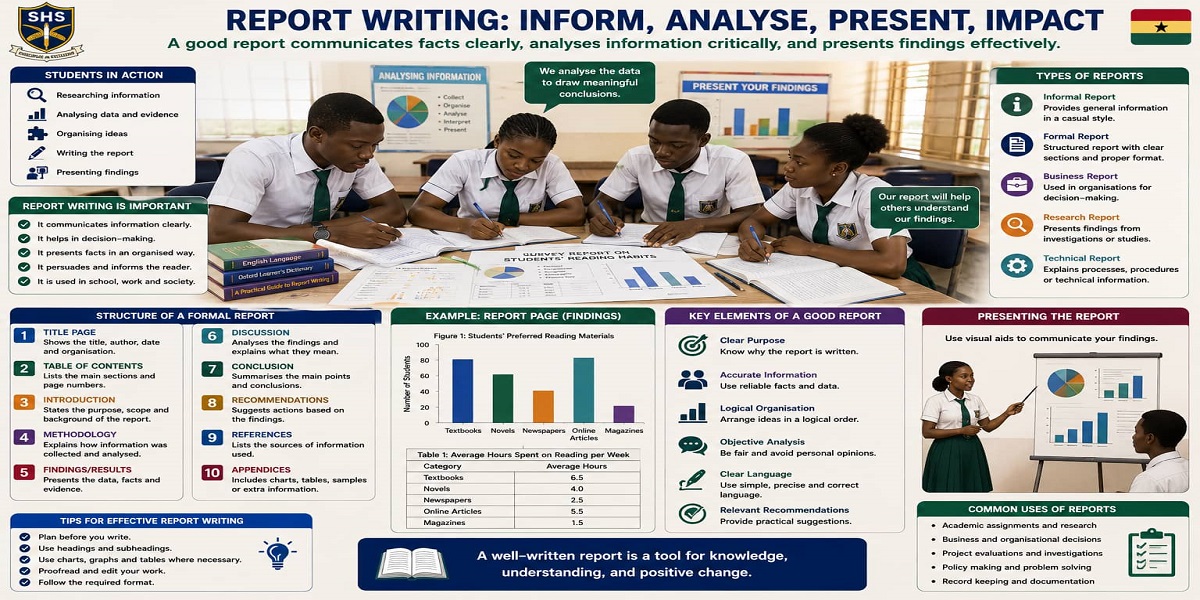
Different kinds of reports exist to serve different purposes. Formal reports are used in official situations, while technical reports communicate scientific and technical information. Business reports analyse financial and market information, and research reports present research findings. Other reports include progress reports, feasibility reports, investigative reports, and incident reports.
A good report contains several sections. These include the introduction, background information, body, conclusion, recommendations, and references. References are essential because they acknowledge sources and help prevent plagiarism.
Reports are important because they communicate ideas, provide documentation, present analyses, assist decision-making, and encourage learning and development. They are valuable tools in education, business, science, and administration.
Effective reports should have a clear purpose, accurate information, proper organisation, objective language, concise writing, and appropriate formatting. Visual aids such as tables and graphs may also be used to support the information presented.
Types Of Reports
| Type | Main Use |
|---|---|
| Formal Report | Official communication |
| Business Report | Corporate analysis |
| Research Report | Academic studies |
| Progress Report | Project updates |
| Incident Report | Recording events and accidents |
Structure Of A Report
| Section | Function |
|---|---|
| Introduction | Introduces the topic and purpose |
| Background Information | Provides context |
| Body | Presents evidence and analysis |
| Conclusion | Summarises findings |
| Recommendations | Suggests actions |
| References | Acknowledges sources |
Worked Examples
Example 1
Scenario: A student prepares a document explaining the results of an experiment and includes findings and conclusions.
Explanation: This is an example of a technical report because it presents scientific information and analysis.
Example 2
Scenario: A project leader provides monthly updates on completed activities and challenges encountered.
Explanation: This represents a progress report because it communicates the status and progress of a project.
Why This Topic Matters
Report writing is an essential skill in academic, professional, and organisational settings. It enables individuals to communicate information clearly, document events accurately, and provide recommendations that support effective decision-making.
Quick Practice
- Define report writing.
- State three sections of a report.
- Explain one importance of report writing.
Summary
Report writing is a structured way of presenting information and recommendations. Different types of reports serve different purposes, and effective reports require organisation, accuracy, objectivity, and proper referencing. Report writing remains an important tool for communication, documentation, and problem-solving.
Access NaCCA-aligned Support Packs
Download your structured NaCCA-aligned Teacher Support Pack and Student Learning Pack, designed for clarity, practicality, and reliable teaching and learning.