Introduction to International Trade Explained for SHS 2 Economics (Semester 2, Week 12)
Countries depend on one another for many of the goods and services they consume. International trade makes this possible by allowing nations to exchange products, expand markets, and promote economic growth.
What You Will Learn
- The meaning of international trade
- The major components of international trade
- The difference between exports and imports
- The meaning of trade surplus and trade deficit
- The role of trade barriers and trade agreements
- Ghana’s major exports, imports, and trading partners
- The benefits and challenges of international trade
Main Explanation
International trade is the exchange of goods and services between countries. It enables countries to obtain products that they cannot produce efficiently while allowing them to specialise in producing goods in which they have comparative advantages. Through international trade, countries improve resource utilisation, increase production, generate employment, earn foreign exchange, and strengthen international cooperation.
The major components of international trade include exports, imports, the balance of trade, trade barriers, and trade agreements. Together, these components determine how countries participate in global commerce and influence economic performance.
Exports are goods and services produced within a country and sold to foreign markets. Export activities generate foreign exchange earnings, create employment opportunities, increase production, and contribute to national income.
Imports are goods and services purchased from other countries for domestic use. They provide consumers and producers with products that may not be available locally or may be obtained more efficiently from foreign markets.
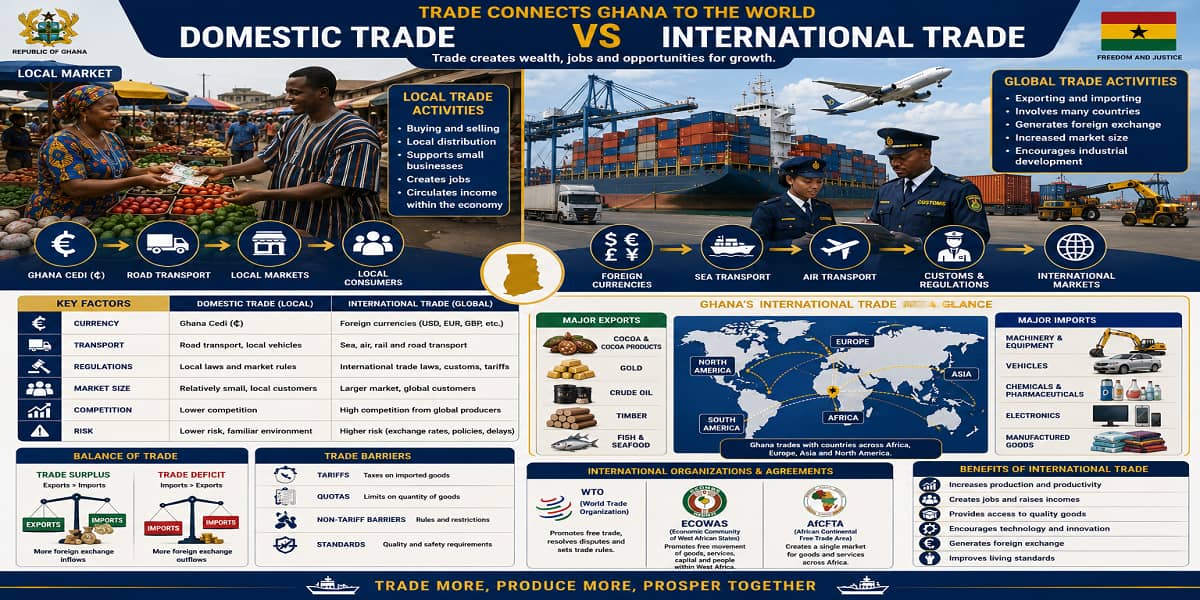
The balance of trade compares the value of exports with the value of imports. A country records a trade surplus when exports exceed imports, while a trade deficit occurs when imports exceed exports. The balance of trade serves as an important indicator of a country’s international trading position.
Components Of International Trade
| Component | Description | Importance |
|---|---|---|
| Exports | Goods and services sold abroad | Generate foreign exchange and employment |
| Imports | Goods and services purchased from other countries | Meet domestic demand and support production |
| Balance Of Trade | Difference between exports and imports | Measures trade performance |
| Trade Barriers | Restrictions placed on international trade | Protect domestic industries |
| Trade Agreements | International arrangements that facilitate trade | Promote economic cooperation |
Governments sometimes introduce trade barriers to regulate imports and protect local industries. Examples include tariffs, import quotas, import licences, subsidies, and other regulatory measures. While these policies may support domestic producers, they may also increase the prices of imported goods and reduce the volume of international trade.
Trade agreements reduce barriers to trade and promote cooperation among countries. They encourage easier movement of goods and services, strengthen regional integration, and create opportunities for economic growth. Important trade organisations and agreements discussed in the lesson include the World Trade Organization (WTO), the Economic Community of West African States (ECOWAS), and the African Continental Free Trade Area (AfCFTA).
Ghana participates actively in international trade by exporting commodities such as cocoa, gold, crude oil, and timber while importing machinery, manufactured goods, petroleum products, vehicles, chemicals, and industrial equipment. The country’s trade relationships with partners in Africa, Europe, Asia, and North America contribute to economic development and international cooperation.
International trade provides many benefits, including increased market access, employment creation, foreign exchange earnings, improved production, technology transfer, and higher economic growth. However, countries may also face challenges such as increased foreign competition, fluctuations in world market prices, dependence on external markets, and exposure to global economic shocks.
International Trade Agreements
| Agreement | Purpose | Contribution To Trade |
|---|---|---|
| World Trade Organization (WTO) | Promotes rules-based global trade | Facilitates international trade cooperation |
| ECOWAS | Promotes regional integration | Encourages trade among West African countries |
| AfCFTA | Creates a continental free trade area | Expands trade opportunities across Africa |
Worked Examples
Example 1
Scenario: Ghana exports cocoa beans to another country and imports industrial machinery for manufacturing.
Explanation: The cocoa beans represent exports because they are sold to foreign markets, while the machinery represents imports because it is purchased from another country for domestic use.
Example 2
Scenario: A country’s exports exceed the value of its imports during a particular year.
Explanation: The country records a trade surplus because the value of exports is greater than the value of imports, indicating a positive balance of trade.
Why This Topic Matters
International trade enables countries to specialise in production, access wider markets, obtain goods and services that are not readily available domestically, and strengthen economic relationships with other nations. Understanding international trade also helps learners appreciate Ghana’s role in the global economy and the importance of regional and international trade cooperation.
Quick Practice
- Define international trade.
- Differentiate between exports and imports.
- Explain the difference between a trade surplus and a trade deficit.
Summary
International trade is the exchange of goods and services between countries. It consists of exports, imports, the balance of trade, trade barriers, and trade agreements. Ghana participates in international trade through the export of commodities and the import of goods that support domestic production and consumption. Organisations such as the WTO, ECOWAS, and AfCFTA promote trade cooperation, while international trade contributes to economic growth, employment, and foreign exchange earnings despite challenges associated with global competition and external economic conditions.
Access NaCCA-aligned Support Packs
Download your structured NaCCA-aligned Teacher Support Pack and Student Learning Pack, designed for clarity, practicality, and reliable teaching and learning.
Comparison of Domestic Trade and International Trade Explained for SHS 2 Economics (Semester 2, Week 12)
Trade takes place both within countries and across national borders. While both forms of trade involve buying and selling goods and services, they differ in terms of market coverage, currency, regulations, transportation, and risks. Understanding these differences helps learners appreciate the role of trade in economic development.
What You Will Learn
- The meaning of domestic trade and international trade.
- The similarities between domestic and international trade.
- The major differences between domestic and international trade.
- The role of currency, transport, and regulations in trade.
- A practical case study based on Ghana’s fish trade.
Main Explanation
Domestic trade refers to the buying and selling of goods and services within the geographical boundaries of a single country. Both buyers and sellers operate under the same legal system, use the same currency, and follow the same national economic policies. Since transactions occur within one country, transportation is generally easier and trading costs are comparatively lower. Domestic trade contributes to employment creation, income generation, and the growth of local industries.
International trade, on the other hand, involves the exchange of goods and services between different countries. It requires traders to operate across different legal systems, currencies, customs procedures, and international regulations. International trade enables countries to access wider markets, specialise in production, earn foreign exchange, and obtain goods that may not be produced efficiently at home. However, it also exposes countries to greater competition, exchange rate fluctuations, and external economic conditions.
Although domestic trade and international trade differ in several respects, they both perform similar economic functions. Both facilitate the movement of goods and services, generate employment and income, satisfy consumer needs, encourage production, and contribute to national development. Their major distinction lies in the geographical scope and the complexity of transactions.
Comparison Between Domestic Trade And International Trade
| Aspect | Domestic Trade | International Trade |
|---|---|---|
| Area of Operation | Within one country | Between two or more countries |
| Currency | Single national currency | Foreign exchange involving different currencies |
| Legal Framework | National laws only | National laws and international agreements |
| Transportation | Local transport systems | International transport networks |
| Trade Barriers | Very limited | Tariffs, quotas, customs procedures, and regulations |
| Market Size | Domestic market | Global market |
| Competition | Mostly local firms | Local and foreign firms |
| Risk | Lower | Higher due to exchange rates and international factors |
Similarities Between Domestic And International Trade
| Similarity | Explanation |
|---|---|
| Exchange of Goods and Services | Both involve buying and selling activities. |
| Employment Creation | Both create jobs for producers, traders, and service providers. |
| Income Generation | Both generate income for businesses and individuals. |
| Economic Growth | Both contribute to national economic development. |
| Consumer Satisfaction | Both provide goods and services that satisfy consumer needs. |
The lesson illustrates these concepts through Ghana’s fish trade. Fish sold within Ghana represents domestic trade because production, transportation, payment, and consumption all occur within the country. Fish exported to foreign markets represents international trade because the transaction involves foreign buyers, international transportation, customs procedures, and foreign currencies. This example demonstrates how the same product can participate in either domestic or international trade depending on the market in which it is sold.
Case Study: Ghana’s Fish Trade
| Feature | Domestic Trade | International Trade |
|---|---|---|
| Customers | Consumers within Ghana | Consumers in foreign countries |
| Currency | Ghana cedi | Foreign currencies |
| Transportation | Road transport | Sea and air transport |
| Regulations | National trade regulations | International customs and trade regulations |
| Market Coverage | National market | International market |
Worked Examples
Example 1
Scenario: A furniture manufacturer in Kumasi supplies products to retailers in Tamale.
Explanation: This is domestic trade because both the producer and the buyers operate within Ghana using the same currency and national regulations.
Example 2
Scenario: A Ghanaian fishing company exports processed fish to European markets.
Explanation: This is international trade because the transaction crosses national borders, involves foreign markets, customs procedures, and payment in foreign currency.
Why This Topic Matters
Understanding the similarities and differences between domestic trade and international trade enables learners to appreciate how businesses operate within local and global markets. It also helps explain the importance of transportation, regulations, foreign exchange, and international cooperation in promoting economic development and expanding market opportunities.
Quick Practice
- Define domestic trade.
- State four differences between domestic trade and international trade.
- Explain three similarities between domestic trade and international trade.
Summary
Domestic trade occurs within the borders of one country, while international trade involves the exchange of goods and services between countries. Although both forms of trade support employment, income generation, production, and economic growth, international trade is generally more complex because it involves foreign currencies, international regulations, customs procedures, and wider markets. Understanding these differences provides a strong foundation for studying global commerce and economic development.
Access NaCCA-aligned Support Packs
Download your structured NaCCA-aligned Teacher Support Pack and Student Learning Pack, designed for clarity, practicality, and reliable teaching and learning.