Determiners and Interjections
Introduction
Minor word classes play an important role in effective communication. This lesson focuses on determiners and interjections. Determiners help identify or provide information about nouns, while interjections express sudden feelings, emotions, or reactions. Understanding their functions enables learners to communicate more accurately in both speech and writing.
Key Concepts
- Determiners: Words placed before nouns to identify or give more information about them.
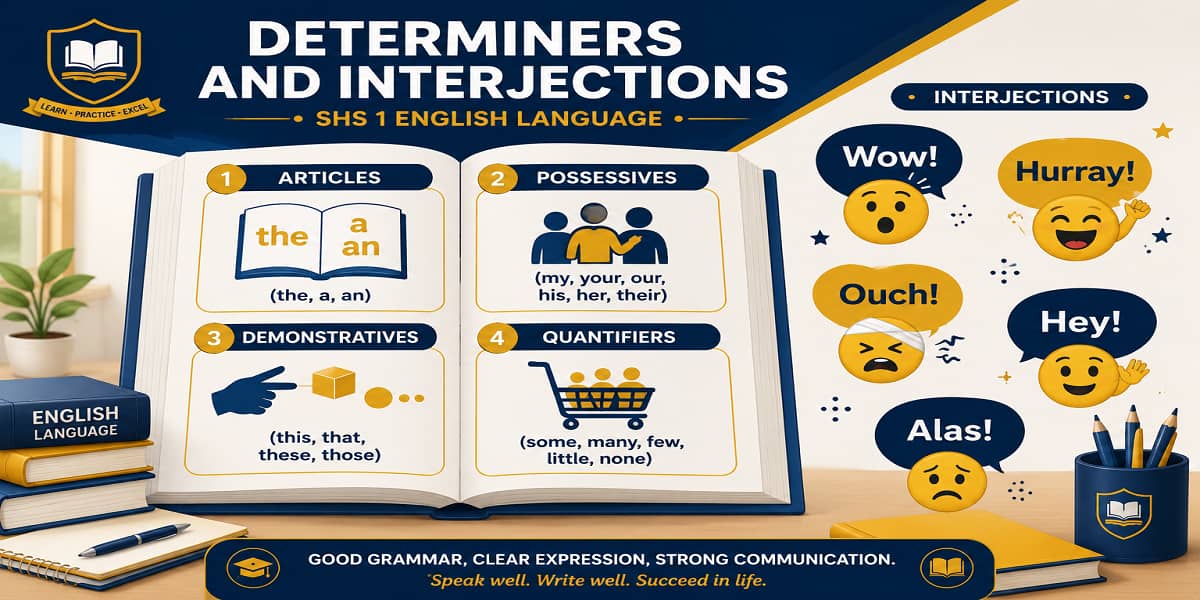
- Articles: Determiners that include the definite article the and the indefinite articles a and an.
- Possessives: Determiners showing ownership or belonging, such as my, your, our, his, her, and their.
- Quantifiers: Determiners indicating quantity, such as some, many, few, little, and none.
- Demonstratives: Determiners used to identify nouns based on their location, including this, that, these, and those.
- Interjections: Words or phrases used to express feelings, emotions, reactions, or to attract attention.
Explanation
Determiners introduce nouns and help readers or listeners identify which person, place, thing, or quantity is being referred to. They provide context and make communication clearer. The lesson discusses four major types of determiners: articles, possessives, quantifiers, and demonstratives.
Types Of Determiners
| Type | Description | Examples |
|---|---|---|
| Articles | Introduce specific or non-specific nouns | the, a, an |
| Possessives | Show ownership or belonging | my, your, our, his, her, their |
| Quantifiers | Indicate quantity or amount | some, many, a few, little, none |
| Demonstratives | Identify nouns according to location | this, that, these, those |
Articles are among the most common determiners. The definite article the refers to a particular noun, while the indefinite articles a and an refer to non-specific singular nouns. Possessive determiners indicate ownership, as in Her car is over the bridge. Quantifiers describe quantity or amount, whereas demonstratives point to people or objects based on their location. This and that are used with singular and uncountable nouns, while these and those are used with plural nouns.
Interjections are words or short expressions that communicate sudden emotions, feelings, or reactions. Unlike most parts of speech, interjections are not grammatically connected to other words in a sentence. They are common in everyday speech and informal writing, although many should be avoided in formal academic writing. Interjections usually appear at the beginning of a sentence.
Examples Of Interjections
| Interjection | Purpose | Example |
|---|---|---|
| Alas | Expresses sadness or pity | Alas! That was so unfortunate. |
| Ah | Expresses surprise or realisation | Ah, the magic show was a surprise! |
| Eh | Requests repetition | Eh! Please repeat that. |
| Dear | Expresses pity or surprise | Oh dear! I feel bad for you. |
| Hey | Calls attention | Hey! Look out for the car. |
| Hurray | Expresses joy | Hurray! We passed the test. |
| Oh | Expresses pain or surprise | Oh! I have a headache. |
| Ouch | Expresses pain | Ouch! You stepped on my toes. |
| Phew | Expresses relief or exhaustion | Phew! That was a long presentation. |
| Uh | Expresses hesitation | Uh! I am not sure. |
| Well | Introduces a remark | Well, that was wonderful. |
| Wow | Expresses admiration | Wow! Your new bike is amazing. |
Examples
Example 1
Problem: Identify the determiner in the sentence: Her car is over the bridge.
- Read the sentence carefully.
- Locate the word that introduces the noun.
- Determine its type.
Final Answer: Her is a possessive determiner because it shows ownership of the car.
Example 2
Problem: Identify the interjection in the sentence: Hurray! We finally cleared the test.
- Identify the word expressing emotion.
- Determine the feeling expressed.
Final Answer: Hurray! is the interjection because it expresses joy.
Application and Activities
- Identify determiners and interjections from passages and other texts.
- Construct sentences using different types of determiners.
- Use interjections appropriately in conversations.
- Compose short paragraphs using determiners and interjections accurately.
Practice Questions
- Define determiners.
- State four types of determiners with one example each.
- Explain the function of interjections in communication.
Summary
Determiners and interjections are important minor word classes in English Language. Determiners provide information about nouns through articles, possessives, quantifiers, and demonstratives. Interjections express sudden emotions, reactions, and feelings in speech and informal writing. Correct use of these word classes improves both spoken and written communication.
Access NaCCA-aligned Support Packs
Download your structured NaCCA-aligned Teacher Support Pack and Student Learning Pack, designed for clarity, practicality, and reliable teaching and learning.