
Types of Financial Institutions Explained for SHS 1 Economics (Semester 2, Week 9)
Financial institutions are essential to every economy because they help people save money, obtain loans, invest funds and protect themselves against financial risks.
What You Will Learn
- The meaning of financial institutions.
- The two major types of financial institutions.
- The functions of depository and non-depository financial institutions.
- Examples of financial institutions in Ghana.
Main Explanation
Financial institutions are organisations that facilitate the flow of funds within the financial system. They provide financial services to individuals, businesses and governments by connecting those who have surplus funds with those who need funds for investment and other economic activities. These institutions contribute significantly to economic growth by promoting savings, investment and financial security.
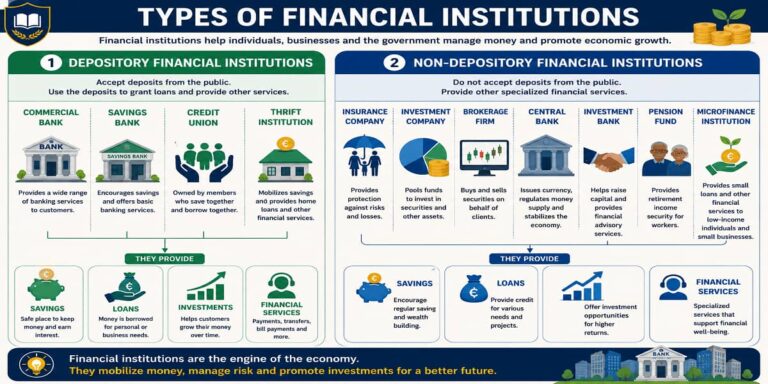
Financial institutions are broadly classified into two categories: depository financial institutions and non-depository financial institutions.
Depository financial institutions obtain most of their funds from customer deposits. They accept money from individuals and organisations and use part of these funds to provide loans and other financial services. Commercial banks, savings banks and credit unions fall under this category. Thrift institutions, such as savings and loan associations and savings banks, also belong to this group because they focus mainly on providing mortgage loans and other consumer loans.
Non-depository financial institutions do not collect deposits from customers as their main source of funds. Instead, they raise funds through insurance policies, securities and other financial products. These institutions provide specialised financial services to different sectors of the economy.
Insurance companies protect individuals and businesses against financial losses through different insurance policies. Investment companies, including mutual funds and exchange-traded funds (ETFs), pool money from investors and invest it in diversified portfolios. Brokerage firms facilitate the buying and selling of securities such as stocks and bonds on behalf of clients. Central banks regulate the money supply, interest rates and currency issuance as the country’s monetary authority. Investment banks specialise in underwriting securities, mergers, acquisitions and other corporate financial services. Pension funds manage retirement savings, while microfinance institutions provide small loans and savings services to low-income individuals and small businesses.
| Category | Main Characteristics | Examples |
|---|---|---|
| Depository Financial Institutions | Accept customer deposits and provide loans and banking services | Commercial banks, savings banks, credit unions, thrift institutions |
| Non-Depository Financial Institutions | Raise funds through securities, insurance and other financial products | Insurance companies, investment companies, brokerage firms, central banks, investment banks, pension funds, microfinance institutions |
Worked Examples
Example 1
Scenario: A customer opens a savings account at GCB Bank Limited and later applies for a business loan.
Explanation: GCB Bank Limited is a depository financial institution because it accepts deposits from customers and provides loans and other financial services.
Example 2
Scenario: A family purchases a life insurance policy from Enterprise Life Assurance Company.
Explanation: Enterprise Life Assurance Company is a non-depository financial institution because it provides insurance services instead of collecting deposits as its primary source of funds.
Why This Topic Matters
Understanding the different types of financial institutions helps learners appreciate how savings, loans, investments and insurance services contribute to economic development. It also enables learners to identify the roles played by various financial institutions in supporting individuals, businesses and governments.
Quick Practice
- Define a financial institution.
- Name the two major types of financial institutions.
- State three examples of depository financial institutions.
- State four examples of non-depository financial institutions.
- Explain the difference between depository and non-depository financial institutions.
Summary
Financial institutions facilitate the movement of funds within an economy and provide essential financial services. They are classified into depository institutions, which accept customer deposits, and non-depository institutions, which provide specialised financial services without relying primarily on deposits. Together, these institutions promote savings, lending, investment, insurance and financial stability in the economy.
Access NaCCA-aligned Support Packs
Download your structured NaCCA-aligned Teacher Support Pack and Student Learning Pack, designed for clarity, practicality, and reliable teaching and learning.