Analysing Nonfiction Texts Explained for SHS 1 English Language (Semester 2, Week 11)
Nonfiction texts present factual information about real people, places, events and issues. Using effective comprehension strategies helps learners understand these texts, identify their main ideas and interpret information accurately.
What You Will Learn
- The meaning of nonfiction texts.
- How prediction improves reading comprehension.
- How to use KWL, DRTA and chunking strategies.
- How text features help readers understand nonfiction texts.
- How collaborative learning strengthens reading comprehension.
Main Explanation
Nonfiction texts provide factual information rather than imaginary stories. To understand these texts effectively, learners apply different reading comprehension strategies before, during and after reading. These strategies help readers make predictions, organise ideas, confirm understanding and interpret information accurately.
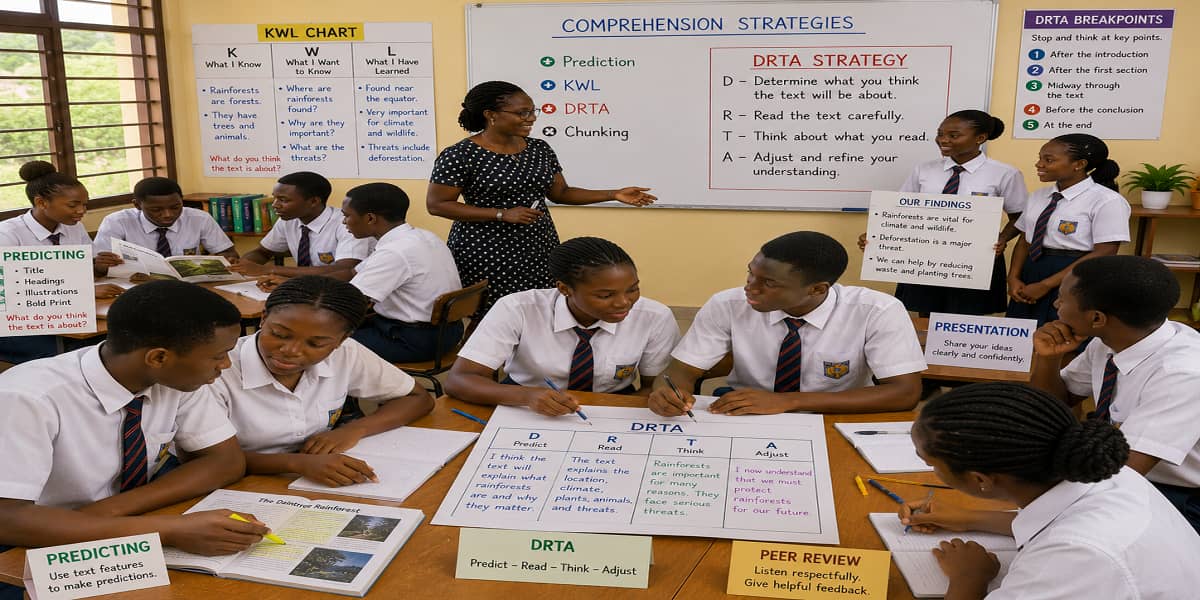
One important strategy is prediction. Learners discuss the importance of prediction in everyday situations and relate it to reading comprehension. Before reading, they study titles, illustrations, headings, subheadings, bold print, italics and other text features to predict what the nonfiction text may discuss. As they continue reading, they compare their predictions with the information presented and revise them whenever necessary.
Learners work in mixed-ability groups to read nonfiction texts collaboratively. At teacher-created or group-created breakpoints, they pause to predict, review and make new predictions before continuing. Every prediction should be supported with evidence from the text. Group delegates then present their findings while classmates provide constructive peer review and respectful critique.
Another useful strategy is the Know, Want-to-know and Learned (KWL) strategy. Learners first brainstorm what they already know about the topic and record this information in the K column. They then write questions about what they want to know in the W column. After reading the text, they complete the L column by recording what they have learned. This strategy encourages organised thinking throughout the reading process.
Learners also use Directed Reading Thinking Activity (DRTA) and chunking to interpret more advanced nonfiction texts. DRTA encourages learners to predict, read, confirm and refine their understanding continuously, while chunking divides longer texts into smaller sections that are easier to understand.
Collaborative learning, brainstorming and task-based activities encourage learners to share ideas, support their predictions with textual evidence and develop confidence in reading and analysing factual texts. These learner-centred strategies also strengthen teamwork, leadership, communication and critical thinking skills.
| Comprehension Strategy | Purpose | Application |
|---|---|---|
| Prediction | Make logical guesses using text clues | Before, during and after reading |
| KWL | Organise prior knowledge and new learning | Know, Want to Know and Learned |
| DRTA | Develop understanding while reading | Predict, read, confirm and refine ideas |
| Chunking | Improve comprehension of longer texts | Divide nonfiction texts into manageable sections |
Worked Examples
Example 1
Scenario: A learner receives a nonfiction passage with only its title, headings and illustrations before reading.
Explanation: The learner studies the available text features to predict what the passage may discuss. As reading continues, the learner compares the predictions with the information in the text and refines them using evidence from the passage.
Example 2
Scenario: A reading group completes a KWL chart while studying a nonfiction text on climate change.
Explanation: The learners first record what they already know about climate change, list questions about what they want to learn and finally complete the chart by recording what they have learned after reading the text. This process helps organise understanding before, during and after reading.
Why This Topic Matters
The ability to analyse nonfiction texts helps learners understand factual information encountered in textbooks, newspapers, magazines, online resources and everyday communication. Applying prediction, KWL, DRTA and chunking strategies improves reading comprehension, critical thinking, problem-solving and effective communication while encouraging collaboration, leadership and respect for different viewpoints.
Quick Practice
- List the main ideas in a nonfiction text.
- Identify and interpret the main ideas in a factual passage.
- Use titles, headings and illustrations to predict the content of a nonfiction text.
- Complete a KWL chart after reading a nonfiction passage.
- Create a nonfiction text on one of the following topics: climate change, drug abuse, importance of education, discipline, tolerance or teenage pregnancy.
Summary
Analysing nonfiction texts requires readers to apply prediction, KWL, DRTA and chunking strategies throughout the reading process. These strategies help learners make logical predictions, organise ideas, support interpretations with evidence and understand factual information more effectively. Collaborative learning and learner-centred activities further strengthen reading comprehension, critical thinking and communication skills.
Access NaCCA-aligned Support Packs
Download your structured NaCCA-aligned Teacher Support Pack and Student Learning Pack, designed for clarity, practicality, and reliable teaching and learning.