Synonyms (Words Similar or Nearest in Meaning)
Introduction
Vocabulary development enables learners to communicate ideas clearly, accurately and effectively. This lesson focuses on synonyms—words that have similar or identical meanings—and how they can be used appropriately in speech and writing. Learners explore subtle differences in meaning, select suitable synonyms for different contexts and develop richer vocabulary through collaborative and practical learning activities.
Key Concepts
- Synonyms: Words that have similar or identical meanings and can sometimes be used interchangeably depending on the context.
- Nuance: The subtle difference in meaning or feeling between words that appear similar.
- Context: The situation or surrounding words that determine the most appropriate synonym to use.
- Vocabulary: The collection of words a person understands and uses in speech and writing.
Explanation
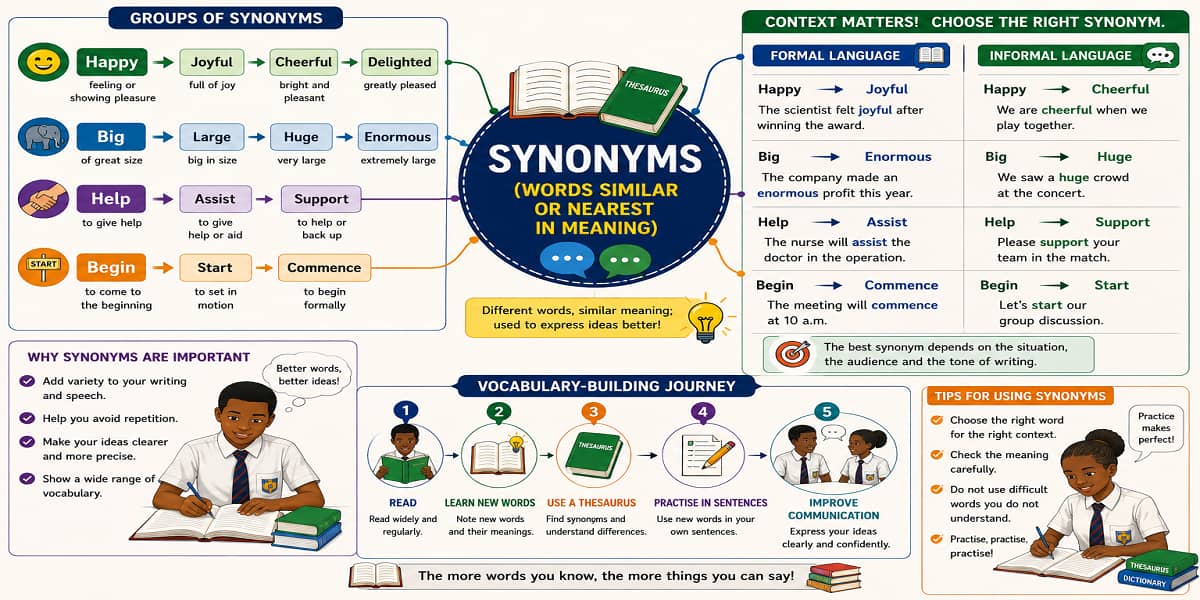
Synonyms are words with similar or identical meanings. Although they often express the same general idea, they may differ slightly in connotation, intensity or level of formality. For example, happiness refers to being pleased, while joyfulness often suggests a stronger feeling.
Using synonyms helps writers and speakers avoid unnecessary repetition, making communication more interesting and varied. They also improve descriptions by allowing more precise word choices. For instance, describing someone as exuberant instead of simply happy communicates a more specific meaning.
Choosing the correct synonym improves clarity and precision. The most appropriate synonym depends on the context and the intended audience. For example, assist may be more suitable than help in formal writing, while kids may be appropriate in casual conversation but children is preferred in formal communication.
Learners broaden their vocabulary by reading extensively, consulting a thesaurus and practising the use of synonyms in speaking and writing. Rewriting sentences with different synonyms helps learners observe how changes in vocabulary affect meaning and tone.
Teaching strategies include direct instruction, word maps, synonym chains, thesaurus training, substitution exercises, contextual activities, interactive games, creative writing, peer review, technology integration and reflective writing. These approaches encourage learners to apply vocabulary confidently in different situations.
| Importance of Synonyms | Explanation |
|---|---|
| Avoid Repetition | Makes writing and speech more varied and engaging. |
| Enhance Descriptions | Provides more precise and vivid expression. |
| Improve Clarity and Precision | Helps communicate intended meanings accurately. |
| Expand Vocabulary | Develops a wider range of words for communication. |
| Adapt to Different Contexts | Allows appropriate word choice for formal and informal situations. |
| Enhance Language Proficiency | Strengthens effective communication in academic and professional settings. |
Examples
Example 1
Problem: Choose the synonym nearest in meaning to enthusiastic.
- Read the sentence carefully.
- Determine the meaning of the underlined word.
- Select the word with the closest meaning.
Final Answer: Energetic.
Example 2
Problem: Rewrite the sentence using a suitable synonym for big.
- Identify the repeated word.
- Select an appropriate synonym that fits the context.
- Rewrite the sentence without changing its meaning.
Final Answer: Words such as large, huge or enormous may be used depending on the context.
Application and Activities
- Match vocabulary items with their meanings.
- Create synonym word chains.
- Complete sentences using appropriate vocabulary in context.
- Write short stories using suitable synonyms.
- Generate synonyms for selected words and use them correctly in sentences.
- Participate in vocabulary games such as bingo, charades and matching activities.
Practice
- Identify the word nearest in meaning to a given vocabulary item.
- Complete sentences using appropriate synonyms.
- Find synonyms for selected words in a short reading passage.
Summary
Synonyms enrich communication by providing words with similar meanings that suit different contexts. Understanding nuances, selecting appropriate vocabulary and practising synonym use help learners improve clarity, precision and fluency in speech and writing. Regular practice through reading, writing, discussion and vocabulary activities strengthens language proficiency and effective communication.
Access NaCCA-aligned Support Packs
Download your structured NaCCA-aligned Teacher Support Pack and Student Learning Pack, designed for clarity, practicality, and reliable teaching and learning.